Thank you for visiting SNEWPapers!
Sign up free
Alexandria Gazette & Daily Advertiser
Alexandria, Virginia
What is this article about?
Portuguese batteries at Porto Praya, Cape Verde Islands, fired on the U.S. ship Franklin as it departed on the 29th ult., causing minor damage. The U.S. crew planned retaliation but was prevented by a gale; the incident stemmed from a governor's order against unauthorized American departures, amid past grievances.
Clipping
OCR Quality
Full Text
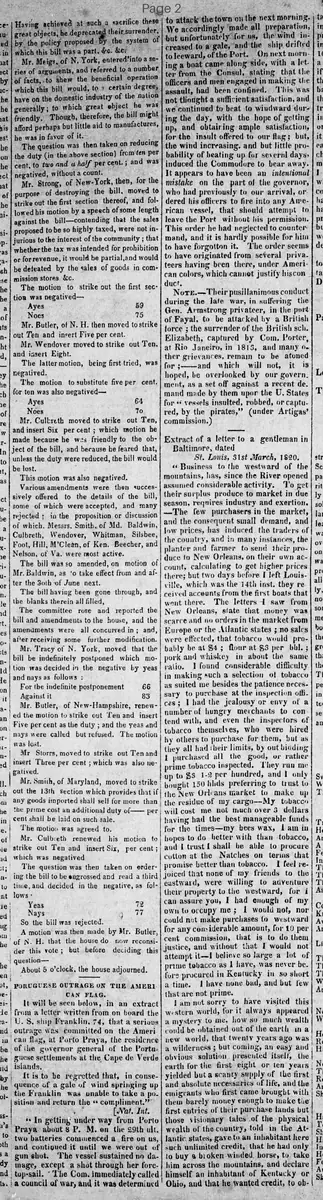
FLAG.
It will be seen below, in an extract
from a letter written from on board the
U. S. ship Franklin, 74, that a serious
outrage was committed on the American
flag, at Porto Praya, the residence
of the governor general of the Portuguese
settlements at the Cape de Verde
islands.
It is to be regretted that, in consequence
of a gale of wind springing up
the Franklin was unable to take a position
and return the "compliment."
Nat. Int.
In getting under way from Porto
Praya about 8 P. M. on the 29th ult.
two batteries commenced a fire on us,
and continued it until we were out of
gun shot. The vessel sustained no damage,
except a shot through her fore-top-sail.
The Com. immediately called
a council of war, and it was determined
to attack the town on the next morning.
We accordingly made all preparation,
but unfortunately for us, the wind increased
to a gale, and the ship drifted
to leeward, of the Port. On next morning
a boat came along side, with a letter
from the Consul, stating that the
officers and men engaged in making the
assault, had been confined. This was
not thought a sufficient satisfaction, and
we continued to beat to windward during
the day, with the hope of getting
up, and obtaining ample satisfaction,
for the insult offered to our flag; but,
the wind increasing. and but little probability
of beating up for several days
induced the Commodore to bear away.
It appears to have been an intentional
mistake on the part of the governor,
who had previously to our arrival, ordered
his officers to fire into any American
vessel, that should attempt to
leave the Port without his permission.
This order he had neglected to countermand,
and it is hardly possible for him
to have forgotten it. The order seems
to have originated from several privateers
having been there, under American
colors, which cannot justify his conduct.
Note.- Their pusillanimous conduct
during the late war, in suffering the
Gen. Armstrong privateer, in the port
of Fayal, to be attacked by a British
force ; the surrender of the British sch.
Elizabeth. captured by Com. Porter
at Rio Janeiro, in 1813, and many other
grievances, remain to be atoned
for ;--and which will not, it is
hoped, be overlooked by our government,
as a set off against a recent demand
made by them upon the U. States
for vessels insulted, robbed, or captured,
by the pirates," (under Artigas'
commission.)
What sub-type of article is it?
What keywords are associated?
What entities or persons were involved?
Where did it happen?
Foreign News Details
Primary Location
Porto Praya, Cape De Verde Islands
Event Date
29th Ult.
Key Persons
Outcome
vessel sustained no damage except a shot through her fore-top-sail. officers and men engaged in the assault confined, but deemed insufficient satisfaction by u.s. crew.
Event Details
As the U.S. ship Franklin departed Porto Praya around 8 P.M. on the 29th ult., two batteries fired on it until out of gun shot. Commodore called council of war to attack town next morning, but gale prevented positioning. Boat brought Consul's letter stating assailants confined; U.S. beat to windward seeking satisfaction but gale forced bearing away. Incident due to governor's unrevoked order to fire on American vessels leaving without permission, prompted by prior privateers under American colors.