Thank you for visiting SNEWPapers!
Sign up free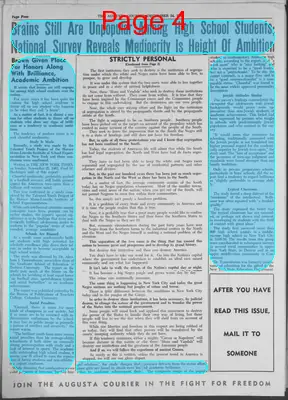
The Augusta Courier
Augusta, Richmond County, Georgia
What is this article about?
A 1962 study by the Talented Youth Project reveals that American high school students favor cheerful mediocrity and athleticism over academic brilliance, leading talented youth to downplay their abilities to fit in socially. Schools are blamed for equally honoring non-academic achievements.
Clipping
OCR Quality
Full Text
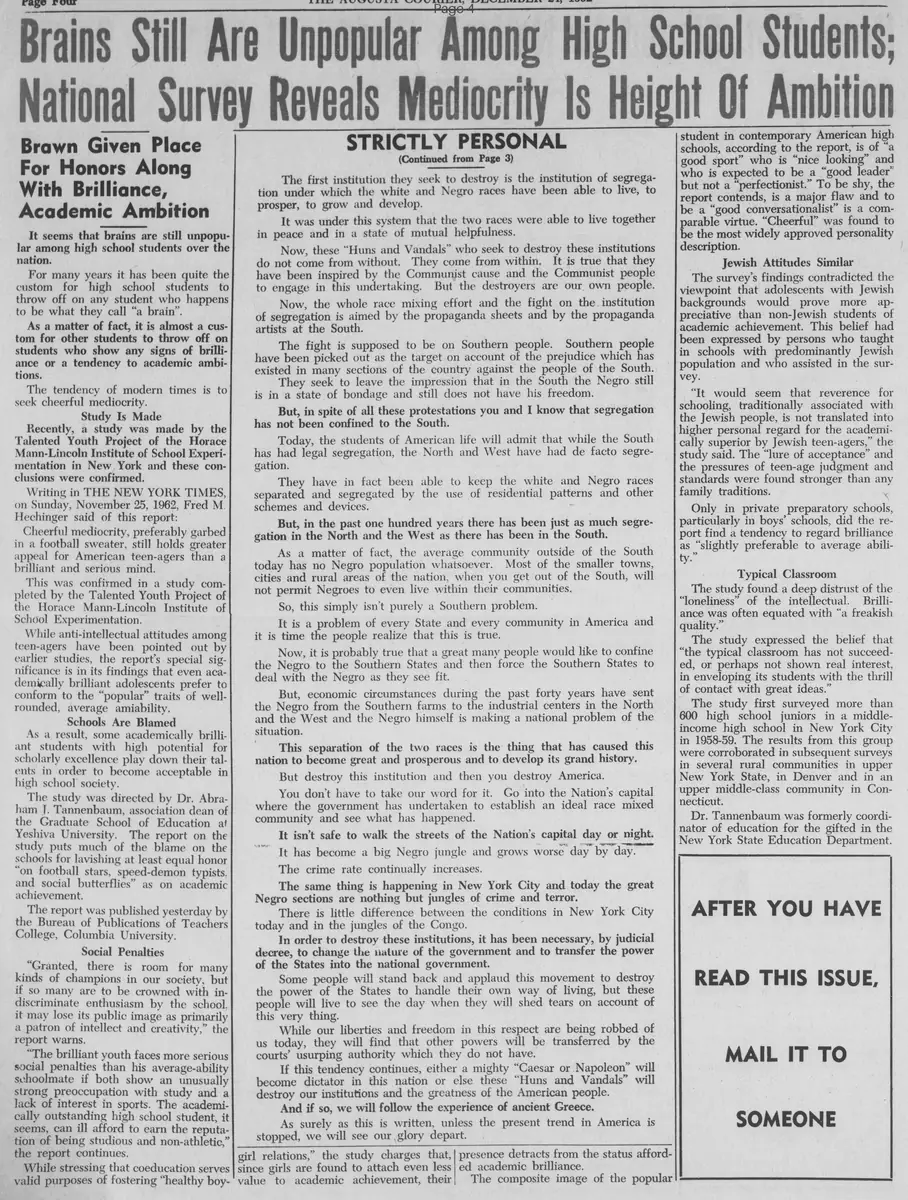
National Survey Reveals Mediocrity as the Height of Ambition
Brawn Given Place For Honors Along With Brilliance,
Academic Ambition
It seems that brains are still unpopular among high school students over the nation.
For many years it has been quite the custom for high school students to throw off on any student who happens to be what they call "a brain".
As a matter of fact, it is almost a custom for other students to throw off on students who show any signs of brilliance or a tendency to academic ambitions.
The tendency of modern times is to seek cheerful mediocrity.
Study Is Made
Recently, a study was made by the Talented Youth Project of the Horace Mann-Lincoln Institute of School Experimentation in New York and these conclusions were confirmed.
Writing in THE NEW YORK TIMES, on Sunday, November 25, 1962, Fred M. Hechinger said of this report:
Cheerful mediocrity, preferably garbed in a football sweater, still holds greater appeal for American teen-agers than a brilliant and serious mind.
This was confirmed in a study completed by the Talented Youth Project of the Horace Mann-Lincoln Institute of School Experimentation.
While anti-intellectual attitudes among teen-agers have been pointed out by earlier studies, the report's special significance is in its findings that even academically brilliant adolescents prefer to conform to the "popular" traits of well-rounded, average amiability.
Schools Are Blamed
As a result, some academically brilliant students with high potential for scholarly excellence play down their talents in order to become acceptable in high school society.
The study was directed by Dr. Abraham I. Tannenbaum, associate dean of the Graduate School of Education at Yeshiva University. The report on the study puts much of the blame on the schools for lavishing at least equal honor "on football stars, speed-demon typists, and social butterflies" as on academic achievement.
The report was published yesterday by the Bureau of Publications of Teachers College, Columbia University.
Social Penalties
"Granted, there is room for many kinds of champions in our society, but if so many are to be crowned with indiscriminate enthusiasm by the school, it may lose its public image as primarily a patron of intellect and creativity," the report warns.
The brilliant youth faces more serious social penalties than his average-ability schoolmate if both show an unusually strong preoccupation with study and a lack of interest in sports. The academically outstanding high school student, it seems, can ill afford to earn the reputation of being studious and non-athletic, the report continues.
While stressing that coeducation serves valid purposes of fostering "healthy boy-girl relations," the study charges that its presence detracts from the status afforded academic brilliance since girls are found to attach even less value to academic achievement, their
The composite image of the popular student in contemporary American high schools, according to the report, is of "a good sport" who is "nice looking" and who is expected to be a "good leader but not a "perfectionist."
To be shy, the report contends, is a major flaw and to be a "good conversationalist" is a comparable virtue. "Cheerful" was found to be the most widely approved personality description.
Jewish Attitudes Similar
The survey's findings contradicted the viewpoint that adolescents with Jewish backgrounds would prove more appreciative than non-Jewish students of academic achievement. This belief had been expressed by persons who taught in schools with predominantly Jewish population and who assisted in the survey.
"It would seem that reverence for schooling, traditionally associated with the Jewish people, is not translated into higher personal regard for the academically superior by Jewish teen-agers," the study said. The "lure of acceptance" and the pressures of teen-age judgment and standards were found stronger than any family traditions.
Only in private preparatory schools, particularly in boys' schools, did the report find a tendency to regard brilliance as "slightly preferable to average ability."
Typical Classroom
The study found a deep distrust of the "loneliness" of the intellectual. Brilliance was often equated with "a freakish quality."
The study expressed the belief that "the typical classroom has not succeeded, or perhaps not shown real interest, in enveloping its students with the thrill of contact with great ideas."
The study first surveyed more than 600 high school juniors in a middle-income high school in New York City in 1958-59. The results from this group were corroborated in subsequent surveys in several rural communities in upper New York State, in Denver and in an upper middle-class community in Connecticut.
Dr. Tannenbaum was formerly coordinator of education for the gifted in the New York State Education Department.
What sub-type of article is it?
What themes does it cover?
What keywords are associated?
What entities or persons were involved?
Where did it happen?
Story Details
Key Persons
Location
American High Schools, New York City, Upper New York State, Denver, Connecticut
Event Date
1958 59, Reported November 25, 1962
Story Details
A national study confirms that high school students disdain academic brilliance, preferring cheerful mediocrity and athleticism; brilliant students hide talents to avoid social penalties, with schools blamed for equal honors to non-academic achievements.