Thank you for visiting SNEWPapers!
Sign up free
The Kentucky Gazette
Lexington, Fayette County, Kentucky
What is this article about?
Article from Republican Watch Tower accuses Aaron Burr of secretly negotiating with Federalist David A. Ogden, backed by Alexander Hamilton, to secure the presidency over Thomas Jefferson in the 1800 election through state vote manipulations. Details propositions, responses, and supporting actions by Burr's associates like Van Ness and Davis.
Clipping
OCR Quality
Full Text
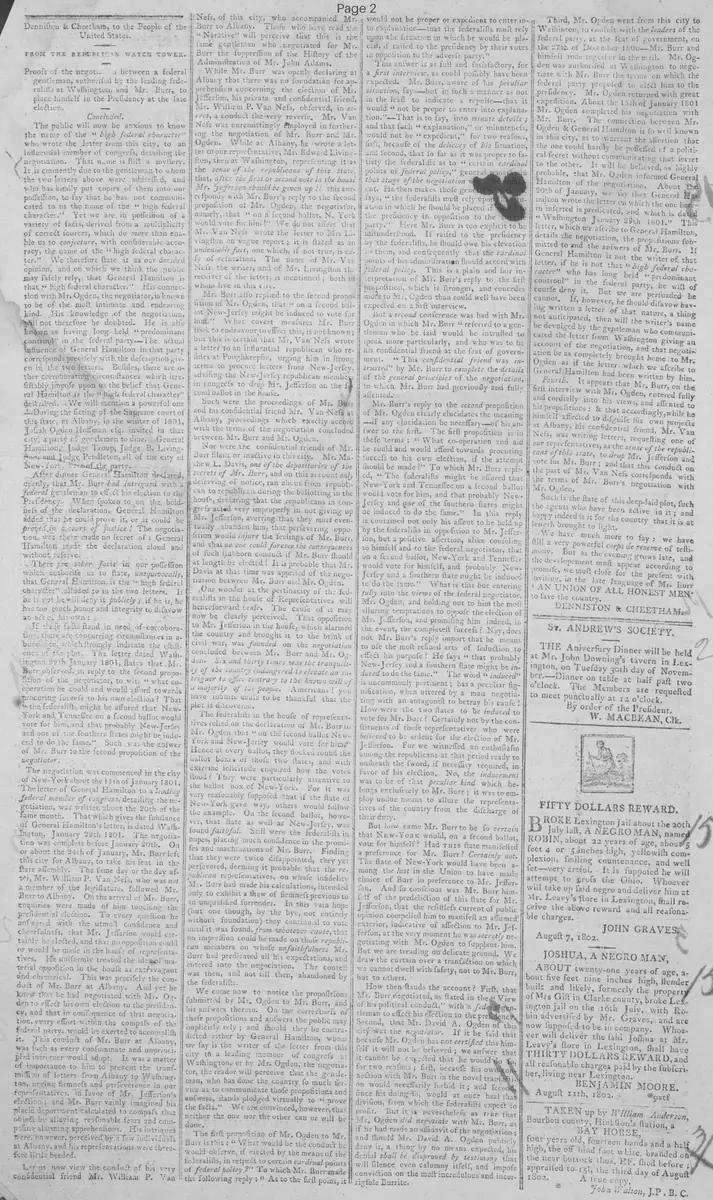
FROM THE REPUBLICAN WATCH TOWER.
Proofs of the negotiation between a federal gentleman, authorized by the leading federalists at Washington, and Mr. Burr, to place himself in the Presidency at the late election.
Concluded.
The public will now be anxious to know the name of the "high federal character" who wrote the letter from this city, to an influential member of congress, detailing the negotiation. That name is still a mystery. It is eminently due to the gentleman to whom the two letters above were addressed, and who has kindly put copies of them into our possession, to say that he has not communicated to us the name of the "high federal character." Yet we are, in possession of a variety of facts, derived from a multiplicity of correct sources, which do more than enable us to conjecture, with considerable accuracy, the name of the "high federal character." We therefore state it as our decided opinion, and on which we think the public may safely rely, that General Hamilton is that "high federal character." His connection with Mr. Ogden, the negotiator, is known to be of the most intimate and endearing kind. His knowledge of the negotiation, will not therefore be doubted. He is also known as having long held "predominant control" in the federal party—The actual influence of General Hamilton in that party corresponds precisely with the description-given in the two letters. Besides, there are other corroborating circumstances which irresistibly impose upon us the belief that General Hamilton is the "high federal character" described. We will mention a powerful one—During the sitting of the Supreme court of this state, at Albany, in the winter of 1801, Josiah Ogden Hoffman Esq. invited in that city, a party of gentlemen to dine. General Hamilton; Judge Troup, Judge B. Livingston and Judge Pendleton, all of the city of New-York, were of the party.
After dinner General Hamilton declared openly, that Mr. Burr had intrigued with a federal gentleman to effect his election to the Presidency. When spoken to on the boldness of the declaration, General Hamilton added that he could prove it, or it could be proved in a court of justice! The negotiation was there made no secret of: General Hamilton made the declaration aloud and without reserve.
There are other facts in our possession which authorize us to state, unequivocally, that General Hamilton is the "high federal character" alluded to in the two letters. If he is not he will deny it publicly; if he is, he has too much honor and integrity to disavow an act of his own:
If these facts stand in need of corroboration, there are concurring circumstances in abundance, which strongly indicate the existence of a plot. The letter dated Washington 29th January 1801, states that Mr. Burr observed, in reply to the second proposition of the negotiator, to wit, "what co-operation he could and would afford towards procuring success to his own election? That the federalists, might be assured that New-York and Tennessee on a second ballot would vote for him, and that probably New-Jersey and one of the southern states might be induced to do the same." Such was the answer of Mr. Burr to the second proposition of the negotiator.
The negotiation was commenced in the city of New-York about the 15th of January 1801. The letter of General Hamilton to a leading federal member of congress, detailing the negotiation, was written about the 20th of the same month. That which gives the substance of General Hamilton's letter, is dated Washington, January 29th 1801. The negotiation was complete before January 20th. On or about the 24th of January, Mr. Burr left this city for Albany, to take his seat in the state assembly. The same day or the day after, Mr. William P. VanNess, who was not a member of the legislature, followed Mr. Burr to Albany. On the arrival of Mr. Burr, enquiries were made of him touching the presidential election. To every question he answered with the utmost confidence and cheerfulness, that Mr. Jefferson would certainly be elected, and that no opposition could or would be made in the house of representatives. He uniformly treated the idea of material opposition in the house as extravagant and chimerical. This was precisely the conduct of Mr. Burr at Albany. And yet he knew that he had negotiated with Mr. Ogden to effect his own election to the presidency, and that in consequence of that negotiation, every effort within the compass of the federal party, would be exerted to accomplish it. This conduct of Mr. Burr at Albany, was such as every consummate and unprincipled intriguer would adopt. It was a matter of importance to him to prevent the transmission of letters from Albany to Washington, urging firmness and perseverance in our representatives. in favor of Mr. Jefferson's election; and Mr. Burr vainly imagined his placid deportment calculated to compass that object by allaying reasonable fears and composing alarming apprehensions. His intrigues were, however, perceived by a few individuals at Albany, and his representations were therefore little heeded.
Let us now view the conduct of his very Confidential friend Mr. William P. Van Ness, of this city, who accompanied Mr. Burr to Albany. Those who have read the "Narrative" will perceive that this is the same gentleman who negotiated for Mr. Burr the suppression of the History of the Administration of Mr. John Adams.
While Mr. Burr was openly declaring at Albany that there was no foundation for apprehension concerning the election of Mr. Jefferson, his private and confidential friend, Mr. William P. Van Ness, observed, in secret, a conduct the very reverse. Mr. Van Ness was unremittingly employed in furthering the negotiation of Mr. Burr and Mr. Ogden. While at Albany, he wrote a letter to our representative, Mr. Edward Livingston, then at Washington, representing it as the sense of the republicans of this state, that, after the first or second vote in the house Mr. Jefferson should be given up !! this corresponds with Mr. Burr's reply to the second proposition of Mr. Ogden, the negotiator, namely, that "on a second ballot, N. York would vote for him!" We do not assert that Mr. Van Ness wrote the letter to Mr. Livingston on vague report; it is stated as an undeniable fact, one which, if not true, is easy of refutation. The name of Mr. Van Ness the writer, and of Mr. Livingston the receiver of the letter, is mentioned; both of whom live in this city.
Mr. Burr also replied to the second proposition of Mr. Ogden, that "on a second ballot New-Jersey might be induced to vote for him." What covert measures Mr. Burr took to endeavour to effect this, is not known; but this is certain that Mr. Van Ness wrote a letter to an influential republican who resides at Poughkeepsie, urging him in strong terms to procure letters from New-Jersey, advising the New-Jersey republican members in congress to drop Mr. Jefferson on the second ballot in the house.
Such were the proceedings of Mr. Burr and his confidential friend Mr. Van Ness at Albany, proceedings which exactly accord with the terms of the negotiation concluded between. Mr. Burr and Mr. Ogden.
Nor were the confidential friends of Mr. Burr silent or inactive in this city. Mr. Matthew L. Davis, one of the depositories of the secrets of Mr. Burr, and on this account only, deserving of notice, ran about from republican to republican during the balloting in the house, declaring that the republicans in congress acted very improperly in not giving up Mr. Jefferson, averring that they must eventually abandon him, that persevering opposition would injure the feelings of Mr. Burr, and that no one could foresee the consequences of such stubborn conduct if Mr. Burr should at length be elected! It is probable that Mr. Davis at that time was apprized of the negotiation between Mr. Burr and Mr. Ogden.
Our wonder at the pertinacity of the federalists in the house of Representatives will henceforward cease. The cause of it may now be clearly perceived. That opposition to Mr. Jefferson in the house, which alarmed the country and brought it to the brink of civil war, was founded on the negotiation concluded between Mr. Burr and Mr. Ogden. Six and thirty times was the tranquility of the country endangered to elevate an intriguer to office contrary to the known will of a majority of the people. Americans! you have infinite cause to be thankful that the plot is discovered.
The federalists in the house of representatives relied on the declaration of Mr. Burr to Mr. Ogden that "on the second ballot New-York and New-Jersey would vote for him." Hence at every ballot, they flocked round the ballot boxes of those two states, and with extreme solicitude enquired how the votes stood? They were particularly attentive to the ballot box of New-York. For it was very reasonably supposed that if the state of New-York gave way, others would follow the example. On the second ballot, however, that state as well as New-Jersey, was found faithful. Still were the federalists in hopes, placing much confidence in the promises and machinations of Mr. Burr. Finding that they were twice disappointed, they yet persevered, deeming it probable that the republican representatives, on whose infidelity Mr. Burr had made his calculations, intended only to exhibit a show of firmness previous to an unqualified surrender. In this vain hope (but one though, by the bye, not entirely without foundation) they continued to vote until it was found, from whatever cause, that no impression could be made on those republican members on whose unfaithfulness Mr. Burr had predicated all his expectations, and entered into the negotiation. The contest was then, and not till then, abandoned by the federalists.
We come now to notice the propositions submitted by Mr. Ogden to Mr. Burr, and his answers thereto. On the correctness or these propositions and answers the public may implicitly rely; and should they be contradicted either by General Hamilton, whom we say is the writer of the letter from this city to a leading member of congress at Washington, or by Mr. Ogden, the negotiator, the reader will perceive that the gentleman, who has done the country so much service as to communicate those propositions and answers, stands pledged virtually to "prove the facts." We are convinced, however, that neither the one nor the other can or will be done.
The first proposition of Mr. Ogden to Mr. Burr is this: "What would be the conduct he would observe, if elected by the means of the federalists, in respect to certain cardinal points of federal policy?" To which Mr. Burr made the following reply: "As to the first point, it would not be proper or expedient to enter into explanation—that the federalists must rely upon the situation in which he would be placed, if raised to the presidency by their votes in opposition to the adverse party."
This answer is as full and satisfactory, for a first interview, as could possibly have been expected. Mr. Burr, aware of his peculiar situation, says—but in such a manner as not in the least to indicate a repulse—that it would "not be proper to enter into explanation." That is to say, into minute details; and that such "explanation," or minuteness, would not be "expedient," for two reasons, first, because of the delicacy of his situation, and second, that so far as it was proper to satisfy the federalists as to "certain cardinal points of federal policy." Here Mr. Burr is too explicit to be misunderstood. If raised to the presidency by the federalists, he should owe his elevation to them, and consequently that the cardinal points of his administration should accord with federal policy. This is a plain and fair interpretation of Mr. Burr's reply to the first proposition, which is stronger, and concedes more to Mr. Ogden than could well have been expected on a first interview.
But a second conference was had with Mr. Ogden in which Mr. Burr "referred to a gentleman who he said would be intrusted to speak more particularly, and who was to be his confidential friend at the seat of government." This confidential friend was "intrusted" by Mr. Burr to complete the details of the general principles of the negotiation, to which Mr. Burr had previously and fully assented.
Mr. Burr's reply to the second proposition of Mr. Ogden clearly elucidates the meaning—if any elucidation be necessary—of his answer to the first. The first proposition is in these terms: "What co-operation and aid he could and would afford towards procuring success to his own election, if the attempt should be made?" To which Mr. Burr replied, "The federalists might be assured that New-York and Tennessee on a second ballot would vote for him, and that probably New-Jersey and one of the southern states might be induced to do the same." In this reply is contained not only his assent to be held up by the federalists in opposition to Mr. Jefferson, but a positive assertion, alike consoling to himself and to the federal negotiator, that on a second ballot, New-York and Tennessee would vote for himself, and probably New-Jersey and a southern state might be induced to do the same." What is this but entering fully into the views of the federal negotiator, Mr. Ogden, and holding out to him the most alluring temptations to oppose the election of Mr. Jefferson, and promising him indeed, in the event, the completest success? Nay, does not Mr. Burr's reply import that he meant to use the most refined arts of seduction to effect his purpose? He says "that probably New-Jersey and a southern state might be induced to do the same." The word "induced" is uncommonly pertinent; has a peculiar signification, when uttered by a man negotiating with an antagonist to betray his cause!
How were the two states to be induced to vote for Mr. Burr? Certainly not by the constituents of those representatives who were believed to be ardent for the election of Mr. Jefferson. For we witnessed an enthusiasm among the republicans at that period ready to unsheathe the sword, if necessity required, in favor of his election. No, the inducement was to be of that peculiar kind which belongs exclusively to Mr. Burr; it was to employ undue means to allure the representatives of the country from the discharge of their duty.
But how came Mr. Burr to be so certain that New-York would, on a second ballot, vote for himself? Had this state manifested a preference for Mr. Burr? Certainly not. The state of New-York would have been among the last in the Union to have made choice of Burr in preference to Mr. Jefferson. And so conscious was Mr. Burr himself of the predilection of this state for Mr. Jefferson, that the resistless current of public opinion compelled him to manifest an assumed exterior, indicative of affection to Mr. Jefferson, at the very moment he was secretly negotiating with Mr. Ogden to supplant him.
But we are treading on delicate ground. We draw the curtain over a transaction on which we cannot dwell with safety, not to Mr. Burr, but to others.
How then stands the account? First, that Mr. Burr negotiated, as stated in the "View of his political conduct," with a federal gentleman to effect his election to the presidency Second, that Mr. David A. Ogden of this city was the negotiator. If it be said that because Mr. Ogden has not certified this himself it will not be believed; we answer that it cannot be expected that he would do so, for two reasons; first, because his own connection with Mr. Burr in the novel transaction would necessarily forbid it; and second. Since his doing so, would at once heal that division, from which the federalists expect to profit. But it is nevertheless as true that Mr. Ogden did negotiate with Mr. Burr, as if he had made an affidavit of the negotiation; and should Mr. David A. Ogden publicly deny it, a thing by no means expected, his denial shall be disproved by testimony that will silence even calumny itself, and impose conviction on the most incredulous and incorrigible Burrite.
Third, Mr. Ogden went from this city to Washington, to consult with the leaders of the federal party, at the seat of government, on the 27th of December 1800—Mr. Burr and himself rode together in the mail. Mr. Ogden was authorized at Washington to negotiate with Mr. Burr the terms on which the federal party proposed to elect him to the presidency. Mr. Ogden returned with great expedition. About the 15th of January 1801 Mr. Ogden completed his negotiation with Mr. Burr. The connection between Mr. Ogden & General Hamilton is so well known in this city, as to warrant the assertion that the one could hardly be possessed of a political secret without communicating that secret to the other. It will be believed, as highly probable, that Mr. Ogden informed General Hamilton of the negotiation. About the 20th of January, we say that General Hamilton wrote the letter on which the one here-in inserted is predicated, and which is dated "Washington January 29th 1801." This letter, which we ascribe to General Hamilton, details the negotiation, the propositions submitted to and the answers of Mr. Burr. If General Hamilton is not the writer of that letter, if he is not that "high federal character" who has long held "predominant control" in the federal party, he will of course deny it. But we are persuaded he cannot. If, however, he should disavow having written a letter of that nature, a thing not anticipated, then will the writer's name be divulged by the gentleman who communicated the letter from Washington giving an account of the negotiation, and that negotiation be as completely brought home to Mr. Ogden as if the letter which we ascribe to General Hamilton had been written by him.
Fourth. It appears that Mr. Burr, on the first interview with Mr. Ogden, entered fully and cordially into his views, and assented to his propositions: & that accordingly, while he himself affected to disguise his own projects at Albany, his confidential friend, Mr. Van Ness, was writing letters, requesting one of our representatives, as the sense of the republicans of this state, to drop Mr. Jefferson and vote for Mr. Burr; and that this conduct on the part of Mr. Van Ness corresponds with the terms of Mr. Burr's negotiation with Mr. Ogden.
Such is the state of this deep-laid plot, such the agents who have been active in it; and happy indeed is it for the country that it is at length brought to light.
We have much more to say: we have still a very powerful corps de reserve of testimony. But as the evening grows late, and the development must appear according to promise, we must close for the present with inviting, in the late language of Mr. Burr AN UNION OF ALL HONEST MEN to save the country.
DENNISTON & CHEETHAM.
What sub-type of article is it?
What themes does it cover?
What keywords are associated?
What entities or persons were involved?
Where did it happen?
Story Details
Key Persons
Location
New York, Washington, Albany
Event Date
January 1801
Story Details
Aaron Burr secretly negotiated with Federalist David A. Ogden, authorized by Alexander Hamilton, to secure presidency over Jefferson by promising state votes on second ballot and aligning policy with Federalists; Burr's associates like Van Ness lobbied covertly while Burr feigned support for Jefferson; plot failed as states remained faithful.