Thank you for visiting SNEWPapers!
Sign up free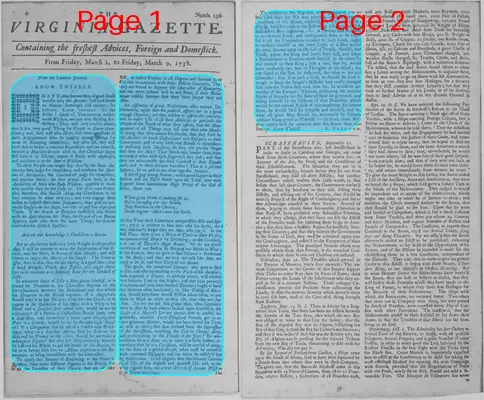
Literary
March 2, 1739
The Virginia Gazette
Richmond, Williamsburg, Richmond County, Virginia
What is this article about?
An essay from the London Journal by R. Freeman defends the ancient maxim 'Know Thyself' as profound wisdom, using examples from politics, intemperate drinking, and greedy commerce to illustrate how self-awareness prevents folly and promotes moral conduct in all stations of life.
Merged-components note: This is a continuation of the same literary essay 'Know Thyself' across pages 1 and 2, with sequential reading order and matching topic.
Clippings
1 of 2
OCR Quality
95%
Excellent
Full Text
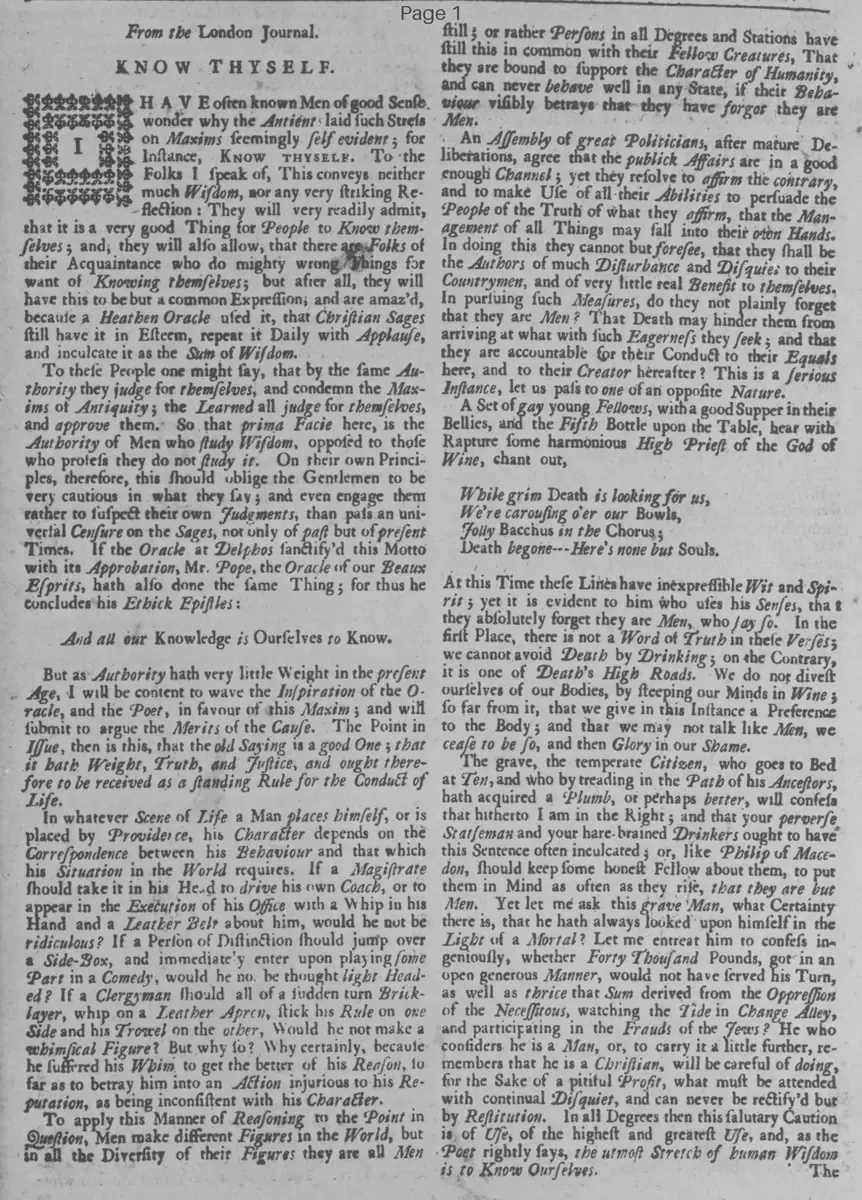
From the London Journal.
KNOW THYSELF.
I have often known Men of good Sense wonder why the Ancients laid such Stress on Maxims seemingly Self evident; for Instance, KNOW THYSELF. To the Folks I speak of, This conveys neither much Wisdom, nor any very striking Reflection: They will very readily admit, that it is a very good Thing for People to Know themselves; and they will also allow, that there are Folks of their Acquaintance who do mighty wrong Things for want of Knowing themselves; but after all, they will have this to be but a common Expression; and are amaz'd, because a Heathen Oracle us'd it, that Christian Sages still have it in Esteem, repeat it Daily with Applause, and inculcate it as the Sum of Wisdom.
To these People one might say, that by the same Authority they judge for themselves, and condemn the Maxims of Antiquity; the Learned all judge for themselves, and approve them. So that prima Facie here, is the Authority of Men who study Wisdom, oppos'd to those who profess they do not study it. On their own Principles, therefore, this should oblige the Gentlemen to be very cautious in what they say; and even engage them rather to suspect their own Judgments, than pass an universal Censure on the Sages, not only of past but of present Times.
If the Oracle at Delphi sanctify'd this Motto with its Approbation, Mr. Pope, the Oracle of our Beaux Esprits, hath also done the same Thing; for thus he concludes his Ethick Epistles:
And all our Knowledge is, Ourselves to Know.
But as Authority hath very little Weight in the present Age, I will be content to wave the Inspiration of the Oracle, and the Poet, in favour of this Maxim; and will submit to argue the Merits of the Cause. The Point in Issue, then is this, that the old Saying is a good One; that it hath Weight, Truth, and Justice, and ought therefore to be received as a standing Rule for the Conduct of Life.
In whatever Scene of Life a Man places himself, or is placed by Providence, his Character depends on the Correspondence between his Behaviour and that which his Situation in the World requires. If a Magistrate should take it in his Head to drive his own Coach, or to appear in the Execution of his Office with a Whip in his Hand and a Leather Belt about him, would he not be ridiculous? If a Person of Distinction should jump over a Side-Box, and immediately enter upon playing Some Part in a Comedy, would he not be thought light Headed? If a Clergyman should all of a sudden turn Bricklayer, whip on a Leather Apron, stick his Rule on one Side and his Trowel on the other, Would he not make a whimsical Figure? But why so? Why certainly, because he suffer'd his Whim to get the better of his Reason, so far as to betray him into an Action injurious to his Reputation, as being inconsistent with his Character.
To apply this Manner of Reasoning to the Point in Question, Men make different Figures in the World, but in all the Diversity of their Figures they are all Men till; or rather Persons in all Degrees and Stations have still this in common with their Fellow Creatures, That they are bound to support the Character of Humanity, and can never behave well in any State, if their Behaviour visibly betrayes that they have forgot they are Men.
An Assembly of great Politicians, after mature Deliberations, agree that the publick Affairs are in a good enough Channel; yet they resolve to affirm the contrary, and to make Use of all their Abilities to persuade the People of the Truth of what they affirm, that the Management of all Things may fall into their own Hands. In doing this they cannot but foresee, that they shall be the Authors of much Disturbance and Disquiet to their Countrymen, and of very little real Benefit to themselves. In pursuing such Measures, do they not plainly forget that they are Men? That Death may hinder them from arriving at what with such Eagerness they seek; and that they are accountable for their Conduct to their Equals here, and to their Creator hereafter? This is a Serious Instance, let us pass to one of an opposite Nature.
A Set of gay young Fellows, with a good Supper in their Bellies, and the Fifth Bottle upon the Table, hear with Rapture some harmonious High Priest of the God of Wine, chant out,
While grim Death is looking for us,
We're carousing o'er our Bowls,
Follow Bacchus in the Chorus;
Death begone---Here's none but Souls.
At this Time these Lines have inexpressible Wit and Spirit; yet it is evident to him who uses his Senses, that they absolutely forget they are Men, who say so.
In the first Place, there is not a Word of Truth in these Verses; we cannot avoid Death by Drinking; on the Contrary, it is one of Death's High Roads. We do not divest ourselves of our Bodies, by steeping our Minds in Wine; so far from it, that we give in this Instance a Preference to the Body; and that we may not talk like Men, we cease to be So, and then Glory in our Shame.
The grave, the temperate Citizen, who goes to Bed at Ten, and who by treading in the Path of his Ancestors, hath acquired a Plumb, or perhaps better, will confess that hitherto I am in the Right; and that your perverse Statesman and your hare-brained Drinkers ought to have this Sentence often inculcated; or, like Philip of Macedon, should keep some honest Fellow about them, to put them in Mind as often as they rise, that they are but Men. Yet let me ask this grave Man, what Certainty there is, that he hath always look'd upon himself in the Light of a Mortal? Let me entreat him to confess ingenuously, whether Forty Thousand Pounds, got in an open generous Manner, would not have served his Turn, as well as thrice that Sum derived from the Oppression of the Necessitous, watching the Tide in Change Alley, and participating in the Frauds of the Jews? He who considers he is a Man, or, to carry it a little further, remembers that he is a Christian, will be careful of doing, for the Sake of a pitiful Profit, what must be attended with continual Disquiet, and can never be rectify'd but by Restitution.
In all Degrees then this salutary Caution is of Use, of the highest and greatest Use, and, as the Poet rightly says, the utmost Stretch of human Wisdom is to Know Ourselves.
The celebrated Mr. Pascal, whose Judgment was no less solid than his Wit was piercing, in describing the Condition of the Great, especially to Princes, in this World, had Recourse to the following Allegory, not less Instructive than ingenious. --- A Person, said he, born to an elevated Rank, and consequently born to be exposed to all the Temptations incident to such Rank, ought to consider himself in the same Light as a Man would do, who, thrown upon an Isle full of People, Wealth, and Trade, where the King had lately been lost, and where a Resemblance in Features made himself to be taken for and treated as their King; such a one, says he, would have constantly two Sets of Thoughts in his Mind: the one suited to the Part he sustained, the other to his real Character: For, if in such a Case, he should be Fool enough to fancy the People's Mistake had really changed him into the Person they took him for, he would be unworthy of his Fortune: Whereas, preserving the exterior Marks of Royalty for the Sake of those he governed, and ruling himself by the Dictates of that Humility, which would be the natural Result of contemplating his former State, he would bless his Subjects and himself, and be, what all great Men should be, reverenced by Others, without being proud in Himself. -- In short, more Wisdom cannot well be crowded into less Room than this Precept, Know Thyself.
R. FREEMAN.
KNOW THYSELF.
I have often known Men of good Sense wonder why the Ancients laid such Stress on Maxims seemingly Self evident; for Instance, KNOW THYSELF. To the Folks I speak of, This conveys neither much Wisdom, nor any very striking Reflection: They will very readily admit, that it is a very good Thing for People to Know themselves; and they will also allow, that there are Folks of their Acquaintance who do mighty wrong Things for want of Knowing themselves; but after all, they will have this to be but a common Expression; and are amaz'd, because a Heathen Oracle us'd it, that Christian Sages still have it in Esteem, repeat it Daily with Applause, and inculcate it as the Sum of Wisdom.
To these People one might say, that by the same Authority they judge for themselves, and condemn the Maxims of Antiquity; the Learned all judge for themselves, and approve them. So that prima Facie here, is the Authority of Men who study Wisdom, oppos'd to those who profess they do not study it. On their own Principles, therefore, this should oblige the Gentlemen to be very cautious in what they say; and even engage them rather to suspect their own Judgments, than pass an universal Censure on the Sages, not only of past but of present Times.
If the Oracle at Delphi sanctify'd this Motto with its Approbation, Mr. Pope, the Oracle of our Beaux Esprits, hath also done the same Thing; for thus he concludes his Ethick Epistles:
And all our Knowledge is, Ourselves to Know.
But as Authority hath very little Weight in the present Age, I will be content to wave the Inspiration of the Oracle, and the Poet, in favour of this Maxim; and will submit to argue the Merits of the Cause. The Point in Issue, then is this, that the old Saying is a good One; that it hath Weight, Truth, and Justice, and ought therefore to be received as a standing Rule for the Conduct of Life.
In whatever Scene of Life a Man places himself, or is placed by Providence, his Character depends on the Correspondence between his Behaviour and that which his Situation in the World requires. If a Magistrate should take it in his Head to drive his own Coach, or to appear in the Execution of his Office with a Whip in his Hand and a Leather Belt about him, would he not be ridiculous? If a Person of Distinction should jump over a Side-Box, and immediately enter upon playing Some Part in a Comedy, would he not be thought light Headed? If a Clergyman should all of a sudden turn Bricklayer, whip on a Leather Apron, stick his Rule on one Side and his Trowel on the other, Would he not make a whimsical Figure? But why so? Why certainly, because he suffer'd his Whim to get the better of his Reason, so far as to betray him into an Action injurious to his Reputation, as being inconsistent with his Character.
To apply this Manner of Reasoning to the Point in Question, Men make different Figures in the World, but in all the Diversity of their Figures they are all Men till; or rather Persons in all Degrees and Stations have still this in common with their Fellow Creatures, That they are bound to support the Character of Humanity, and can never behave well in any State, if their Behaviour visibly betrayes that they have forgot they are Men.
An Assembly of great Politicians, after mature Deliberations, agree that the publick Affairs are in a good enough Channel; yet they resolve to affirm the contrary, and to make Use of all their Abilities to persuade the People of the Truth of what they affirm, that the Management of all Things may fall into their own Hands. In doing this they cannot but foresee, that they shall be the Authors of much Disturbance and Disquiet to their Countrymen, and of very little real Benefit to themselves. In pursuing such Measures, do they not plainly forget that they are Men? That Death may hinder them from arriving at what with such Eagerness they seek; and that they are accountable for their Conduct to their Equals here, and to their Creator hereafter? This is a Serious Instance, let us pass to one of an opposite Nature.
A Set of gay young Fellows, with a good Supper in their Bellies, and the Fifth Bottle upon the Table, hear with Rapture some harmonious High Priest of the God of Wine, chant out,
While grim Death is looking for us,
We're carousing o'er our Bowls,
Follow Bacchus in the Chorus;
Death begone---Here's none but Souls.
At this Time these Lines have inexpressible Wit and Spirit; yet it is evident to him who uses his Senses, that they absolutely forget they are Men, who say so.
In the first Place, there is not a Word of Truth in these Verses; we cannot avoid Death by Drinking; on the Contrary, it is one of Death's High Roads. We do not divest ourselves of our Bodies, by steeping our Minds in Wine; so far from it, that we give in this Instance a Preference to the Body; and that we may not talk like Men, we cease to be So, and then Glory in our Shame.
The grave, the temperate Citizen, who goes to Bed at Ten, and who by treading in the Path of his Ancestors, hath acquired a Plumb, or perhaps better, will confess that hitherto I am in the Right; and that your perverse Statesman and your hare-brained Drinkers ought to have this Sentence often inculcated; or, like Philip of Macedon, should keep some honest Fellow about them, to put them in Mind as often as they rise, that they are but Men. Yet let me ask this grave Man, what Certainty there is, that he hath always look'd upon himself in the Light of a Mortal? Let me entreat him to confess ingenuously, whether Forty Thousand Pounds, got in an open generous Manner, would not have served his Turn, as well as thrice that Sum derived from the Oppression of the Necessitous, watching the Tide in Change Alley, and participating in the Frauds of the Jews? He who considers he is a Man, or, to carry it a little further, remembers that he is a Christian, will be careful of doing, for the Sake of a pitiful Profit, what must be attended with continual Disquiet, and can never be rectify'd but by Restitution.
In all Degrees then this salutary Caution is of Use, of the highest and greatest Use, and, as the Poet rightly says, the utmost Stretch of human Wisdom is to Know Ourselves.
The celebrated Mr. Pascal, whose Judgment was no less solid than his Wit was piercing, in describing the Condition of the Great, especially to Princes, in this World, had Recourse to the following Allegory, not less Instructive than ingenious. --- A Person, said he, born to an elevated Rank, and consequently born to be exposed to all the Temptations incident to such Rank, ought to consider himself in the same Light as a Man would do, who, thrown upon an Isle full of People, Wealth, and Trade, where the King had lately been lost, and where a Resemblance in Features made himself to be taken for and treated as their King; such a one, says he, would have constantly two Sets of Thoughts in his Mind: the one suited to the Part he sustained, the other to his real Character: For, if in such a Case, he should be Fool enough to fancy the People's Mistake had really changed him into the Person they took him for, he would be unworthy of his Fortune: Whereas, preserving the exterior Marks of Royalty for the Sake of those he governed, and ruling himself by the Dictates of that Humility, which would be the natural Result of contemplating his former State, he would bless his Subjects and himself, and be, what all great Men should be, reverenced by Others, without being proud in Himself. -- In short, more Wisdom cannot well be crowded into less Room than this Precept, Know Thyself.
R. FREEMAN.
What sub-type of article is it?
Essay
What themes does it cover?
Moral Virtue
Political
Temperance
What keywords are associated?
Know Thyself
Self Knowledge
Moral Conduct
Humanity
Philosophy
Temperance
Politics
What entities or persons were involved?
R. Freeman.
Literary Details
Title
Know Thyself.
Author
R. Freeman.
Subject
On The Maxim 'Know Thyself'
Key Lines
And All Our Knowledge Is, Ourselves To Know.
While Grim Death Is Looking For Us,
We're Carousing O'er Our Bowls,
Follow Bacchus In The Chorus;
Death Begone Here's None But Souls.
The Utmost Stretch Of Human Wisdom Is To Know Ourselves.
Know Thyself.