Thank you for visiting SNEWPapers!
Sign up free
Daily National Intelligencer
Washington, District Of Columbia
What is this article about?
Editorial submitted to the National Intelligencer urging Congress to adopt a protective system for US domestic manufactures, highlighting the risks of dependency on foreign nations like Great Britain, and arguing for economic independence through fostering local industry amid trade restrictions.
Merged-components note: This is a continuation of the editorial article on manufactures and policy, split across pages 2 and 3; the second component was incorrectly labeled as 'story'.
Clippings
1 of 2
OCR Quality
Full Text
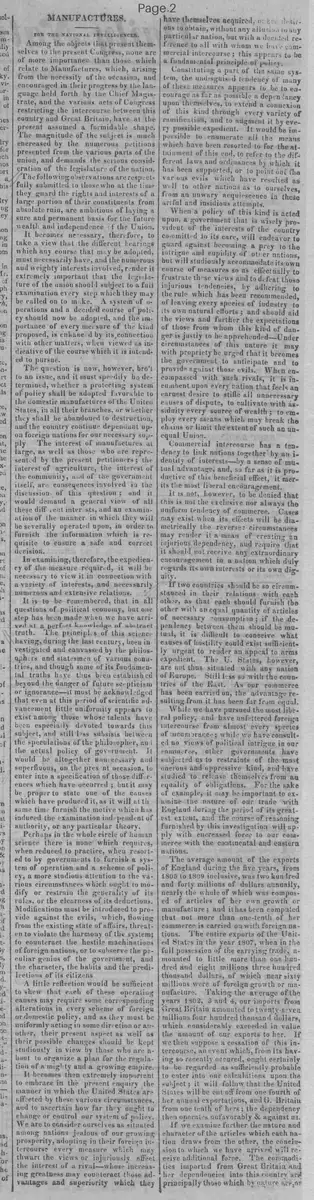
FOR THE NATIONAL INTELLIGENCER.
Among the objects that present themselves to the present Congress, none are of more importance than those which relate to Manufactures, which, arising from the necessity of the occasion, and encouraged in their progress by the language held forth by the Chief Magistrate, and the various acts of Congress restricting the intercourse between this country and Great Britain, have at the present assumed a formidable shape.
The magnitude of the subject is much encreased by the numerous petitions presented from the various parts of the union, and demands the serious consideration of the Legislature of the nation.
The following observations are respectfully submitted to those who at the time they guard the rights and interests of a large portion of their constituents from absolute ruin, are ambitious of laying a sure and permanent basis for the future wealth and independence of the Union.
It becomes necessary, therefore, to take a view that the different bearings which any course that may be adopted, must necessarily have, and the numerous and weighty interests involved, render it extremely important that the legislature of the union should subject to a full examination every step which they may be called on to make. A system of operations and a decided course of policy should now be adopted, and the importance of every measure of the kind proposed, is enhanced by its connection with other matters, when viewed as indicative of the course which it is intended to pursue.
The question is now, however, brought to an issue, and it must speedily be determined, whether a protecting system of policy shall be adopted favorable to the domestic manufactures of the United States, in all their branches, or whether they shall be abandoned to destruction, and the country continue dependent upon foreign nations for our necessary supply. The interest of manufactures at large, as well as those who are represented by the present petitioners; the interest of agriculture, the interest of the community, and of the government itself, are consequences involved in the discussion of this question; and it would demand a general view of all these different interests, and an examination of the manner in which they will be severally operated upon, in order to furnish the information which is requisite to ensure a safe and correct decision.
In examining, therefore, the expediency of the measure required, it will be necessary to view it in connection with a variety of interests, and necessarily numerous and extensive relations.
It is to be remembered, that in all questions of political economy, but one step has been made when we have arrived at a perfect knowledge of abstract truth. The principles of this science having, during the last century, been investigated and canvassed by the philosophers and statesmen of various countries, and though some of its fundamental truths have thus been established beyond the danger of future scepticism or ignorance—it must be acknowledged that even at this period of scientific advancement little uniformity appears to exist among those whose talents have been especially devoted towards this subject, and still less subsists between the speculations of the philosopher, and the actual policy of government. It would be altogether unnecessary and superfluous, on the present occasion, to enter into a specification of those differences which have occurred; but it may be proper to state one of the causes which have produced it, as it will at the same time furnish the motive which has induced the examination independent of authority, or any particular theory.
Perhaps in the whole circle of human science there is none which requires, when reduced to practice, when resorted to by governments to furnish a system of operation and a scheme of policy, a more studious attention to the various circumstances which ought to modify or restrain the generality of its rules, or the clearness of its deductions. Modifications must be introduced to provide against the evils, which, flowing from the existing state of affairs, threaten to violate the harmony of the system; to counteract the hostile machinations of foreign nations, or to subserve the peculiar genius of the government, and the character, the habits and the predilections of its citizens.
A little reflection would be sufficient to shew that each of these operating causes may require some corresponding alterations in every scheme of foreign or domestic policy, and as they must be uniformly acting in some direction or another, their present aspect as well as their possible changes should be kept studiously in view by those who are about to organize a plan for the regulation of a mighty and a growing empire.
It becomes then extremely important to embrace in the present enquiry the manner in which the United States are affected by these various circumstances, and to ascertain how far they ought to change or control our system of policy.
We are to consider ourselves as situated among nations jealous of our growing prosperity, adopting in their foreign intercourse every measure which may thwart the views or injuriously affect the interest of a rival—whose increasing greatness may counteract those advantages and superiority which they have themselves acquired. Without any allusion to any particular nation, but with a decided reference to all with whom we have commercial intercourse; this appears to be a fundamental principle of policy.
Constituting a part of the same system, the undisguised tendency of many of these measures appears to be to encourage as far as possible a dependency upon themselves, to extend a connexion of this kind through every variety of ramification, and to augment it by every possible expedient. It would be impossible to enumerate all the means which have been resorted to for the attainment of this end, to refer to the different laws and ordinances by which it has been supported, or to point out the various evils which have resulted as well to other nations as to ourselves from an unwary acquiescence in these artful and insidious attempts.
When a policy of this kind is acted upon, a government that is wisely provident of the interests of the country committed to its care, will endeavor to guard against becoming a prey to the intrigue and cupidity of other nations, but will studiously accommodate its own course of measures so as effectually to frustrate these views and to defeat those injurious tendencies, by adhering to the rule which has been recommended, of leaving every species of industry to its own natural efforts; and should aid the views and further the expectations of those from whom this kind of danger is justly to be apprehended—Under circumstances of this nature it may with propriety be urged that it becomes the government to anticipate and to provide against those evils. When encompassed with such rivals, it is incumbent upon every nation that feels an earnest desire to stifle all unnecessary causes of dispute, to cultivate with assiduity every source of wealth; to employ every means which may break the chains or limit the extent of such an unequal Union.
Commercial intercourse has a tendency to link nations together by an identity of interests—by a sense of mutual advantage, and, so far as it is productive of this beneficial effect, it merits the most liberal encouragement.
It is not, however, to be denied that this is not the exclusive nor always the uniform tendency of commerce. Cases may exist when its effects will be diametrically the reverse: circumstances may render it a mean of creating an injurious dependency, and require that it should not receive any extraordinary encouragement in a nation which duly regards its own interests or its own dignity.
If two countries should be so circumstanced in their relations with each other, as that each should furnish the other with an equal quantity of articles of necessary consumption; if the dependency between them should be mutual, it is difficult to conceive what causes of hostility could exist sufficiently urgent to render an appeal to arms expedient. The U. States, however, are not thus situated with any nation of Europe. Still less so with the countries of the East. As our commerce has been carried on, the advantage resulting from it has been far from equal.
While we have pursued the most liberal policy, and have unfettered foreign intercourse from almost every species of incumbrance; while we have consulted no views of political intrigue in our commerce, other governments have subjected us to restraints of the most onerous and oppressive kind, and have studied to release themselves from an equality of obligations. For the sake of example, it may be important to examine the nature of our trade with England during the period of its greatest extent, and the course of reasoning furnished by this investigation will apply with increased force to our commerce with the continental and eastern nations.
The average amount of the exports of England during the five years, from 1805 to 1809 inclusive, was two hundred and forty millions of dollars annually, nearly the whole of which was composed of articles of her own growth or manufacture; and it has been computed that not more than one-tenth of her commerce is carried on with foreign nations. The entire exports of the United States in the year 1807, when in the full possession of the carrying trade, amounted to little more than one hundred and eight millions three hundred thousand dollars, of which near sixty millions were of foreign growth or manufacture. Taking the average of the years 1802, 3 and 4, our imports from Great Britain amounted to twenty-seven millions four hundred thousand dollars, which considerably exceeded in value the amount of our exports to her. If we then suppose a cessation of this intercourse, an event which, from its having so recently occurred, ought certainly to be regarded as sufficiently probable to enter into our calculations upon the subject: it will follow that the United States will be cut off from one fourth of her annual exportations, and G. Britain from one tenth of hers; the dependency then operates unfavorably & against us.
If we examine further the nature and character of the articles which each nation draws from the other, the conclusion to which we have arrived will receive additional force. The commodities imported from Great Britain and her dependencies into this country are principally those which by nature are, or by education and habit have become, essential to our comfort and convenience, cloths, muslins and groceries, deprived of which our comforts would be much diminished, and it would be difficult to supply the demand from any other foreign source.
Cotton, rice, tobacco, and a small portion of grain, are our exports in return. None of these articles in the degree that they are furnished by us, are necessary for her subsistence or her comfort; and from her extensive connections with other countries where the same agricultural productions are raised, she could supply any deficiency occasioned by a cessation of trade with us at an additional expense of not more than two per cent. on the entire amount. In addition to this, it should be further considered, that by cutting off our commerce with the rest of the world the pressure of these evils would be augmented upon us, while, by occupying our place and appropriating to herself all the trade which had belonged to us, it would be alleviated as to her.
By a recent regulation in England, the natural tendency of this connection to operate to her advantage, has been materially increased. American grain of all kinds, is virtually prohibited from constituting any part of the consumption of her inhabitants. The manifest effect of this measure is to render them independent of us for all articles necessary to their subsistence, and to continue our dependence upon them for the commodities essential to ours.
This is referred to, not as affording us any cause of complaint, but as a measure which is entitled to our most serious consideration, and it is important to determine whether the principle from which it springs is not proper for our adoption.
It arises from a desire to render themselves altogether free from the control of foreign nations in procuring the articles essential to their subsistence, and to attain this end at every sacrifice and expense. Extensive as the commerce of that nation is, with the capacities she possesses of remedying any evil arising from an interruption of her intercourse with any one country by extending her trade proportionably with others, she is nevertheless resolved to place her supply of necessary articles beyond the possibility of danger or the reach of accident.
When this principle can be brought fairly into operation, the legislature of the nation ought to adopt it as the governing rule of policy, every technical maxim of abstract science ought to yield to this imperative dictate of prudence, which requires that we should secure within ourselves the source of whatever is necessary for our comfort or subsistence.
The recent events which have transpired in this country, have impressed many salutary lessons of wisdom, and informed us of many important truths: we have discovered that we possess ample means of supplying all our own necessary demands, the resources of the country have been brought into action, and their extent and variety have been laid open to observation. We contain within ourselves the means of exciting every species of national wealth, and though the circumstances of the times, and the novelty of the enterprises rendered them in an unusual degree perilous and difficult, still, if proper regulations are now adopted by the government to foster and encourage the infant manufacturing establishments of the country: we have nothing to apprehend in any future emergency.
(To be continued.)
What sub-type of article is it?
What keywords are associated?
What entities or persons were involved?
Editorial Details
Primary Topic
Adoption Of Protective Policy For Domestic Manufactures
Stance / Tone
Advocacy For Economic Independence And Protectionism
Key Figures
Key Arguments