Thank you for visiting SNEWPapers!
Sign up free
Literary
December 15, 1827
Literary Cadet And Rhode Island Statesman
Providence, Providence County, Rhode Island
What is this article about?
Newspaper review of Sir Walter Scott's 'The Chronicles of the Canongate,' featuring his preface revealing himself as the author of the Waverley Novels, explaining his incognito, and acknowledging sources like Joseph Train and historical anecdotes from Jacobite era.
Clipping
OCR Quality
95%
Excellent
Full Text
PROVIDENCE.
THE CHRONICLES OF THE CANONGATE.
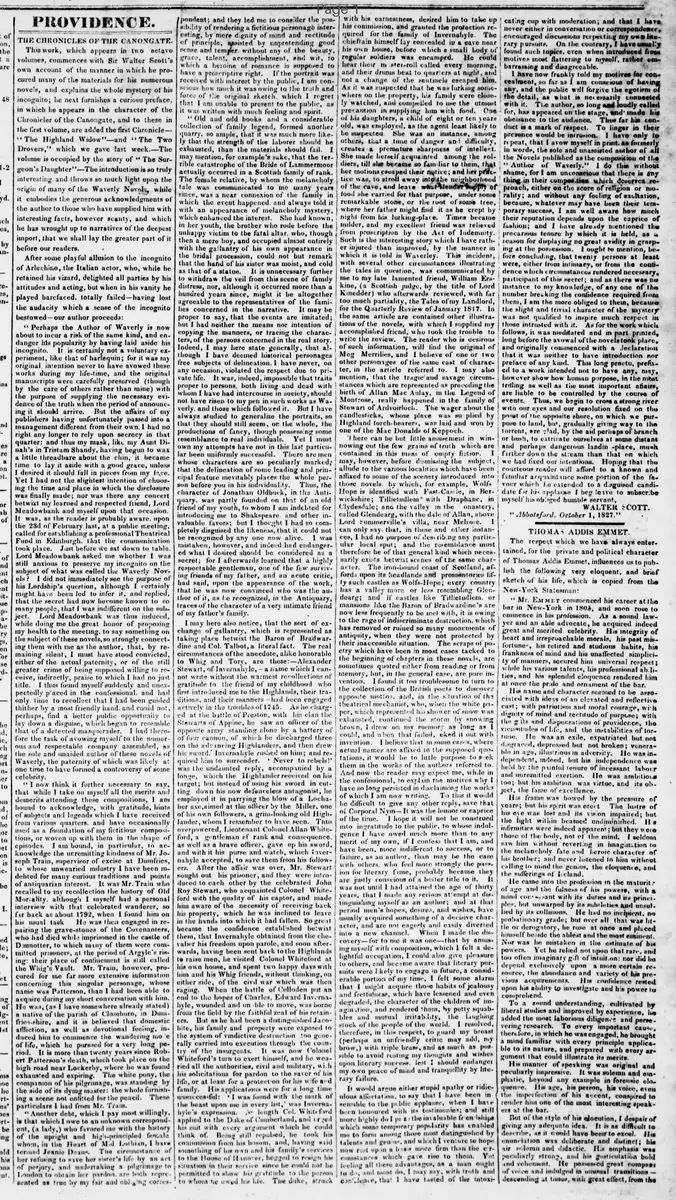
This work, which appears in two octavo volumes, commences with Sir Walter Scott's own account of the manner in which he procured many of the materials for his numerous novels, and explains the whole mystery of his incognito; he next furnishes a curious preface, in which he appears in the character of the Chronicler of the Canongate, and to these in the first volume, are added the first Chronicle—"The Highland Widow" and "The Two Drovers," which we gave last week.—The volume is occupied by the story of "The Surgeon's Daughter'—The introduction is so truly interesting, and throws so much light upon the origin of many of the Waverly Novels, while it embodies the generous acknowledgments of the author to those who have supplied him with interesting facts, however scanty, and which he has wrought up to narratives of the deepest import, that we shall lay the greater part of it before our readers.
After some playful allusion to the incognito of Arlechino, the Italian actor, who, while he retained his vizard, delighted all parties by his attitudes and acting, but when in his vanity he played barefaced, totally failed—having lost the audacity which a sense of the incognito bestowed—our author proceeds:
"Perhaps the Author of Waverly is now about to incur a risk of the same kind, and endanger his popularity by having laid aside his incognito. It is certainly not a voluntary experiment, like that of harlequin; for it was my original intention never to have avowed these works during my life-time, and the original manuscripts were carefully preserved (though by the care of others rather than mine) with the purpose of supplying the necessary evidence of the truth when the period of announcing it should arrive. But the affairs of my publishers having unfortunately passed into a management different from their own, I had no right any longer to rely upon secrecy in that quarter: and thus my mask, like my Aunt Dinah's in Tristram Shandy, having begun to wax a little threadbare about the chin, it became time to lay it aside with a good grace, unless I desired it should fall in pieces from my face.
Yet I had not the slightest intention of choosing the time and place in which the disclosure was finally made; nor was there any concert betwixt my learned and respected friend, Lord Meadowbank and myself upon that occasion. It was, as the reader is probably aware, upon the 23d of February last, at a public meeting, called for establishing a professional Theatrical Fund in Edinburgh, that the communication took place. Just before we sat down to table. Lord Meadowbank asked me whether I was still anxious to preserve my incognito on the subject of what was called the Waverly Novels? I did not immediately see the purpose of his Lordship's question, although I certainly might have been led to infer it, and replied. that the secret had now become known to so many people, that I was indifferent on the subject." Lord Meadowbank was thus induced, while doing me the great honor of proposing my health to the meeting, to say something on the subject of these novels, so strongly connecting them with me as the author, that, by remaining silent, I must have stood convicted, either of the actual paternity, or of the still greater crime of being supposed willing to receive, indirectly, praise to which I had no just title. I thus found myself suddenly and unexpectedly placed in the confessional, and had only time to recollect that I had been guided thither by a most friendly hand, and could not, perhaps, find a better public opportunity to lay down a disguise, which began to resemble that of a detected masquerader. I had therefore the task of avowing myself to the numerous and respectable company assembled, as the sole and unaided author of these novels of Waverly, the paternity of which was likely at one time to have formed a controversy of some celebrity.
"I now think it further necessary to say, that while I take on myself all the merits and demerits attending these compositions, I am bound to acknowledge, with gratitude, hints of subjects and legends which I have received from various quarters, and have occasionally used as a foundation of my fictitious compositions, or woven up with them in the shape of episode. I am bound, in particular, to acknowledge the unremitting kindness of Mr. Joseph Train, supervisor of excise at Dumfries, to whose unwearied industry I have been indebted for many curious traditions and points of antiquarian interest. It was Mr. Train who recalled to my recollection the history of Old Mortality, although I myself had a personal interview with that celebrated wanderer, so far back as about 1792, when I found him on his usual task
He was then engaged in repairing the grave-stones of the Covenanters, who had died while imprisoned in the castle of Dunnotter, to which many of them were committed prisoners, at the period of Argyle's rising: their place of confinement is still called the Whig's Vault. Mr. Train, however, procured for me far more extensive information concerning this singular personage, whose name was Patterson, than I had been able to acquire during my short conversation with him. He was, (as I have somewhere already stated) a native of the parish of Closeburn, in Dumfries-shire, and it is believed that domestic affliction, as well as devotional feeling, induced him to commence the wandering mode of life, which he pursued for a very long period. It is more than twenty years since Robert Patterson's death, which took place on the high road near Lockerby, where he was found exhausted and expiring. The white pony, the companion of his pilgrimage, was standing by the side of its dying master: the whole furnishing a scene not unfitted for the pencil. These particulars I had from Mr. Train.
"Another debt, which I pay most willingly, is that which I owe to an unknown correspondent, (a lady,) who favored me with the history of the upright and high-principled female whom, in the Heart of Mid Lothian, I have termed Jeanie Deans. The circumstance of her refusing to save her sister's life by an act of perjury, and undertaking a pilgrimage to London to obtain her pardon, are both represented as true by my fair and obliging correspondent; and they led me to consider the possibility of rendering a fictitious personage interesting, by mere dignity of mind and rectitude of principle, assisted by unpretending good sense and temper, without any of the beauty, grace, talent, accomplishment, and wit, to which a heroine of romance is supposed to have a prescriptive right. If the portrait was received with interest by the public, I am conscious how much it was owing to the truth and force of the original sketch, which I regret that I am unable to present to the public, as it was written with much feeling and spirit.
"Old and odd books and a considerable collection of family legend, formed another quarry, so ample, that it was much more likely that the strength of the laborer should be exhausted, than the materials should fail. I may mention, for example's sake, that the terrible catastrophe of the Bride of Lammermoor actually occurred in a Scottish family of rank. The female relative, by whom the melancholy tale was communicated to me many years since, was a near connexion of the family in which the event happened, and always told it with an appearance of melancholy mystery, which enhanced the interest. She had known, in her youth, the brother who rode before the unhappy victim to the fatal altar, who, though then a mere boy, and occupied almost entirely with the gallantry of his own appearance in the bridal procession, could not but remark that the hand of his sister was moist, and cold as that of a statue. It is unnecessary further to withdraw the veil from this scene of family distress, nor, although it occurred more than a hundred years since, might it be altogether agreeable to the representatives of the families concerned in the narrative. It may be proper to say, that the events are imitated: but I had neither the means nor intention of copying the manners, or tracing the characters, of the persons concerned in the real story. Indeed, I may here state generally, that although I have deemed historical personages free subjects of delineation, I have never, on any occasion, violated the respect due to private life. It was, indeed, impossible that traits proper to persons, both living and dead with whom I have had intercourse in society, should not have risen to my pen in such works as Waverly, and those which followed it. But I have always studied to generalize the portraits, so that they should still seem, on the whole, the productions of fancy, though possessing some resemblance to real individuals. Yet I must own my attempts have not in this last particular been uniformly successful. There are men whose characters are so peculiarly marked, that the delineation of some leading and principal feature inevitably places the whole person before you in his individuality. Thus, the character of Jonathan Oldbuck, in the Antiquary, was partly founded on that of an old friend of my youth, to whom I am indebted for introducing me to Shakspeare, and other invaluable favors; but I thought I had so completely disguised the likeness, that it could not be recognized by any one now alive. I was mistaken, however, and indeed had endangered what I desired should be considered as a secret; for I afterwards learned that a highly respectable gentleman, one of the few surviving friends of my father, and an acute critic, had said, upon the appearance of the work, that he was now convinced who was the author of it, as he recognized, in the Antiquary, traces of the character of a very intimate friend of my father's family.
I may here also notice, that the sort of exchange of gallantry, which is represented as taking place betwixt the Baron of Bradwardine and Col. Talbot, a literal fact. The real circumstances of the anecdote, alike honorable to Whig and Tory, are these:—Alexander Stewart, of Invernahyle,—a name which I cannot write without the warmest recollections of gratitude to the friend of my childhood who first introduced me to the Highlands, their traditions, and their manners—had been engaged actively in the troubles of 1745. As he charged at the battle of Preston, with his clan the Stewarts of Appine, he saw an officer of the opposite army standing alone by a battery of four cannon, of which he discharged three on the advancing Highlanders, and then drew his sword. Invernahyle rushed on him; and required him to surrender. "Never to rebels!" was the undaunted reply, accompanied by a lunge, which the Highlander received on his target; but instead of using his sword in cutting down his now defenceless antagonist, he employed it in parrying the blow of a Lochaber axe, aimed at the officer by the Miller, one of his own followers, a grim-looking old Highlander, whom I remember to have seen. Thus overpowered, Lieutenant Colonel Allan Whiteford, a gentleman of rank and consequence, as well as a brave officer, gave up his sword. and with it his purse and watch, which Invernahyle accepted, to save them from his followers. After the affair was over, Mr. Stewart sought out his prisoner, and they were introduced to each other by the celebrated John Roy Stewart, who acquainted Colonel Whiteford with the quality of his captor, and made him aware of the necessity of receiving back his property, which he was inclined to leave in the hands into which it had fallen. So great became the confidence established betwixt them, that Invernahyle obtained from the chevalier his freedom upon parole, and soon afterwards, having been sent back to the Highlands to raise men, he visited Colonel Whitford at his own house, and spent two happy days with him and his Whig friends, without thinking, on either side, of the civil war which was then raging. When the battle of Culloden put an end to the hopes of Charles, Edward Invernahyle, wounded and unable to move, was borne from the field by the faithful zeal of his retainers. But as he had been a distinguished Jacobite, his family and property were exposed to the system of vindictive destruction too generally carried into execution through the country of the insurgents. It was now Colonel Whiteford's turn to exert himself, and he wearied all the authorities, civil and military, with his solicitations for pardon to the saver of his life, or at least for a protection for his wife and family. His applications were for a long time unsuccessful: "I was found with the mark of the beast upon me in every list," was Invernahyle's expression. At length Col. Whiteford applied to the Duke of Cumberland, and urged his suit with every argument which he could think of. Being still repulsed, he took his commission from his bosom, and, having said something of his own and his family's services to the House of Hanover, begged to resign his situation in their service since he could not be permitted to show his gratitude to the person to whom he owed his life. The duke, struck with his earnestness, desired him to take up his commission, and granted the protection required for the family of Invernahyle. The chieftain himself lay concealed in a cave near his own house, before which a small body of regular soldiers was encamped. He could hear their muster-roll called every morning. and their drums beat to quarters at night, and not a change of the sentinels escaped him. As it was suspected that he was lurking somewhere on the property, his family were closely watched, and compelled to use the utmost precaution in supplying him with food. One of his daughters, a child of eight or ten years old, was employed, as the agent least likely to be suspected. She was an instance, among others, that a time of danger and difficulty, creates a premature sharpness of intellect. She made herself acquainted among the soldiers, till she became so familiar to them, that her motions escaped their notice; and her practice was, to stroll away into the neighborhood of the cave, and leave what slender supply of food she carried for that purpose, under some remarkable stone, or the root of some tree, where her father might find it as he crept by night from his lurking-place. Times became milder, and my excellent friend was relieved from proscription by the Act of Indemnity.
Such is the interesting story which I have rather injured than improved, by the manner in which it is told in Waverley. This incident, with several other circumstances illustrating the tales in question, was communicated by me to my late lamented friend, William Erskine, (a Scottish judge, by the title of Lord Kinedder) who afterwards reviewed, with far too much partiality, the Tales of my Landlord, for the Quarterly Review of January 1817. In the same article are contained other illustrations of the novels, with which I supplied my accomplished friend, who took the trouble to write the review. The reader who is desirous of such information, will find the original of Meg Merrilies, and I believe of one or two other personages of the same cast of character, in the article referred to. I may also mention, that the tragic and savage circumstances which are represented as preceding the birth of Allan Mac Aulay, in the Legend of Montrose, really happened in the family of Stewart of Ardvoirlich. The wager about the candlesticks, whose place was supplied by Highland torch-bearers, was laid and won by one of the Mac Donalds of Keppoch.
I here can be but little amusement in winnowing out the few grains of truth which are contained in this mass of empty fiction. I may, however, before dismissing the subject, allude to the various localities which have been affixed to some of the scenery introduced into those novels, by which, for example, Wolf's Hope is identified with Fast Castle, in Berwickshire; Tillietudlem with Draphane, in Clydesdale; and the valley in the Monastery, called Glendearg, with the dale of Allan, above Lord Sommerville's villa, near Melrose. I can only say, that, in these and other instances, I had no purpose of describing any particular local spot; and the resemblance must therefore be of that general kind which necessarily exists betwixt scenes of the same character. The iron-bound coast of Scotland, afford upon its headlands and prominontories fifty such castles as Wolf's-Hope; every country has a valley more or less resembling Glendearg; and if castles like Tillietudlem, or mansions like the Baron of Bradwardine's are now less frequently to be met with, it is owing to the rage of indiscriminate destruction, which has removed or ruined so many monuments of antiquity, when they were not protected by their inaccessible situation. The scraps of poetry which have been in most cases tacked to the beginning of chapters in these novels, are sometimes quoted either from reading or from memory, but, in the general case, are pure invention. I found it too troublesome to turn to the collection of the British poets to discover apposite mottoes, and, in the situation of the theatrical mechanist, who, when the white paper, which represented his shower of snow was exhausted, continued the storm by snowing brown, I drew on my memory as long as I could, and when that failed, eked it out with invention. I believe that in some cases, where actual names are affixed to the supposed quotations, it would be to little purpose to seek them in the works of the authors referred to.
And now the reader may expect me, while in the confessional, to explain the motives why I have so long persisted in disclaiming the works of which I am now writing. To this it would be difficult to give any other reply, save that of Corporal Nym—It was the humour or caprice of the time. I hope it will not be construed into ingratitude to the public, to whose indulgence I have owed much more than to any merit of my own, if I confess that I am, and have been, more indifferent to success, or to failure, as an author, than may be the case with others, who feel more strongly the passion for literary fame, probably because they are justly conscious of a better title to it. It was not until I had attained the age of thirty years, that I made any serious attempt at distinguishing myself as an author; and at that period men's hopes, desires, and wishes, have usually acquired something of a decisive character, and are not eagerly and easily diverted into a new channel. When I made the discovery—for to me it was one—that by amusing myself with composition, which I felt a delightful occupation, I could also give pleasure to others, and became aware that literary pursuits were likely to engage in future, a considerable portion of my time, I felt some alarm that I might acquire those habits of jealousy and fretfulness, which have lessened and even degraded, the character of the children of imagination, and rendered them, by petty squabbles and mutual irritability, the laughing stock of the people of the world. I resolved, therefore, in this respect, to guard my breast (perhaps an unfriendly critic may add, my brow,) with triple brass, and as much as possible to avoid resting my thoughts and wishes upon literary success, lest I should endanger my own peace of mind and tranquillity by literary failure.
It would argue either stupid apathy or ridiculous affectation, to say that I have been insensible to the public applause, when I have been honoured with its testimonies; and still more highly do I prize the invaluable friendships which some temporary popularity has enabled me to form among those most distinguished by talents and genius, and which I venture to hope now rest upon a basis more firm than the circulating cup with moderation; and that I have, never either in conversation or correspondence, encouraged discussions respecting my own literary pursuits. On the contrary, I have usually found such topics, even when introduced from motives most flattering to myself, rather embarrassing and disagreeable.
I have now frankly told my motives for concealment, so far as I am conscious of having any, and the public will forgive the egotism of the detail, as what is necessarily connected with it. The author, so long and loudly called for, has appeared on the stage, and made his obeisance to the audience. Thus far his conduct is a mark of respect. To linger in their presence would be intrusion. I have only to repeat, that I avow myself in print, as formerly in words, the sole and unassisted author of all the Novels published as the composition of the "Author of Waverly." I do this without shame, or I am unconscious that there is any thing in their composition which deserves reproach, either on the score of religion or morality; and without any feeling of exultation, because, whatever may have been their temporary success, I am well aware how much their reputation depends upon the caprice of fashion; and I have already mentioned the precarious tenure by which it is held, as a reason for displaying no great avidity in grasping at the possession. I ought to mention, before concluding, that twenty persons at least were, either from intimacy, or from the confidence which circumstances rendered necessary, participant of this secret; and as there was no instance to my knowledge, of any one of the number breaking the confidence required from them, I am the more obliged to them, because the slight and trivial character of the mystery was not qualified to inspire much respect in those intrusted with it. As for the work which follows, it was meditated and in part printed, long before the avowal of the novels took place, and originally commenced with a declaration that it was neither to have introduction nor preface of any kind. This long proem, prefixed to a work intended not to have any, may, however show how human purposes, in the most trifling as well as the most important affairs, are liable to be controlled by the course of events. Thus, we begin to cross a strong river with our eyes and our resolution fixed on the point of the opposite shore, on which we purpose to land, but, gradually giving way to the torrent, are glad, by the aid perhaps of branch or bush, to extricate ourselves at some distant and perhaps dangerous landing-place, much farther down the stream than that on which we had fixed our intentions. Hoping that the courteous reader will afford to a known and familiar acquaintance some portion of the favour which he extended to a disguised candidate for his applause I beg leave to subscribe myself his obliged humble servant,
WALTER SCOTT
Abbotsford, October 1, 1827.
THE CHRONICLES OF THE CANONGATE.
This work, which appears in two octavo volumes, commences with Sir Walter Scott's own account of the manner in which he procured many of the materials for his numerous novels, and explains the whole mystery of his incognito; he next furnishes a curious preface, in which he appears in the character of the Chronicler of the Canongate, and to these in the first volume, are added the first Chronicle—"The Highland Widow" and "The Two Drovers," which we gave last week.—The volume is occupied by the story of "The Surgeon's Daughter'—The introduction is so truly interesting, and throws so much light upon the origin of many of the Waverly Novels, while it embodies the generous acknowledgments of the author to those who have supplied him with interesting facts, however scanty, and which he has wrought up to narratives of the deepest import, that we shall lay the greater part of it before our readers.
After some playful allusion to the incognito of Arlechino, the Italian actor, who, while he retained his vizard, delighted all parties by his attitudes and acting, but when in his vanity he played barefaced, totally failed—having lost the audacity which a sense of the incognito bestowed—our author proceeds:
"Perhaps the Author of Waverly is now about to incur a risk of the same kind, and endanger his popularity by having laid aside his incognito. It is certainly not a voluntary experiment, like that of harlequin; for it was my original intention never to have avowed these works during my life-time, and the original manuscripts were carefully preserved (though by the care of others rather than mine) with the purpose of supplying the necessary evidence of the truth when the period of announcing it should arrive. But the affairs of my publishers having unfortunately passed into a management different from their own, I had no right any longer to rely upon secrecy in that quarter: and thus my mask, like my Aunt Dinah's in Tristram Shandy, having begun to wax a little threadbare about the chin, it became time to lay it aside with a good grace, unless I desired it should fall in pieces from my face.
Yet I had not the slightest intention of choosing the time and place in which the disclosure was finally made; nor was there any concert betwixt my learned and respected friend, Lord Meadowbank and myself upon that occasion. It was, as the reader is probably aware, upon the 23d of February last, at a public meeting, called for establishing a professional Theatrical Fund in Edinburgh, that the communication took place. Just before we sat down to table. Lord Meadowbank asked me whether I was still anxious to preserve my incognito on the subject of what was called the Waverly Novels? I did not immediately see the purpose of his Lordship's question, although I certainly might have been led to infer it, and replied. that the secret had now become known to so many people, that I was indifferent on the subject." Lord Meadowbank was thus induced, while doing me the great honor of proposing my health to the meeting, to say something on the subject of these novels, so strongly connecting them with me as the author, that, by remaining silent, I must have stood convicted, either of the actual paternity, or of the still greater crime of being supposed willing to receive, indirectly, praise to which I had no just title. I thus found myself suddenly and unexpectedly placed in the confessional, and had only time to recollect that I had been guided thither by a most friendly hand, and could not, perhaps, find a better public opportunity to lay down a disguise, which began to resemble that of a detected masquerader. I had therefore the task of avowing myself to the numerous and respectable company assembled, as the sole and unaided author of these novels of Waverly, the paternity of which was likely at one time to have formed a controversy of some celebrity.
"I now think it further necessary to say, that while I take on myself all the merits and demerits attending these compositions, I am bound to acknowledge, with gratitude, hints of subjects and legends which I have received from various quarters, and have occasionally used as a foundation of my fictitious compositions, or woven up with them in the shape of episode. I am bound, in particular, to acknowledge the unremitting kindness of Mr. Joseph Train, supervisor of excise at Dumfries, to whose unwearied industry I have been indebted for many curious traditions and points of antiquarian interest. It was Mr. Train who recalled to my recollection the history of Old Mortality, although I myself had a personal interview with that celebrated wanderer, so far back as about 1792, when I found him on his usual task
He was then engaged in repairing the grave-stones of the Covenanters, who had died while imprisoned in the castle of Dunnotter, to which many of them were committed prisoners, at the period of Argyle's rising: their place of confinement is still called the Whig's Vault. Mr. Train, however, procured for me far more extensive information concerning this singular personage, whose name was Patterson, than I had been able to acquire during my short conversation with him. He was, (as I have somewhere already stated) a native of the parish of Closeburn, in Dumfries-shire, and it is believed that domestic affliction, as well as devotional feeling, induced him to commence the wandering mode of life, which he pursued for a very long period. It is more than twenty years since Robert Patterson's death, which took place on the high road near Lockerby, where he was found exhausted and expiring. The white pony, the companion of his pilgrimage, was standing by the side of its dying master: the whole furnishing a scene not unfitted for the pencil. These particulars I had from Mr. Train.
"Another debt, which I pay most willingly, is that which I owe to an unknown correspondent, (a lady,) who favored me with the history of the upright and high-principled female whom, in the Heart of Mid Lothian, I have termed Jeanie Deans. The circumstance of her refusing to save her sister's life by an act of perjury, and undertaking a pilgrimage to London to obtain her pardon, are both represented as true by my fair and obliging correspondent; and they led me to consider the possibility of rendering a fictitious personage interesting, by mere dignity of mind and rectitude of principle, assisted by unpretending good sense and temper, without any of the beauty, grace, talent, accomplishment, and wit, to which a heroine of romance is supposed to have a prescriptive right. If the portrait was received with interest by the public, I am conscious how much it was owing to the truth and force of the original sketch, which I regret that I am unable to present to the public, as it was written with much feeling and spirit.
"Old and odd books and a considerable collection of family legend, formed another quarry, so ample, that it was much more likely that the strength of the laborer should be exhausted, than the materials should fail. I may mention, for example's sake, that the terrible catastrophe of the Bride of Lammermoor actually occurred in a Scottish family of rank. The female relative, by whom the melancholy tale was communicated to me many years since, was a near connexion of the family in which the event happened, and always told it with an appearance of melancholy mystery, which enhanced the interest. She had known, in her youth, the brother who rode before the unhappy victim to the fatal altar, who, though then a mere boy, and occupied almost entirely with the gallantry of his own appearance in the bridal procession, could not but remark that the hand of his sister was moist, and cold as that of a statue. It is unnecessary further to withdraw the veil from this scene of family distress, nor, although it occurred more than a hundred years since, might it be altogether agreeable to the representatives of the families concerned in the narrative. It may be proper to say, that the events are imitated: but I had neither the means nor intention of copying the manners, or tracing the characters, of the persons concerned in the real story. Indeed, I may here state generally, that although I have deemed historical personages free subjects of delineation, I have never, on any occasion, violated the respect due to private life. It was, indeed, impossible that traits proper to persons, both living and dead with whom I have had intercourse in society, should not have risen to my pen in such works as Waverly, and those which followed it. But I have always studied to generalize the portraits, so that they should still seem, on the whole, the productions of fancy, though possessing some resemblance to real individuals. Yet I must own my attempts have not in this last particular been uniformly successful. There are men whose characters are so peculiarly marked, that the delineation of some leading and principal feature inevitably places the whole person before you in his individuality. Thus, the character of Jonathan Oldbuck, in the Antiquary, was partly founded on that of an old friend of my youth, to whom I am indebted for introducing me to Shakspeare, and other invaluable favors; but I thought I had so completely disguised the likeness, that it could not be recognized by any one now alive. I was mistaken, however, and indeed had endangered what I desired should be considered as a secret; for I afterwards learned that a highly respectable gentleman, one of the few surviving friends of my father, and an acute critic, had said, upon the appearance of the work, that he was now convinced who was the author of it, as he recognized, in the Antiquary, traces of the character of a very intimate friend of my father's family.
I may here also notice, that the sort of exchange of gallantry, which is represented as taking place betwixt the Baron of Bradwardine and Col. Talbot, a literal fact. The real circumstances of the anecdote, alike honorable to Whig and Tory, are these:—Alexander Stewart, of Invernahyle,—a name which I cannot write without the warmest recollections of gratitude to the friend of my childhood who first introduced me to the Highlands, their traditions, and their manners—had been engaged actively in the troubles of 1745. As he charged at the battle of Preston, with his clan the Stewarts of Appine, he saw an officer of the opposite army standing alone by a battery of four cannon, of which he discharged three on the advancing Highlanders, and then drew his sword. Invernahyle rushed on him; and required him to surrender. "Never to rebels!" was the undaunted reply, accompanied by a lunge, which the Highlander received on his target; but instead of using his sword in cutting down his now defenceless antagonist, he employed it in parrying the blow of a Lochaber axe, aimed at the officer by the Miller, one of his own followers, a grim-looking old Highlander, whom I remember to have seen. Thus overpowered, Lieutenant Colonel Allan Whiteford, a gentleman of rank and consequence, as well as a brave officer, gave up his sword. and with it his purse and watch, which Invernahyle accepted, to save them from his followers. After the affair was over, Mr. Stewart sought out his prisoner, and they were introduced to each other by the celebrated John Roy Stewart, who acquainted Colonel Whiteford with the quality of his captor, and made him aware of the necessity of receiving back his property, which he was inclined to leave in the hands into which it had fallen. So great became the confidence established betwixt them, that Invernahyle obtained from the chevalier his freedom upon parole, and soon afterwards, having been sent back to the Highlands to raise men, he visited Colonel Whitford at his own house, and spent two happy days with him and his Whig friends, without thinking, on either side, of the civil war which was then raging. When the battle of Culloden put an end to the hopes of Charles, Edward Invernahyle, wounded and unable to move, was borne from the field by the faithful zeal of his retainers. But as he had been a distinguished Jacobite, his family and property were exposed to the system of vindictive destruction too generally carried into execution through the country of the insurgents. It was now Colonel Whiteford's turn to exert himself, and he wearied all the authorities, civil and military, with his solicitations for pardon to the saver of his life, or at least for a protection for his wife and family. His applications were for a long time unsuccessful: "I was found with the mark of the beast upon me in every list," was Invernahyle's expression. At length Col. Whiteford applied to the Duke of Cumberland, and urged his suit with every argument which he could think of. Being still repulsed, he took his commission from his bosom, and, having said something of his own and his family's services to the House of Hanover, begged to resign his situation in their service since he could not be permitted to show his gratitude to the person to whom he owed his life. The duke, struck with his earnestness, desired him to take up his commission, and granted the protection required for the family of Invernahyle. The chieftain himself lay concealed in a cave near his own house, before which a small body of regular soldiers was encamped. He could hear their muster-roll called every morning. and their drums beat to quarters at night, and not a change of the sentinels escaped him. As it was suspected that he was lurking somewhere on the property, his family were closely watched, and compelled to use the utmost precaution in supplying him with food. One of his daughters, a child of eight or ten years old, was employed, as the agent least likely to be suspected. She was an instance, among others, that a time of danger and difficulty, creates a premature sharpness of intellect. She made herself acquainted among the soldiers, till she became so familiar to them, that her motions escaped their notice; and her practice was, to stroll away into the neighborhood of the cave, and leave what slender supply of food she carried for that purpose, under some remarkable stone, or the root of some tree, where her father might find it as he crept by night from his lurking-place. Times became milder, and my excellent friend was relieved from proscription by the Act of Indemnity.
Such is the interesting story which I have rather injured than improved, by the manner in which it is told in Waverley. This incident, with several other circumstances illustrating the tales in question, was communicated by me to my late lamented friend, William Erskine, (a Scottish judge, by the title of Lord Kinedder) who afterwards reviewed, with far too much partiality, the Tales of my Landlord, for the Quarterly Review of January 1817. In the same article are contained other illustrations of the novels, with which I supplied my accomplished friend, who took the trouble to write the review. The reader who is desirous of such information, will find the original of Meg Merrilies, and I believe of one or two other personages of the same cast of character, in the article referred to. I may also mention, that the tragic and savage circumstances which are represented as preceding the birth of Allan Mac Aulay, in the Legend of Montrose, really happened in the family of Stewart of Ardvoirlich. The wager about the candlesticks, whose place was supplied by Highland torch-bearers, was laid and won by one of the Mac Donalds of Keppoch.
I here can be but little amusement in winnowing out the few grains of truth which are contained in this mass of empty fiction. I may, however, before dismissing the subject, allude to the various localities which have been affixed to some of the scenery introduced into those novels, by which, for example, Wolf's Hope is identified with Fast Castle, in Berwickshire; Tillietudlem with Draphane, in Clydesdale; and the valley in the Monastery, called Glendearg, with the dale of Allan, above Lord Sommerville's villa, near Melrose. I can only say, that, in these and other instances, I had no purpose of describing any particular local spot; and the resemblance must therefore be of that general kind which necessarily exists betwixt scenes of the same character. The iron-bound coast of Scotland, afford upon its headlands and prominontories fifty such castles as Wolf's-Hope; every country has a valley more or less resembling Glendearg; and if castles like Tillietudlem, or mansions like the Baron of Bradwardine's are now less frequently to be met with, it is owing to the rage of indiscriminate destruction, which has removed or ruined so many monuments of antiquity, when they were not protected by their inaccessible situation. The scraps of poetry which have been in most cases tacked to the beginning of chapters in these novels, are sometimes quoted either from reading or from memory, but, in the general case, are pure invention. I found it too troublesome to turn to the collection of the British poets to discover apposite mottoes, and, in the situation of the theatrical mechanist, who, when the white paper, which represented his shower of snow was exhausted, continued the storm by snowing brown, I drew on my memory as long as I could, and when that failed, eked it out with invention. I believe that in some cases, where actual names are affixed to the supposed quotations, it would be to little purpose to seek them in the works of the authors referred to.
And now the reader may expect me, while in the confessional, to explain the motives why I have so long persisted in disclaiming the works of which I am now writing. To this it would be difficult to give any other reply, save that of Corporal Nym—It was the humour or caprice of the time. I hope it will not be construed into ingratitude to the public, to whose indulgence I have owed much more than to any merit of my own, if I confess that I am, and have been, more indifferent to success, or to failure, as an author, than may be the case with others, who feel more strongly the passion for literary fame, probably because they are justly conscious of a better title to it. It was not until I had attained the age of thirty years, that I made any serious attempt at distinguishing myself as an author; and at that period men's hopes, desires, and wishes, have usually acquired something of a decisive character, and are not eagerly and easily diverted into a new channel. When I made the discovery—for to me it was one—that by amusing myself with composition, which I felt a delightful occupation, I could also give pleasure to others, and became aware that literary pursuits were likely to engage in future, a considerable portion of my time, I felt some alarm that I might acquire those habits of jealousy and fretfulness, which have lessened and even degraded, the character of the children of imagination, and rendered them, by petty squabbles and mutual irritability, the laughing stock of the people of the world. I resolved, therefore, in this respect, to guard my breast (perhaps an unfriendly critic may add, my brow,) with triple brass, and as much as possible to avoid resting my thoughts and wishes upon literary success, lest I should endanger my own peace of mind and tranquillity by literary failure.
It would argue either stupid apathy or ridiculous affectation, to say that I have been insensible to the public applause, when I have been honoured with its testimonies; and still more highly do I prize the invaluable friendships which some temporary popularity has enabled me to form among those most distinguished by talents and genius, and which I venture to hope now rest upon a basis more firm than the circulating cup with moderation; and that I have, never either in conversation or correspondence, encouraged discussions respecting my own literary pursuits. On the contrary, I have usually found such topics, even when introduced from motives most flattering to myself, rather embarrassing and disagreeable.
I have now frankly told my motives for concealment, so far as I am conscious of having any, and the public will forgive the egotism of the detail, as what is necessarily connected with it. The author, so long and loudly called for, has appeared on the stage, and made his obeisance to the audience. Thus far his conduct is a mark of respect. To linger in their presence would be intrusion. I have only to repeat, that I avow myself in print, as formerly in words, the sole and unassisted author of all the Novels published as the composition of the "Author of Waverly." I do this without shame, or I am unconscious that there is any thing in their composition which deserves reproach, either on the score of religion or morality; and without any feeling of exultation, because, whatever may have been their temporary success, I am well aware how much their reputation depends upon the caprice of fashion; and I have already mentioned the precarious tenure by which it is held, as a reason for displaying no great avidity in grasping at the possession. I ought to mention, before concluding, that twenty persons at least were, either from intimacy, or from the confidence which circumstances rendered necessary, participant of this secret; and as there was no instance to my knowledge, of any one of the number breaking the confidence required from them, I am the more obliged to them, because the slight and trivial character of the mystery was not qualified to inspire much respect in those intrusted with it. As for the work which follows, it was meditated and in part printed, long before the avowal of the novels took place, and originally commenced with a declaration that it was neither to have introduction nor preface of any kind. This long proem, prefixed to a work intended not to have any, may, however show how human purposes, in the most trifling as well as the most important affairs, are liable to be controlled by the course of events. Thus, we begin to cross a strong river with our eyes and our resolution fixed on the point of the opposite shore, on which we purpose to land, but, gradually giving way to the torrent, are glad, by the aid perhaps of branch or bush, to extricate ourselves at some distant and perhaps dangerous landing-place, much farther down the stream than that on which we had fixed our intentions. Hoping that the courteous reader will afford to a known and familiar acquaintance some portion of the favour which he extended to a disguised candidate for his applause I beg leave to subscribe myself his obliged humble servant,
WALTER SCOTT
Abbotsford, October 1, 1827.
What sub-type of article is it?
Essay
What themes does it cover?
Political
Friendship
War Peace
What keywords are associated?
Waverley Novels
Authorship Revelation
Scott Incognito
Historical Sources
Jacobite Rising
Old Mortality
Jeanie Deans
Invernahyle
Culloden
What entities or persons were involved?
Sir Walter Scott
Literary Details
Title
Preface To The Chronicles Of The Canongate
Author
Sir Walter Scott
Subject
Revelation Of Authorship Of Waverley Novels And Acknowledgments Of Sources
Form / Style
Autobiographical Prose Preface
Key Lines
Perhaps The Author Of Waverly Is Now About To Incur A Risk Of The Same Kind, And Endanger His Popularity By Having Laid Aside His Incognito.
I Had Therefore The Task Of Avowing Myself To The Numerous And Respectable Company Assembled, As The Sole And Unaided Author Of These Novels Of Waverly.
I Avow Myself In Print, As Formerly In Words, The Sole And Unassisted Author Of All The Novels Published As The Composition Of The "Author Of Waverly."