Thank you for visiting SNEWPapers!
Sign up free
Story
November 8, 1873
Nashville Union And American
Nashville, Davidson County, Tennessee
What is this article about?
A Louisville Courier-Journal reporter interviews a Nashville Railroad insider debunking rumors of financial distress amid a panic, including falling receipts, iron debts, floating debt maturities, and stock sales by H.D. Newcomb and others. The road is described as sound.
Clipping
OCR Quality
95%
Excellent
Full Text
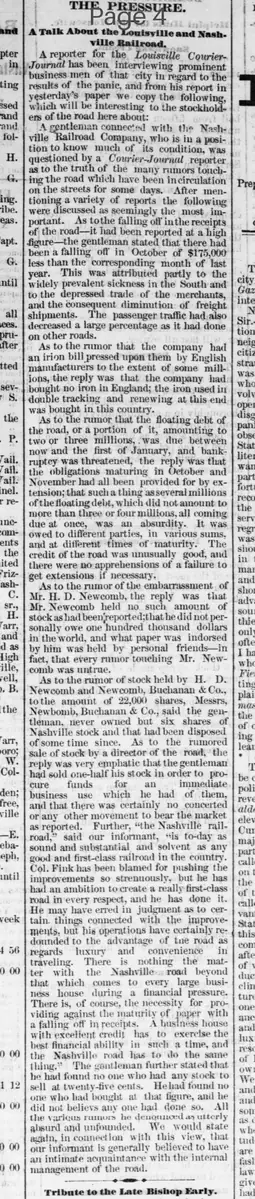
A Talk About the Louisville and Nashville Railroad
A reporter for the Louisville Courier-Journal has been interviewing prominent business men of that city in regard to the results of the panic, and from his report in yesterday's paper we copy the following, which will be interesting to the stockholders of the road here about:
A gentleman connected with the Nashville Railroad Company, who is in a position to know much of its condition, was questioned by a Courier-Journal reporter as to the truth of the many rumors touching the road which have been in circulation on the streets for some days. After mentioning a variety of reports the following were discussed as seemingly the most important. As to the falling off in the receipts of the road—it had been reported at a high figure—the gentleman stated that there had been a falling off in October of $175,000 less than the corresponding month of last year. This was attributed partly to the widely prevalent sickness in the South and to the depressed trade of the merchants, and the consequent diminution of freight shipments. The passenger traffic had also decreased a large percentage as it had done on other roads.
As to the rumor that the company had an iron bill pressed upon them by English manufacturers to the extent of some millions, the reply was that the company had bought no iron in England; the iron used in double tracking and renewing at this end was bought in this country.
As to the rumor that the floating debt of the road, or a portion of it, amounting to two or three millions, was due between now and the first of January, and bankruptcy was threatened, the reply was that the obligations maturing in October and November had all been provided for by extension; that such a thing as several millions of the floating debt, which did not amount to more than three or four millions, all coming due at once, was an absurdity. It was owed to different parties, in various sums, and at different times of maturity. The credit of the road was unusually good, and there were no apprehensions of a failure to get extensions if necessary.
As to the rumor of the embarrassment of Mr. H. D. Newcomb, the reply was that Mr. Newcomb held no such amount of stock as had been reported; that he did not personally owe one hundred thousand dollars in the world, and what paper was indorsed by him was held by personal friends—in fact, that every rumor touching Mr. Newcomb was untrue.
As to the rumor of stock held by H. D. Newcomb and Newcomb, Buchanan & Co., to the amount of 22,000 shares, Messrs. Newcomb, Buchanan & Co., said the gentleman, never owned but six shares of Nashville stock and that had been disposed of some time since. As to the rumored sale of stock by a director of the road, the reply was very emphatic that the gentleman had sold one-half his stock in order to procure funds for an immediate business use which he had of them, and that there was certainly no concerted or any other movement to bear the market as reported. Further, "the Nashville railroad," said our informant, "is to-day as sound and substantial and solvent as any good and first-class railroad in the country. Col. Fink has been blamed for pushing the improvements so strenuously, but he has had an ambition to create a really first-class road in every respect, and he has done it. He may have erred in judgment as to certain things connected with the improvements, but his operations have certainly redounded to the advantage of the road as regards luxury and convenience in traveling. There is nothing the matter with the Nashville road beyond that which comes to every large business house during a financial pressure. There is, of course, the necessity for providing against the maturity of paper with a falling off in receipts. A business house with excellent credit has to exercise the best financial ability in such a time, and the Nashville road has to do the same thing." The gentleman further stated that he had found no one who had any stock to sell at twenty-five cents. He had found no one who had bought at that figure, and he did not believe any one had done so. All the various rumors he denounced as utterly absurd and unfounded. We would state again, in connection with this view, that our informant is generally believed to have an intimate acquaintance with the internal management of the road.
A reporter for the Louisville Courier-Journal has been interviewing prominent business men of that city in regard to the results of the panic, and from his report in yesterday's paper we copy the following, which will be interesting to the stockholders of the road here about:
A gentleman connected with the Nashville Railroad Company, who is in a position to know much of its condition, was questioned by a Courier-Journal reporter as to the truth of the many rumors touching the road which have been in circulation on the streets for some days. After mentioning a variety of reports the following were discussed as seemingly the most important. As to the falling off in the receipts of the road—it had been reported at a high figure—the gentleman stated that there had been a falling off in October of $175,000 less than the corresponding month of last year. This was attributed partly to the widely prevalent sickness in the South and to the depressed trade of the merchants, and the consequent diminution of freight shipments. The passenger traffic had also decreased a large percentage as it had done on other roads.
As to the rumor that the company had an iron bill pressed upon them by English manufacturers to the extent of some millions, the reply was that the company had bought no iron in England; the iron used in double tracking and renewing at this end was bought in this country.
As to the rumor that the floating debt of the road, or a portion of it, amounting to two or three millions, was due between now and the first of January, and bankruptcy was threatened, the reply was that the obligations maturing in October and November had all been provided for by extension; that such a thing as several millions of the floating debt, which did not amount to more than three or four millions, all coming due at once, was an absurdity. It was owed to different parties, in various sums, and at different times of maturity. The credit of the road was unusually good, and there were no apprehensions of a failure to get extensions if necessary.
As to the rumor of the embarrassment of Mr. H. D. Newcomb, the reply was that Mr. Newcomb held no such amount of stock as had been reported; that he did not personally owe one hundred thousand dollars in the world, and what paper was indorsed by him was held by personal friends—in fact, that every rumor touching Mr. Newcomb was untrue.
As to the rumor of stock held by H. D. Newcomb and Newcomb, Buchanan & Co., to the amount of 22,000 shares, Messrs. Newcomb, Buchanan & Co., said the gentleman, never owned but six shares of Nashville stock and that had been disposed of some time since. As to the rumored sale of stock by a director of the road, the reply was very emphatic that the gentleman had sold one-half his stock in order to procure funds for an immediate business use which he had of them, and that there was certainly no concerted or any other movement to bear the market as reported. Further, "the Nashville railroad," said our informant, "is to-day as sound and substantial and solvent as any good and first-class railroad in the country. Col. Fink has been blamed for pushing the improvements so strenuously, but he has had an ambition to create a really first-class road in every respect, and he has done it. He may have erred in judgment as to certain things connected with the improvements, but his operations have certainly redounded to the advantage of the road as regards luxury and convenience in traveling. There is nothing the matter with the Nashville road beyond that which comes to every large business house during a financial pressure. There is, of course, the necessity for providing against the maturity of paper with a falling off in receipts. A business house with excellent credit has to exercise the best financial ability in such a time, and the Nashville road has to do the same thing." The gentleman further stated that he had found no one who had any stock to sell at twenty-five cents. He had found no one who had bought at that figure, and he did not believe any one had done so. All the various rumors he denounced as utterly absurd and unfounded. We would state again, in connection with this view, that our informant is generally believed to have an intimate acquaintance with the internal management of the road.
What sub-type of article is it?
Historical Event
Curiosity
What themes does it cover?
Misfortune
Deception
What keywords are associated?
Railroad Rumors
Financial Panic
Louisville Nashville
Stock Sales
Debt Maturity
Receipts Decline
What entities or persons were involved?
H. D. Newcomb
Col. Fink
Newcomb, Buchanan & Co.
Where did it happen?
Louisville, Nashville
Story Details
Key Persons
H. D. Newcomb
Col. Fink
Newcomb, Buchanan & Co.
Location
Louisville, Nashville
Event Date
October
Story Details
An anonymous insider debunks rumors about the Louisville and Nashville Railroad's financial health during a panic, attributing reduced receipts to sickness and trade depression, denying foreign debts and imminent bankruptcy, and affirming the road's solvency under Col. Fink's improvements.