Thank you for visiting SNEWPapers!
Sign up free
Indiana State Sentinel
Indianapolis, Marion County, Indiana
What is this article about?
Eyewitness account from Buena Vista, Mexico, on March 29, 1847, describing U.S. troop encampment conditions after returning from Agua Nueva on March 10, mail receipt on March 20, arrival of Gen. Lamar and Texans on March 23, and reflections on the Battle of Buena Vista victory, volunteer conduct, and criticisms.
Clipping
OCR Quality
Full Text
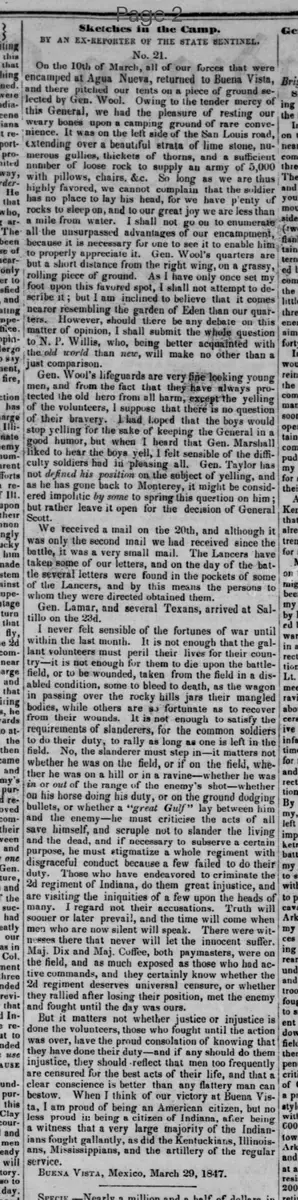
An Eye-Witness of the State Sentinel:
No. 21.
On the 10th of March, all of our forces that were encamped at Agua Nueva, returned to Buena Vista, and there pitched our tents on a piece of ground selected by Gen. Wool. Owing to the tender mercy of this General, we had the pleasure of resting our weary bones upon a camping ground of rare convenience. It was on the left side of the San Louis road, extending over a beautiful strata of lime stone, numerous gullies, thickets of thorns, and a sufficient number of loose rock to supply an army of 5,000 with pillows, chairs, &c. So long as we are thus highly favored, we cannot complain that the soldier has no place to lay his head, for we have plenty of rocks to sleep on, and to our great joy we are less than a mile from water. I shall not go on to enumerate all the unsurpassed advantages of our encampment, because it is necessary for one to see it to enable him to properly appreciate it. Gen. Wool's quarters are but a short distance from the right wing, on a grassy, rolling piece of ground. As I have only once set my foot upon this favored spot, I shall not attempt to describe it; but I am inclined to believe that it comes nearer resembling the garden of Eden than our quarters. However, should there be any debate on this matter of opinion, I shall submit the whole question to N. P. Willis, who, being better acquainted with the old world than new, will make no other than a just comparison.
Gen. Wool's lifeguards are very fine looking young men, and from the fact that they have always protected the old hero from all harm, except the yelling of the volunteers, I suppose that there is no question of their bravery. I had hoped that the boys would stop yelling for the sake of keeping the General in a good humor, but when I heard that Gen. Marshall liked to hear the boys yell, I felt sensible of the difficulty soldiers had in pleasing all. Gen. Taylor has not defined his position on the subject of yelling, and as he has gone back to Monterey, it might be considered impolitic by some to spring this question on him; but rather leave it open for the decision of General Scott.
We received a mail on the 20th, and although it was only the second mail we had received since the battle, it was a very small mail. The Lancers have taken some of our letters, and on the day of the battle several letters were found in the pockets of some of the Lancers, and by this means the persons to whom they were directed obtained them.
Gen. Lamar, and several Texans, arrived at Saltillo on the 23d.
I never felt sensible of the fortunes of war until within the last month. It is not enough that the gallant volunteers must peril their lives for their country—it is not enough for them to die upon the battlefield, or to be wounded, taken from the field in a disabled condition, some to bleed to death, as the wagon in passing over the rocky hills jars their mangled bodies, while others are so fortunate as to recover from their wounds. It is not enough to satisfy the requirements of slanderers, for the common soldiers to do their duty, to rally as long as one is left in the field. No, the slanderer must step in—it matters not whether he was on the field, or if on the field, whether he was on a hill or in a ravine—whether he was in or out of the range of the enemy's shot—whether on his horse doing his duty, or on the ground dodging bullets, or whether a "great Gulf" lay between him and the enemy—he must criticise the acts of all save himself, and scruple not to slander the living and the dead, and if necessary to subserve a certain purpose, he must stigmatize a whole regiment with disgraceful conduct because a few failed to do their duty. Those who have endeavored to criminate the 2d regiment of Indiana, do them great injustice, and are visiting the iniquities of a few upon the heads of many. I regard not their accusations. Truth will sooner or later prevail, and the time will come when men who are now silent will speak. There were witnesses there that never will let the innocent suffer. Maj. Dix and Maj. Coffee, both paymasters, were on the field, and as much exposed as those who had active commands, and they certainly know whether the 2d regiment deserves universal censure, or whether they rallied after losing their position, met the enemy and fought until the day was ours.
But it matters not whether justice or injustice is done the volunteers, those who fought until the action was over, have the proud consolation of knowing that they have done their duty—and if any should do them injustice, they should reflect that men too frequently are censured for the best acts of their life, and that a clear conscience is better than any flattery man can bestow. When I think of our victory at Buena Vista, I am proud of being an American citizen, but no less proud in being a citizen of Indiana, after being a witness that a very large majority of the Indianians fought gallantly, as did the Kentuckians, Illinoisans, Mississippians, and the artillery of the regular service.
Buena Vista, Mexico, March 29, 1847.
What sub-type of article is it?
What keywords are associated?
What entities or persons were involved?
Where did it happen?
Foreign News Details
Primary Location
Buena Vista, Mexico
Event Date
March 10 29, 1847
Key Persons
Outcome
u.s. victory at buena vista; reflections on volunteer conduct and criticisms of the 2d indiana regiment; troops returned to camp with challenging conditions.
Event Details
U.S. forces returned to Buena Vista from Agua Nueva on March 10 and encamped on rough terrain selected by Gen. Wool. Mail received on March 20, small due to captures by Lancers. Gen. Lamar and Texans arrived at Saltillo on March 23. Eyewitness defends volunteers' actions in the battle, praises Indiana, Kentucky, Illinois, Mississippi troops and regulars, criticizes slanderers.