Thank you for visiting SNEWPapers!
Sign up free
Story
May 30, 1856
Saint Croix Union
Stillwater, Washington County, Minnesota
What is this article about?
Promotional description of Stillwater, Minnesota Territory, highlighting its central location, role in lumber trade, future railroads, farming, county seat status, public buildings, churches, abundant springs, and topography as of 1855.
Clipping
OCR Quality
95%
Excellent
Full Text
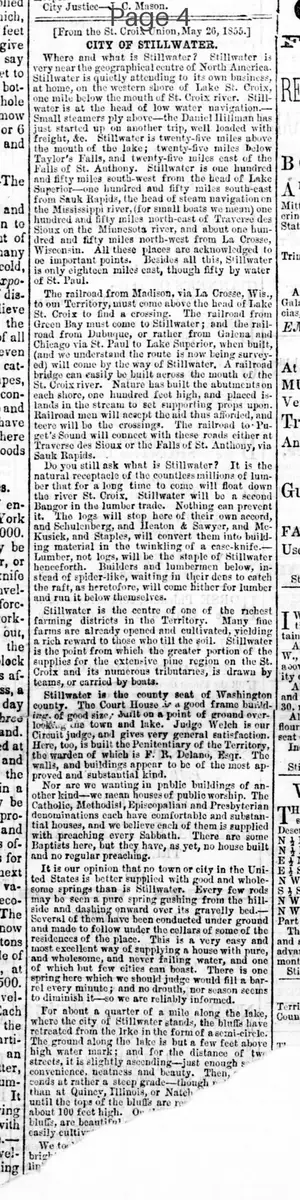
[From the St. Croix Union, May 26, 1855.]
CITY OF STILLWATER.
Where and what is Stillwater? Stillwater is very near the geographical centre of North America. Stillwater is quietly attending to its own business, at home, on the western shore of Lake St. Croix, one mile below the mouth of St. Croix river. Stillwater is at the head of low water navigation.— Small steamers ply above—the Daniel Hillman has just started up on another trip, well loaded with freight, &c. Stillwater is twenty-five miles above the mouth of the lake; twenty-five miles below Taylor's Falls, and twenty-five miles east of the Falls of St. Anthony. Stillwater is one hundred and fifty miles south-west from the head of Lake Superior—one hundred and fifty miles south-east from Sauk Rapids, the head of steam navigation on the Mississippi river, (for small boats we mean) one hundred and fifty miles north-west of Traverse des Sioux on the Minnesota river, and about one hundred and fifty miles north-west from La Crosse, Wisconsin. All these places are acknowledged to be important points. Besides all this, Stillwater is only eighteen miles east, though fifty by water of St. Paul.
The railroad from Madison, via La Crosse, Wis., to our Territory, must come above the head of Lake St. Croix to find a crossing. The railroad from Green Bay must come to Stillwater; and the railroad from Dubuque, or rather from Galena and Chicago via St. Paul to Lake Superior, when built, (and we understand the route is now being surveyed) will come by the way of Stillwater. A railroad bridge can easily be built across the mouth of the St. Croix river. Nature has built the abutments on each shore, one hundred feet high, and placed islands in the stream to set supporting props upon. Railroad men will accept the aid thus afforded, and there will be the crossings. The railroad to Puget's Sound will connect with these roads either at Traverse des Sioux or the Falls of St. Anthony, via Sauk Rapids.
Do you still ask what is Stillwater? It is the natural receptacle of the countless millions of lumber that for a long time to come will float down the river St. Croix, Stillwater will be a second Bangor in the lumber trade. Nothing can prevent it. The logs will stop here of their own accord, and Schulenberg, and Heaton & Sawyer, and McKusick, and Staples, will convert them into building material in the twinkling of an eye-knife.— Lumber, not logs, will be the staple of Stillwater henceforth. Builders and lumbermen below, instead of spider-like, waiting in their dens to catch the raft, as heretofore, will come hither for lumber and run it below themselves.
Stillwater is the centre of one of the richest farming districts in the Territory. Many fine farms are already opened and cultivated, yielding a rich reward to those who till the soil. Stillwater is the point from which the greater portion of the supplies for the extensive pine region on the St. Croix and its numerous tributaries, is drawn by teams, or carried by boats.
Stillwater is the county seat of Washington county. The Court House is a good frame building, of good size, built on a point of ground overlooking the town and lake. Judge Welch is our Circuit judge, and gives very general satisfaction. Here, too, is built the Penitentiary of the Territory, the warden of which is F. R. Delano, Esqr. The walls, and buildings appear to be of the most approved and substantial kind.
Nor are we wanting in public buildings of another kind—we mean houses of public worship. The Catholic, Methodist, Episcopalian and Presbyterian denominations each have comfortable and substantial houses, and we believe each of them is supplied with preaching every Sabbath. There are some Baptists here, but they have, as yet, no house built and no regular preaching.
It is our opinion that no town or city in the United States is better supplied with good and wholesome springs than is Stillwater. Every few rods may be seen a pure spring gushing from the hill-side and dashing onward over its gravelly bed.— Several of them have been conducted under ground and made to follow under the cellars of some of the residences of the place. This is a very easy and most excellent way of supplying a house with pure, and wholesome, and never failing water, and one of which but few cities can boast. There is one spring here which we should judge would fill a barrel every minute; and no drouth, nor season seems to diminish it so we are reliably informed.
For about a quarter of a mile along the lake, where the city of Stillwater stands, the bluffs have retreated from the lake in the form of a semi-circle. The ground along the lake is but a few feet above high water mark; and for the distance of two streets, it is slightly ascending—just enough for convenience, neatness and beauty. Then, it ascends at rather a steep grade—though not so steep as at Quincy, Illinois, or Natchez—until the tops of the bluffs are reached, about 100 feet high. Our bluffs, are beautifully cultivated—
CITY OF STILLWATER.
Where and what is Stillwater? Stillwater is very near the geographical centre of North America. Stillwater is quietly attending to its own business, at home, on the western shore of Lake St. Croix, one mile below the mouth of St. Croix river. Stillwater is at the head of low water navigation.— Small steamers ply above—the Daniel Hillman has just started up on another trip, well loaded with freight, &c. Stillwater is twenty-five miles above the mouth of the lake; twenty-five miles below Taylor's Falls, and twenty-five miles east of the Falls of St. Anthony. Stillwater is one hundred and fifty miles south-west from the head of Lake Superior—one hundred and fifty miles south-east from Sauk Rapids, the head of steam navigation on the Mississippi river, (for small boats we mean) one hundred and fifty miles north-west of Traverse des Sioux on the Minnesota river, and about one hundred and fifty miles north-west from La Crosse, Wisconsin. All these places are acknowledged to be important points. Besides all this, Stillwater is only eighteen miles east, though fifty by water of St. Paul.
The railroad from Madison, via La Crosse, Wis., to our Territory, must come above the head of Lake St. Croix to find a crossing. The railroad from Green Bay must come to Stillwater; and the railroad from Dubuque, or rather from Galena and Chicago via St. Paul to Lake Superior, when built, (and we understand the route is now being surveyed) will come by the way of Stillwater. A railroad bridge can easily be built across the mouth of the St. Croix river. Nature has built the abutments on each shore, one hundred feet high, and placed islands in the stream to set supporting props upon. Railroad men will accept the aid thus afforded, and there will be the crossings. The railroad to Puget's Sound will connect with these roads either at Traverse des Sioux or the Falls of St. Anthony, via Sauk Rapids.
Do you still ask what is Stillwater? It is the natural receptacle of the countless millions of lumber that for a long time to come will float down the river St. Croix, Stillwater will be a second Bangor in the lumber trade. Nothing can prevent it. The logs will stop here of their own accord, and Schulenberg, and Heaton & Sawyer, and McKusick, and Staples, will convert them into building material in the twinkling of an eye-knife.— Lumber, not logs, will be the staple of Stillwater henceforth. Builders and lumbermen below, instead of spider-like, waiting in their dens to catch the raft, as heretofore, will come hither for lumber and run it below themselves.
Stillwater is the centre of one of the richest farming districts in the Territory. Many fine farms are already opened and cultivated, yielding a rich reward to those who till the soil. Stillwater is the point from which the greater portion of the supplies for the extensive pine region on the St. Croix and its numerous tributaries, is drawn by teams, or carried by boats.
Stillwater is the county seat of Washington county. The Court House is a good frame building, of good size, built on a point of ground overlooking the town and lake. Judge Welch is our Circuit judge, and gives very general satisfaction. Here, too, is built the Penitentiary of the Territory, the warden of which is F. R. Delano, Esqr. The walls, and buildings appear to be of the most approved and substantial kind.
Nor are we wanting in public buildings of another kind—we mean houses of public worship. The Catholic, Methodist, Episcopalian and Presbyterian denominations each have comfortable and substantial houses, and we believe each of them is supplied with preaching every Sabbath. There are some Baptists here, but they have, as yet, no house built and no regular preaching.
It is our opinion that no town or city in the United States is better supplied with good and wholesome springs than is Stillwater. Every few rods may be seen a pure spring gushing from the hill-side and dashing onward over its gravelly bed.— Several of them have been conducted under ground and made to follow under the cellars of some of the residences of the place. This is a very easy and most excellent way of supplying a house with pure, and wholesome, and never failing water, and one of which but few cities can boast. There is one spring here which we should judge would fill a barrel every minute; and no drouth, nor season seems to diminish it so we are reliably informed.
For about a quarter of a mile along the lake, where the city of Stillwater stands, the bluffs have retreated from the lake in the form of a semi-circle. The ground along the lake is but a few feet above high water mark; and for the distance of two streets, it is slightly ascending—just enough for convenience, neatness and beauty. Then, it ascends at rather a steep grade—though not so steep as at Quincy, Illinois, or Natchez—until the tops of the bluffs are reached, about 100 feet high. Our bluffs, are beautifully cultivated—
What sub-type of article is it?
Historical Event
Curiosity
What themes does it cover?
Exploration
Triumph
Fortune Reversal
What keywords are associated?
Stillwater
Lake St Croix
Lumber Trade
Railroads
Washington County
Penitentiary
Natural Springs
Farming District
What entities or persons were involved?
Schulenberg
Heaton & Sawyer
Mckusick
Staples
Judge Welch
F. R. Delano
Where did it happen?
Stillwater, Western Shore Of Lake St. Croix, Minnesota Territory
Story Details
Key Persons
Schulenberg
Heaton & Sawyer
Mckusick
Staples
Judge Welch
F. R. Delano
Location
Stillwater, Western Shore Of Lake St. Croix, Minnesota Territory
Event Date
1855
Story Details
Detailed description of Stillwater's strategic location, importance for navigation, future railroad hubs, dominance in lumber trade, rich farming district, role as county seat with courthouse and penitentiary, churches, abundant natural springs, and scenic bluffs.