Thank you for visiting SNEWPapers!
Sign up free
Editorial
September 4, 1908
Eagle River Review
Eagle River, Vilas County, Wisconsin
What is this article about?
An editorial offering moral advice against fretting or worrying, inspired by biblical wisdom from an old grandmother's saying. It warns that excessive worry causes mental and nervous health issues, while encouraging diligent effort without anxiety over uncontrollable outcomes.
Clipping
OCR Quality
98%
Excellent
Full Text
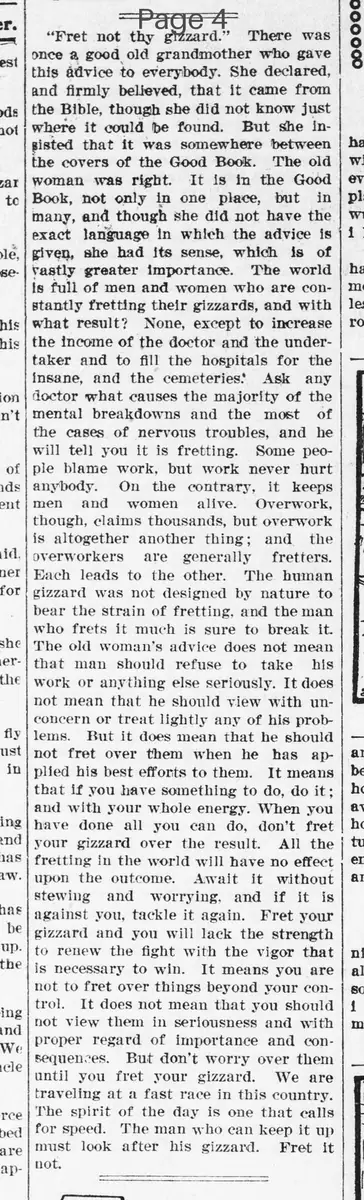
"Fret not thy gizzard." There was once a good old grandmother who gave this advice to everybody. She declared, and firmly believed, that it came from the Bible, though she did not know just where it could be found. But she insisted that it was somewhere between the covers of the Good Book.
The old woman was right. It is in the Good Book, not only in one place, but in many, and though she did not have the exact language in which the advice is given, she had its sense, which is of vastly greater importance.
The world is full of men and women who are constantly fretting their gizzards, and with what result? None, except to increase the income of the doctor and the undertaker and to fill the hospitals for the insane, and the cemeteries. Ask any doctor what causes the majority of the mental breakdowns and the most of the cases of nervous troubles, and he will tell you it is fretting. Some people blame work, but work never hurt anybody. On the contrary, it keeps men and women alive. Overwork, though, claims thousands, but overwork is altogether another thing: and the overworkers are generally fretters. Each leads to the other. The human gizzard was not designed by nature to bear the strain of fretting, and the man who frets it much is sure to break it.
The old woman's advice does not mean that man should refuse to take his work or anything else seriously. It does not mean that he should view with unconcern or treat lightly any of his problems. But it does mean that he should not fret over them when he has applied his best efforts to them. It means that if you have something to do, do it: and with your whole energy. When you have done all you can do, don't fret your gizzard over the result. All the fretting in the world will have no effect upon the outcome. Await it without stewing and worrying, and if it is against you, tackle it again. Fret your gizzard and you will lack the strength to renew the fight with the vigor that is necessary to win.
It means you are not to fret over things beyond your control. It does not mean that you should not view them in seriousness and with proper regard of importance and consequences. But don't worry over them until you fret your gizzard.
We are traveling at a fast race in this country. The spirit of the day is one that calls for speed. The man who can keep it up must look after his gizzard. Fret it not.
The old woman was right. It is in the Good Book, not only in one place, but in many, and though she did not have the exact language in which the advice is given, she had its sense, which is of vastly greater importance.
The world is full of men and women who are constantly fretting their gizzards, and with what result? None, except to increase the income of the doctor and the undertaker and to fill the hospitals for the insane, and the cemeteries. Ask any doctor what causes the majority of the mental breakdowns and the most of the cases of nervous troubles, and he will tell you it is fretting. Some people blame work, but work never hurt anybody. On the contrary, it keeps men and women alive. Overwork, though, claims thousands, but overwork is altogether another thing: and the overworkers are generally fretters. Each leads to the other. The human gizzard was not designed by nature to bear the strain of fretting, and the man who frets it much is sure to break it.
The old woman's advice does not mean that man should refuse to take his work or anything else seriously. It does not mean that he should view with unconcern or treat lightly any of his problems. But it does mean that he should not fret over them when he has applied his best efforts to them. It means that if you have something to do, do it: and with your whole energy. When you have done all you can do, don't fret your gizzard over the result. All the fretting in the world will have no effect upon the outcome. Await it without stewing and worrying, and if it is against you, tackle it again. Fret your gizzard and you will lack the strength to renew the fight with the vigor that is necessary to win.
It means you are not to fret over things beyond your control. It does not mean that you should not view them in seriousness and with proper regard of importance and consequences. But don't worry over them until you fret your gizzard.
We are traveling at a fast race in this country. The spirit of the day is one that calls for speed. The man who can keep it up must look after his gizzard. Fret it not.
What sub-type of article is it?
Moral Or Religious
What keywords are associated?
Fretting
Worry
Gizzard
Bible Advice
Mental Health
Overwork
Editorial Details
Primary Topic
Advice Against Fretting And Worrying
Stance / Tone
Advisory And Exhortative
Key Arguments
Fretting Causes Mental Breakdowns, Nervous Troubles, And Increases Doctors' And Undertakers' Incomes
Work Is Beneficial, But Overwork Often Stems From Fretting
The Human Body Is Not Designed To Endure Fretting
Apply Best Efforts To Problems Without Fretting Over Results
Fretting Over Uncontrollable Things Weakens One's Ability To Fight
In A Fast Paced Society, One Must Protect Against Fretting