Thank you for visiting SNEWPapers!
Sign up free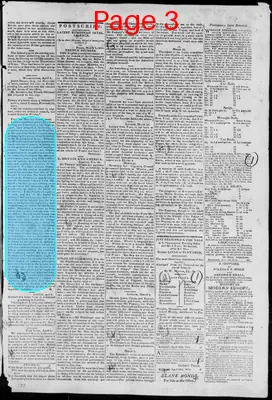
Editorial
April 15, 1811
Virginia Argus
Richmond, Virginia
What is this article about?
An editorial defends President Madison's constitutional removal of Secretary of State Robert Smith, criticizing republican newspapers for assuming improper motives without evidence, arguing the change strengthens administration unity amid differing opinions.
Clipping
OCR Quality
98%
Excellent
Full Text
From the National Intelligencer.
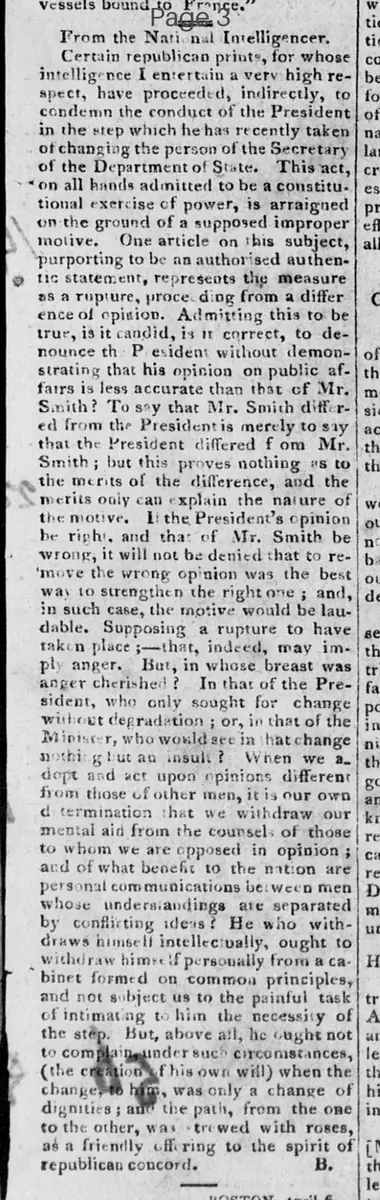
Certain republican prints, for whose intelligence I entertain a very high respect, have proceeded, indirectly, to condemn the conduct of the President in the step which he has recently taken of changing the person of the Secretary of the Department of State. This act, on all hands admitted to be a constitutional exercise of power, is arraigned on the ground of a supposed improper motive. One article on this subject, purporting to be an authorised authentic statement, represents the measure as a rupture, proceeding from a difference of opinion. Admitting this to be true, is it candid, is it correct, to denounce the President without demonstrating that his opinion on public affairs is less accurate than that of Mr. Smith? To say that Mr. Smith differed from the President is merely to say that the President differed from Mr. Smith; but this proves nothing as to the merits of the difference, and the merits only can explain the nature of the motive. If the President's opinion be right, and that of Mr. Smith be wrong, it will not be denied that to remove the wrong opinion was the best way to strengthen the right one; and, in such case, the motive would be laudable. Supposing a rupture to have taken place;—that, indeed, may imply anger. But, in whose breast was anger cherished? In that of the President, who only sought for change without degradation: or, in that of the Minister, who would see in that change nothing but an insult? When we adopt and act upon opinions different from those of other men, it is our own determination that we withdraw our mental aid from the counsel of those to whom we are opposed in opinion; and of what benefit to the nation are personal communications between men whose understandings are separated by conflicting ideas? He who withdraws himself intellectually, ought to withdraw himself personally from a cabinet formed on common principles, and not subject us to the painful task of intimating to him the necessity of the step. But, above all, he ought not to complain under such circumstances, (the creation of his own will) when the change, to him, was only a change of dignities; and the path, from the one to the other, was strewed with roses, as a friendly offering to the spirit of republican concord.
B.
Certain republican prints, for whose intelligence I entertain a very high respect, have proceeded, indirectly, to condemn the conduct of the President in the step which he has recently taken of changing the person of the Secretary of the Department of State. This act, on all hands admitted to be a constitutional exercise of power, is arraigned on the ground of a supposed improper motive. One article on this subject, purporting to be an authorised authentic statement, represents the measure as a rupture, proceeding from a difference of opinion. Admitting this to be true, is it candid, is it correct, to denounce the President without demonstrating that his opinion on public affairs is less accurate than that of Mr. Smith? To say that Mr. Smith differed from the President is merely to say that the President differed from Mr. Smith; but this proves nothing as to the merits of the difference, and the merits only can explain the nature of the motive. If the President's opinion be right, and that of Mr. Smith be wrong, it will not be denied that to remove the wrong opinion was the best way to strengthen the right one; and, in such case, the motive would be laudable. Supposing a rupture to have taken place;—that, indeed, may imply anger. But, in whose breast was anger cherished? In that of the President, who only sought for change without degradation: or, in that of the Minister, who would see in that change nothing but an insult? When we adopt and act upon opinions different from those of other men, it is our own determination that we withdraw our mental aid from the counsel of those to whom we are opposed in opinion; and of what benefit to the nation are personal communications between men whose understandings are separated by conflicting ideas? He who withdraws himself intellectually, ought to withdraw himself personally from a cabinet formed on common principles, and not subject us to the painful task of intimating to him the necessity of the step. But, above all, he ought not to complain under such circumstances, (the creation of his own will) when the change, to him, was only a change of dignities; and the path, from the one to the other, was strewed with roses, as a friendly offering to the spirit of republican concord.
B.
What sub-type of article is it?
Partisan Politics
Constitutional
What keywords are associated?
Cabinet Change
Secretary Of State
Presidential Power
Political Differences
Republican Criticism
What entities or persons were involved?
President
Mr. Smith
Republican Prints
Editorial Details
Primary Topic
Defense Of Presidential Cabinet Change
Stance / Tone
Supportive Of President Against Critics
Key Figures
President
Mr. Smith
Republican Prints
Key Arguments
Removal Is A Constitutional Exercise Of Power
Critics Assume Improper Motives Without Proving President's Opinion Wrong
Difference Of Opinion Justifies Change To Strengthen Administration
Secretary Should Withdraw If Opinions Conflict, Not Complain