Thank you for visiting SNEWPapers!
Sign up free
Story
April 11, 1955
Trainman News
Indianapolis, Marion County, Indiana
What is this article about?
A Federal Department of Labor study of 411 large Canadian companies shows over half have pension plans, up from 8% in 1936. Most are contributory, with variations in contributions, benefits, and retirement flexibility. Report highlights progress but calls for improvements in uniformity and portability.
Clipping
OCR Quality
98%
Excellent
Full Text
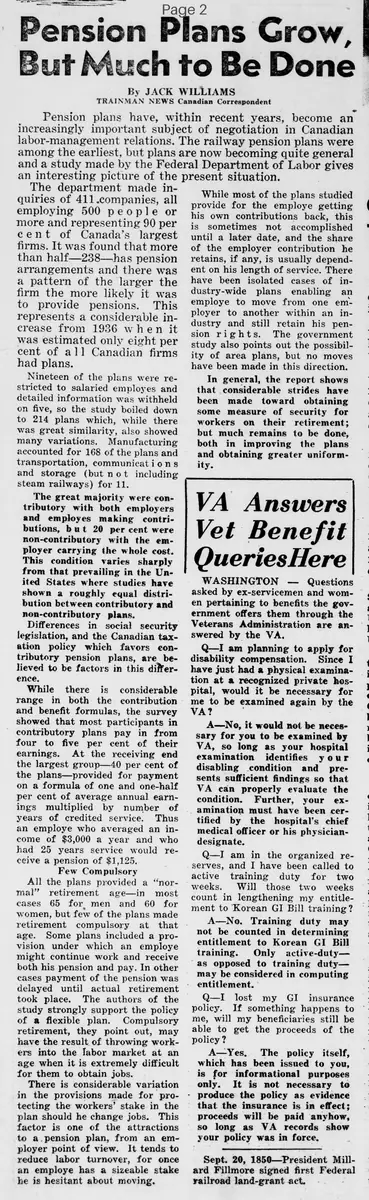
Pension Plans
Grow,
But Much to Be Done
By JACK WILLIAMS
TRAINMAN NEWS Canadian Correspondent
Pension plans have, within recent years, become an increasingly important subject of negotiation in Canadian labor-management relations. The railway pension plans were among the earliest, but plans are now becoming quite general and a study made by the Federal Department of Labor gives an interesting picture of the present situation.
The department made inquiries of 411 companies, all employing 500 people or more and representing 90 per cent of Canada's largest firms. It was found that more than half—238—has pension arrangements and there was a pattern of the larger the firm the more likely it was to provide pensions. This represents a considerable increase from 1936 when it was estimated only eight per cent of all Canadian firms had plans.
Nineteen of the plans were restricted to salaried employees and detailed information was withheld on five, so the study boiled down to 214 plans which, while there was great similarity, also showed many variations. Manufacturing accounted for 168 of the plans and transportation, communications and storage (but not including steam railways) for 11.
The great majority were contributory with both employers and employees making contributions, but 20 per cent were non-contributory with the employer carrying the whole cost. This condition varies sharply from that prevailing in the United States where studies have shown a roughly equal distribution between contributory and non-contributory plans.
Differences in social security legislation and the Canadian taxation policy which favors contributory pension plans, are believed to be factors in this difference.
While there is considerable range in both the contribution and benefit formulas, the survey showed that most participants in contributory plans pay in from four to five per cent of their earnings. At the receiving end the largest group—40 per cent of the plans—provided for payment on a formula of one and one-half per cent of average annual earnings multiplied by number of years of credited service. Thus an employee who averaged an income of $3,000 a year and who had 25 years service would receive a pension of $1,125.
Few Compulsory
All the plans provided a "normal" retirement age—in most cases 65 for men and 60 for women, but few of the plans made retirement compulsory at that age. Some plans included a provision under which an employee might continue work and receive both his pension and pay. In other cases payment of the pension was delayed until actual retirement took place. The authors of the study strongly support the policy of a flexible plan. Compulsory retirement, they point out, may have the result of throwing workers into the labor market at an age when it is extremely difficult for them to obtain jobs.
There is considerable variation in the provisions made for protecting the workers' stake in the plan should he change jobs. This factor is one of the attractions to a pension plan, from an employer point of view. It tends to reduce labor turnover, for once an employee has a sizeable stake he is hesitant about moving.
While most of the plans studied provide for the employee getting his own contributions back, this is sometimes not accomplished until a later date, and the share of the employer contribution he retains, if any, is usually dependent on his length of service. There have been isolated cases of industry-wide plans enabling an employee to move from one employer to another within an industry and still retain his pension rights. The government study also points out the possibility of area plans, but no moves have been made in this direction.
In general, the report shows that considerable strides have been made toward obtaining some measure of security for workers on their retirement; but much remains to be done, both in improving the plans and obtaining greater uniformity.
Grow,
But Much to Be Done
By JACK WILLIAMS
TRAINMAN NEWS Canadian Correspondent
Pension plans have, within recent years, become an increasingly important subject of negotiation in Canadian labor-management relations. The railway pension plans were among the earliest, but plans are now becoming quite general and a study made by the Federal Department of Labor gives an interesting picture of the present situation.
The department made inquiries of 411 companies, all employing 500 people or more and representing 90 per cent of Canada's largest firms. It was found that more than half—238—has pension arrangements and there was a pattern of the larger the firm the more likely it was to provide pensions. This represents a considerable increase from 1936 when it was estimated only eight per cent of all Canadian firms had plans.
Nineteen of the plans were restricted to salaried employees and detailed information was withheld on five, so the study boiled down to 214 plans which, while there was great similarity, also showed many variations. Manufacturing accounted for 168 of the plans and transportation, communications and storage (but not including steam railways) for 11.
The great majority were contributory with both employers and employees making contributions, but 20 per cent were non-contributory with the employer carrying the whole cost. This condition varies sharply from that prevailing in the United States where studies have shown a roughly equal distribution between contributory and non-contributory plans.
Differences in social security legislation and the Canadian taxation policy which favors contributory pension plans, are believed to be factors in this difference.
While there is considerable range in both the contribution and benefit formulas, the survey showed that most participants in contributory plans pay in from four to five per cent of their earnings. At the receiving end the largest group—40 per cent of the plans—provided for payment on a formula of one and one-half per cent of average annual earnings multiplied by number of years of credited service. Thus an employee who averaged an income of $3,000 a year and who had 25 years service would receive a pension of $1,125.
Few Compulsory
All the plans provided a "normal" retirement age—in most cases 65 for men and 60 for women, but few of the plans made retirement compulsory at that age. Some plans included a provision under which an employee might continue work and receive both his pension and pay. In other cases payment of the pension was delayed until actual retirement took place. The authors of the study strongly support the policy of a flexible plan. Compulsory retirement, they point out, may have the result of throwing workers into the labor market at an age when it is extremely difficult for them to obtain jobs.
There is considerable variation in the provisions made for protecting the workers' stake in the plan should he change jobs. This factor is one of the attractions to a pension plan, from an employer point of view. It tends to reduce labor turnover, for once an employee has a sizeable stake he is hesitant about moving.
While most of the plans studied provide for the employee getting his own contributions back, this is sometimes not accomplished until a later date, and the share of the employer contribution he retains, if any, is usually dependent on his length of service. There have been isolated cases of industry-wide plans enabling an employee to move from one employer to another within an industry and still retain his pension rights. The government study also points out the possibility of area plans, but no moves have been made in this direction.
In general, the report shows that considerable strides have been made toward obtaining some measure of security for workers on their retirement; but much remains to be done, both in improving the plans and obtaining greater uniformity.
What sub-type of article is it?
Labor Report
Economic Survey
What keywords are associated?
Pension Plans
Canadian Labor
Federal Study
Contributory Plans
Retirement Age
Labor Turnover
What entities or persons were involved?
Jack Williams
Where did it happen?
Canada
Story Details
Key Persons
Jack Williams
Location
Canada
Event Date
Recent Years, Compared To 1936
Story Details
Federal Department of Labor study of 411 large companies finds 238 have pension plans, mostly contributory, with details on contributions, benefits, retirement ages, and portability issues. Highlights growth from 1936 and differences from US plans.