Thank you for visiting SNEWPapers!
Sign up free
The Camas Hot Springs Exchange
Hot Springs, Camas, Sanders County, Montana
What is this article about?
Historical account of Castle, Montana, a silver mining boomtown founded in 1887 that peaked with 2,000 residents before declining due to silver demonetization in the 1890s. Details prospecting, infrastructure, railroads, freighting, and anecdotes from the era, now a ghost town.
Clipping
OCR Quality
Full Text
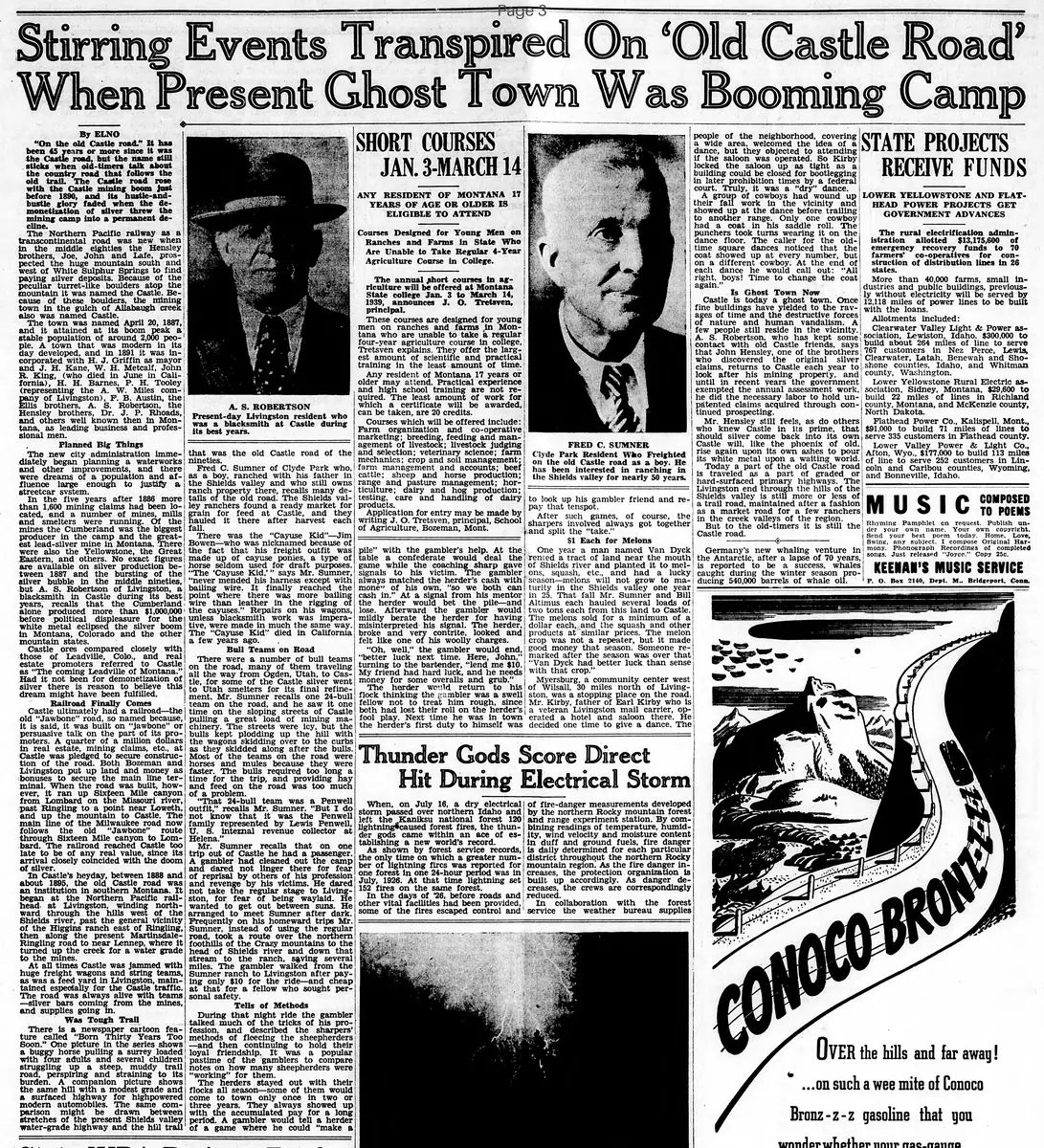
"On the old Castle road." It has been 45 years or more since it was the Castle road, but the name still sticks when old-timers talk about the country road that follows the old trail. The Castle road rose with the Castle mining boom just before 1890, and its hustle-and-bustle glory faded when the demonetization of silver threw the mining camp into a permanent decline.
The Northern Pacific railway as a transcontinental road was new when in the middle eighties the Hensley brothers, Joe, John and Lafe, prospected the huge mountain south and west of White Sulphur Springs to find paying silver deposits. Because of the peculiar turret-like boulders atop the mountain it was named the Castle. Because of these boulders, the mining town in the gulch of Allabaugh creek also was named Castle.
The town was named April 20, 1887, and it attained at its boom peak a stable population of around 2,000 people. A town that was modern in its day developed, and in 1891 it was incorporated with H. J. Griffin as mayor and J. H. Kane, W. H. Metcalf, John R. King (who died in June in California), H. H. Barnes, P. H. Tooley (representing the A. W. Miles company of Livingston), F. B. Austin, the Ellis brothers, A. S. Robertson, the Hensley brothers, Dr. J. P. Rhoads, and others well known then in Montana, as leading business and professional men.
Planned Big Things
The new city administration immediately began planning a waterworks and other improvements, and there were dreams of a population and affluence large enough to justify a streetcar system.
In the five years after 1886 more than 1,600 mining claims had been located, and a number of mines, mills and smelters were running. Of the mines the Cumberland was the biggest producer in the camp and the greatest lead-silver mine in Montana. There were also the Yellowstone, the Great Eastern, and others. No exact figures are available on silver production between 1887 and the bursting of the silver bubble in the middle nineties, but A. S. Robertson of Livingston, a blacksmith in Castle during its best years, recalls that the Cumberland alone produced more than $1,000,000 before political displeasure for the white metal eclipsed the silver boom in Montana, Colorado and the other mountain states.
Castle ores compared closely with those of Leadville, Colo., and real estate promoters referred to Castle as "The coming Leadville of Montana."
Had it not been for demonetization of silver there is reason to believe this dream might have been fulfilled.
Railroad Finally Comes
Castle ultimately had a railroad--the old "Jawbone" road, so named because, it is said, it was built on "jawbone" or persuasive talk on the part of its promoters. A quarter of a million dollars in real estate, mining claims, etc., at Castle was pledged to secure construction of the road. Both Bozeman and Livingston put up land and money as bonuses to secure the main line terminal. When the road was built, however, it ran up Sixteen Mile canyon from Lombard on the Missouri river, past Ringling to a point near Loweth, and up the mountain to Castle. The main line of the Milwaukee road now follows the old "Jawbone" route through Sixteen Mile canyon to Lombard. The railroad reached Castle too late to be of any real value, since its arrival closely coincided with the doom of silver.
In Castle's heyday, between 1888 and about 1895, the old Castle road was an institution in southern Montana. It began at the Northern Pacific railhead, at Livingston, winding northward through the hills west of the Shields river, past the general vicinity of the Higgins ranch east of Ringling, then along the present Martinsdale-Ringling road to near Lennep, where it turned up the creek for a water grade to the mines.
At all times Castle was jammed with huge freight wagons and string teams, as was a feed yard in Livingston, maintained especially for the Castle traffic. The road was always alive with teams--silver bars coming from the mines, and supplies going in.
Was Tough Trail
There is a newspaper cartoon feature called "Born Thirty Years Too Soon." One picture in the series shows a buggy horse pulling a surrey loaded with four adults and several children struggling up a steep, muddy trail road, perspiring and straining to its burden. A companion picture shows the same hill with a modest grade and a surfaced highway for highpowered modern automobiles. The same comparison might be drawn between stretches of the present Shields valley water-grade highway and the hill trail that was the old Castle road of the nineties.
Fred C. Sumner of Clyde Park who, as a boy, ranched with his father in the Shields valley and who still owns ranch property there, recalls many details of the old road. The Shields valley ranchers found a ready market for grain for feed at Castle, and they hauled it there after harvest each fall.
There was the "Cayuse Kid"--Jim Bowen--who was nicknamed because of the fact that his freight outfit was made up of cayuse ponies, a type of horse seldom used for draft purposes. "The 'Cayuse Kid,'" says Mr. Sumner, "never mended his harness except with bailing wire. It finally reached the point where there was more bailing wire than leather in the rigging of the cayuses." Repairs on his wagons, unless blacksmith work was imperative, were made in much the same way. The "Cayuse Kid" died in California a few years ago.
Bull Teams on Road
There were a number of bull teams on the road, many of them traveling all the way from Ogden, Utah, to Castle, for some of the Castle silver went to Utah smelters for its final refinement. Mr. Sumner recalls one 24-bull team on the road, and he saw it one time on the sloping streets of Castle pulling a great load of mining machinery. The streets were icy, but the bulls kept plodding up the hill with the wagons skidding over to the curbs as they skidded along after the bulls.
Most of the teams on the road were horses and mules because they were faster. The bulls required too long a time for the trip, and providing hay and feed on the road was too much of a problem.
"That 24-bull team was a Penwell outfit," recalls Mr. Sumner. "But I do not know that it was the Penwell family represented by Lewis Penwell, U. S. internal revenue collector at Helena."
Mr. Sumner recalls that on one trip out of Castle he had a passenger. A gambler had cleaned out the camp and dared not linger there for fear of reprisal by others of his profession and revenge by his victims. He dared not take the regular stage to Livingston, for fear of being waylaid. He wanted to get out between suns. He arranged to meet Sumner after dark. Frequently on his homeward trips Mr. Sumner, instead of using the regular road, took a route over the northern foothills of the Crazy mountains to the head of Shields river and down that stream to the ranch, saving several miles. The gambler walked from the Sumner ranch to Livingston after paying only $10 for the ride and cheap at that for a fellow who sought personal safety.
Tells of Methods
During that night ride the gambler talked much of the tricks of his profession, and described the sharpers' methods of fleecing the sheepherders--and then continuing to hold their loyal friendship. It was a popular pastime of the gamblers to compare notes on how many sheepherders were "working" for them.
The herders stayed out with their flocks all season--some of them would come to town only once in two or three years. They always showed up with the accumulated pay for a long period. A gambler would tell a herder of a game where he could "make a killing." The herder would be introduced to a sucker game with a confederate dealing and another sharp coaching him. The gambler would build up a pile with the gambler's help. At the table a confederate would deal the game while the coaching sharp gave signals to his victim. The gambler always matched the herder's cash with money of his own, "so we both can cash in." At a signal from his mentor the herder would bet the pile and lose. Afterward the gambler would mildly berate the herder for having misinterpreted his signal. The herder, broke and very contrite, looked and felt like one of his woolly charges.
"Oh, well," the gambler would end, turning to the bartender. "Lend me $10. My friend had hard luck, and he needs money for some overalls and grub."
The herder would return to his flock thinking the gambler was a swell fellow not to treat him rough, since both had lost their roll on the herder's fool play. Next time he was in town the herder's first duty to himself was to look up his gambler friend and repay that tenspot.
After such games, of course, the sharpers involved always got together and split the "take."
$1 Each for Melons
One year a man named Van Dyck rented a tract of land near the mouth of Shields river and planted it to melons, squash, etc., and had a lucky season--melons will not grow to maturity in the Shields valley one year in 25. That fall Mr. Sumner and Bill Altimus each hauled several loads of two tons each from this land to Castle. The melons sold for a minimum of a dollar each, and the squash and other products at similar prices. The melon crop was not a repeater, but it made good money that season. Someone remarked after the season was over that "Van Dyck had better luck than sense with that crop."
Meyersburg, a community center west of Wilsall, 30 miles north of Livingston, was a stopping place on the road. Mr. Kirby, father of Earl Kirby who is a veteran Livingston mail carrier, operated a hotel and saloon there. He decided one time to give a dance. The people of the neighborhood, covering a wide area, welcomed the idea of a dance, but they objected to attending if the saloon was operated. So Kirby locked the saloon up as tight as a building could be closed for bootlegging in later prohibition times by a federal court. Truly, it was a "dry" dance.
A group of cowboys had wound up their fall work in the vicinity and showed up at the dance before trailing to another range. Only one cowboy had a coat in his saddle roll. The punchers took turns wearing it on the dance floor. The caller for the old-time square dances noticed that the coat showed up at every number, but on a different cowboy. At the end of each dance he would call out: "All right, boys! Time to change the coat again."
Is Ghost Town Now
Castle is today a ghost town. Once fine buildings have yielded to the ravages of time and the destructive forces of nature and human vandalism. A few people still reside in the vicinity. A. S. Robertson, who has kept some contact with old Castle friends, says that John Hensley, one of the brothers who discovered the original silver claims, returns to Castle each year to look after his mining property, and until in recent years the government exempted the annual assessment work, he did the necessary labor to hold unpatented claims acquired through continued prospecting.
Mr. Hensley still feels, as do others who knew Castle in its prime, that should silver come back into its own Castle will, like the phoenix of old, rise again upon its own ashes to pour its white metal upon a waiting world.
Today a part of the old Castle road is traveled as a part of graded or hard-surfaced primary highways. The Livingston end through the hills of the Shields valley is still more or less of a trail road, maintained after a fashion as a market road for a few ranchers in the creek valleys of the region. But to the old-timers it is still the Castle road.
What sub-type of article is it?
What themes does it cover?
What keywords are associated?
What entities or persons were involved?
Where did it happen?
Story Details
Key Persons
Location
Castle, Montana
Event Date
1887 1895
Story Details
The Hensley brothers discovered silver deposits near White Sulphur Springs in the 1880s, leading to the founding of Castle town in 1887, which boomed to 2,000 residents with mines like Cumberland producing over $1M in silver. Incorporated in 1891, it planned modern improvements but declined after silver demonetization in the 1890s. Anecdotes include freighting on Castle road, gamblers' tricks, and local events; now a ghost town with hopes of revival.