Thank you for visiting SNEWPapers!
Sign up free
Story
July 14, 1932
Atlanta Daily World
Atlanta, Fulton County, Georgia
What is this article about?
In Des Moines, a group of boxers and wrestlers at Tommy Ryan's fight club is approached by carnival owner T.I. Cash to take over his athletic show after troubles with authorities. The narrator, despite reservations, pursues the deal, leading to the loss of their earnings and bankroll.
Clipping
OCR Quality
98%
Excellent
Full Text
Funny Fights
By CARL BECKWITH
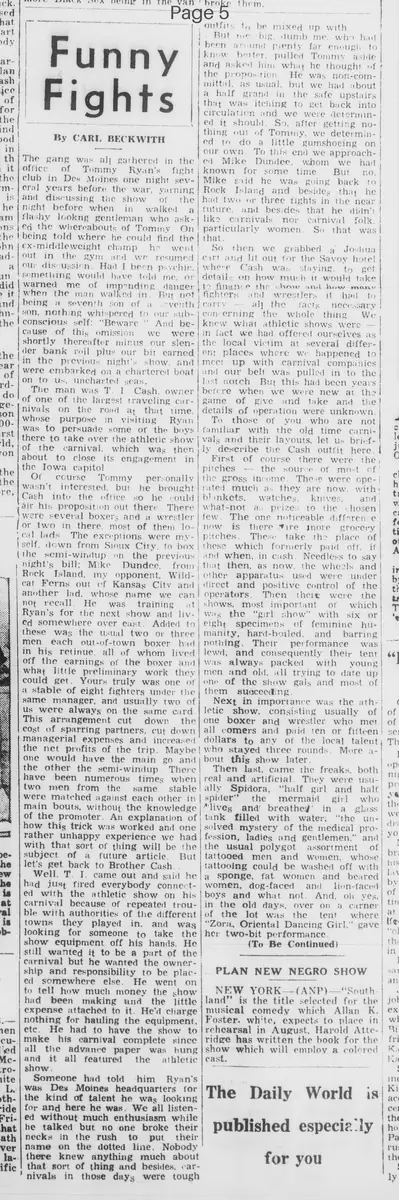
The gang was all gathered in the office of Tommy Ryan's fight club in Des Moines one night several years before the war, yarning and discussing the show of the night before when in walked a flashy looking gentleman who asked the whereabouts of Tommy. On being told where he could find the ex-middleweight champ he went out in the gym and we resumed our discussion. Had I been psychic, something would have told me, or warned me of impending danger when the man walked in. But not being a seventh son of a seventh son, nothing whispered to our subconscious self: "Beware." And because of this omission we were shortly thereafter minus our slender bank roll plus our bit earned in the previous night's show, and were embarked on a chartered boat on to us, uncharted seas.
The man was T. I. Cash, owner of one of the largest traveling carnivals on the road at that time, whose purpose in visiting Ryan was to persuade some of the boys there to take over the athletic show of the carnival, which was then about to close its engagement in the Iowa capitol.
Of course Tommy personally wasn't interested, but he brought Cash into the office so he could air his proposition out there. There were several boxers and a wrestler or two in there, most of them local lads. The exceptions were myself, down from Sioux City, to box the semi-windup on the previous night's bill; Mike Dundee, from Rock Island, my opponent, Wildcat Ferns out of Kansas City and another lad, whose name we cannot recall. He was training at Ryan's for the next show and lived somewhere over east. Added to these was the usual two or three men each out-of-town boxer had in his retinue, all of whom lived off the earnings of the boxer and what little preliminary work they could get. Yours truly was one of a stable of eight fighters under the same manager, and usually two of us were always on the same card. This arrangement cut down the cost of sparring partners, cut down managerial expenses and increased the net profits of the trip. Maybe! one would have the main go and the other the semi-windup. There have been numerous times when two men from the same stable were matched against each other in main bouts, without the knowledge of the promoter. An explanation of how this trick was worked and one rather unhappy experience we had with that sort of thing will be the subject of a future article. But let's get back to Brother Cash.
Well, T. I. came out and said he had just fired everybody connected with the athletic show on his carnival because of repeated trouble with authorities of the different towns they played in, and was looking for someone to take the show equipment off his hands. He still wanted it to be a part of the carnival but he wanted the ownership and responsibility to be placed somewhere else. He went on to tell how much money the show had been making and the little expense attached to it. He'd charge nothing for hauling the equipment, etc. He had to have the show to make his carnival complete since all the advance paper was hung and it all featured the athletic show.
Someone had told him Ryan's was Des Moines headquarters for the kind of talent he was looking for and here he was. We all listened without much enthusiasm while he talked but no one broke their necks in the rush to put their name on the dotted line. Nobody there knew anything much about that sort of thing and besides, carnivals in those days were tough.
But me big dumb me who had been around plenty far enough, to know better, pulled Tommy aside and asked him what he thought of the proposition. He was non-committal, as usual, but we had about a half grand in the safe upstairs that was itching to get back into circulation and we were determined it should. So, after getting nothing out of Tommy, we determined to do a little gumshoeing on our own. To this end we approached Mike Dundee, whom we had known for some time. But no. Mike said he was going back to Rock Island and besides that he had two or three fights in the near future, and besides that he didn't like carnivals nor carnival folk particularly women. So that was that.
So then we grabbed a Joshua cab and lit out for the Savoy hotel where Cash was staying to get detail on how much it would take to finance the show and how many fighters and wrestlers it had to carry - all the facts necessary concerning the whole thing. We knew what athletic shows were - in fact we had offered ourselves as the local victim at several different places where we happened to meet up with carnival companies and our belt was pulled in to the last notch. But this had been years before when we were new at the game of give and take and the details of operation were unknown.
To those of you who are not familiar with the old time carnivals and their layouts, let us briefly describe the Cash outfit here. First of course there were the pitches - the source of most of the gross income. These were operated much as they are now, with blankets, watches, knives, and what-not as prize to the chosen few. The one noticeable difference now is there are more grocery pitches. These take the place of those which formerly paid off, if and when, in cash. Needless to say that then, as now, the wheels and other apparatus used were under direct and positive control of the operators. Then there were the shows, most important of which was the "girl show" with six or eight specimens of feminine humanity, hard-boiled, and barring nothing. Their performance was lewd, and consequently their tent was always packed with young men and old, all trying to date up one of the show gals and most of them succeeding.
Next in importance was the athletic show, consisting usually of one boxer and wrestler who met all comers and paid ten or fifteen dollars to any of the local talent who stayed three rounds. More about this show later.
Then last, came the freaks, both real and artificial. They were usually Spidora, "half girl and half spider" the mermaid girl who "lives and breathes" in a glass tank filled with water, "the unsolved mystery of the medical profession, ladies and gentlemen." and the usual polyglot assortment of tattooed men and women, whose tattooing could be washed off with a sponge, fat women and bearded women, dog-faced and lion-faced boys and what not. And, oh yes, in the old days, over on a corner of the lot was the tent where "Zora, Oriental Dancing Girl," gave her two-bit performance.
(To Be Continued)
By CARL BECKWITH
The gang was all gathered in the office of Tommy Ryan's fight club in Des Moines one night several years before the war, yarning and discussing the show of the night before when in walked a flashy looking gentleman who asked the whereabouts of Tommy. On being told where he could find the ex-middleweight champ he went out in the gym and we resumed our discussion. Had I been psychic, something would have told me, or warned me of impending danger when the man walked in. But not being a seventh son of a seventh son, nothing whispered to our subconscious self: "Beware." And because of this omission we were shortly thereafter minus our slender bank roll plus our bit earned in the previous night's show, and were embarked on a chartered boat on to us, uncharted seas.
The man was T. I. Cash, owner of one of the largest traveling carnivals on the road at that time, whose purpose in visiting Ryan was to persuade some of the boys there to take over the athletic show of the carnival, which was then about to close its engagement in the Iowa capitol.
Of course Tommy personally wasn't interested, but he brought Cash into the office so he could air his proposition out there. There were several boxers and a wrestler or two in there, most of them local lads. The exceptions were myself, down from Sioux City, to box the semi-windup on the previous night's bill; Mike Dundee, from Rock Island, my opponent, Wildcat Ferns out of Kansas City and another lad, whose name we cannot recall. He was training at Ryan's for the next show and lived somewhere over east. Added to these was the usual two or three men each out-of-town boxer had in his retinue, all of whom lived off the earnings of the boxer and what little preliminary work they could get. Yours truly was one of a stable of eight fighters under the same manager, and usually two of us were always on the same card. This arrangement cut down the cost of sparring partners, cut down managerial expenses and increased the net profits of the trip. Maybe! one would have the main go and the other the semi-windup. There have been numerous times when two men from the same stable were matched against each other in main bouts, without the knowledge of the promoter. An explanation of how this trick was worked and one rather unhappy experience we had with that sort of thing will be the subject of a future article. But let's get back to Brother Cash.
Well, T. I. came out and said he had just fired everybody connected with the athletic show on his carnival because of repeated trouble with authorities of the different towns they played in, and was looking for someone to take the show equipment off his hands. He still wanted it to be a part of the carnival but he wanted the ownership and responsibility to be placed somewhere else. He went on to tell how much money the show had been making and the little expense attached to it. He'd charge nothing for hauling the equipment, etc. He had to have the show to make his carnival complete since all the advance paper was hung and it all featured the athletic show.
Someone had told him Ryan's was Des Moines headquarters for the kind of talent he was looking for and here he was. We all listened without much enthusiasm while he talked but no one broke their necks in the rush to put their name on the dotted line. Nobody there knew anything much about that sort of thing and besides, carnivals in those days were tough.
But me big dumb me who had been around plenty far enough, to know better, pulled Tommy aside and asked him what he thought of the proposition. He was non-committal, as usual, but we had about a half grand in the safe upstairs that was itching to get back into circulation and we were determined it should. So, after getting nothing out of Tommy, we determined to do a little gumshoeing on our own. To this end we approached Mike Dundee, whom we had known for some time. But no. Mike said he was going back to Rock Island and besides that he had two or three fights in the near future, and besides that he didn't like carnivals nor carnival folk particularly women. So that was that.
So then we grabbed a Joshua cab and lit out for the Savoy hotel where Cash was staying to get detail on how much it would take to finance the show and how many fighters and wrestlers it had to carry - all the facts necessary concerning the whole thing. We knew what athletic shows were - in fact we had offered ourselves as the local victim at several different places where we happened to meet up with carnival companies and our belt was pulled in to the last notch. But this had been years before when we were new at the game of give and take and the details of operation were unknown.
To those of you who are not familiar with the old time carnivals and their layouts, let us briefly describe the Cash outfit here. First of course there were the pitches - the source of most of the gross income. These were operated much as they are now, with blankets, watches, knives, and what-not as prize to the chosen few. The one noticeable difference now is there are more grocery pitches. These take the place of those which formerly paid off, if and when, in cash. Needless to say that then, as now, the wheels and other apparatus used were under direct and positive control of the operators. Then there were the shows, most important of which was the "girl show" with six or eight specimens of feminine humanity, hard-boiled, and barring nothing. Their performance was lewd, and consequently their tent was always packed with young men and old, all trying to date up one of the show gals and most of them succeeding.
Next in importance was the athletic show, consisting usually of one boxer and wrestler who met all comers and paid ten or fifteen dollars to any of the local talent who stayed three rounds. More about this show later.
Then last, came the freaks, both real and artificial. They were usually Spidora, "half girl and half spider" the mermaid girl who "lives and breathes" in a glass tank filled with water, "the unsolved mystery of the medical profession, ladies and gentlemen." and the usual polyglot assortment of tattooed men and women, whose tattooing could be washed off with a sponge, fat women and bearded women, dog-faced and lion-faced boys and what not. And, oh yes, in the old days, over on a corner of the lot was the tent where "Zora, Oriental Dancing Girl," gave her two-bit performance.
(To Be Continued)
What sub-type of article is it?
Biography
Curiosity
What themes does it cover?
Deception
Misfortune
What keywords are associated?
Carnival
Boxing
Athletic Show
Des Moines
Scam
Fight Club
What entities or persons were involved?
Tommy Ryan
T. I. Cash
Carl Beckwith
Mike Dundee
Wildcat Ferns
Where did it happen?
Des Moines, Iowa
Story Details
Key Persons
Tommy Ryan
T. I. Cash
Carl Beckwith
Mike Dundee
Wildcat Ferns
Location
Des Moines, Iowa
Event Date
Several Years Before The War
Story Details
A group of fighters at Tommy Ryan's club in Des Moines is approached by T.I. Cash to take over his carnival's athletic show. The narrator pursues the proposition despite doubts, leading to the loss of their bankroll and earnings as they venture into unknown territory.