Thank you for visiting SNEWPapers!
Sign up free
Editorial
June 14, 1814
Alexandria Gazette, Commercial And Political
Alexandria, Virginia
What is this article about?
Editorial from the Connecticut Courant critiques the US government's instability, likening it to children's caprices, quoting Federalist No. 62 by Alexander Hamilton on mutable laws' harms to liberty, business, and morality, arguing it fosters speculation akin to gambling.
Clipping
OCR Quality
95%
Excellent
Full Text
:0:
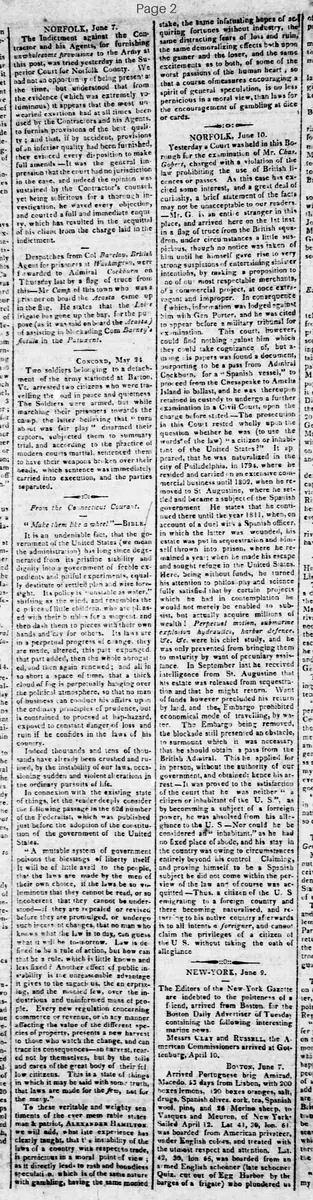
From the Connecticut Courant.
"Make them like a wheel" -Bible.
It is an undeniable fact, that the government of the United States (we mean the administration) has long since degenerated from its pristine stability and dignity into a government of feeble expedients and pitiful experiments, equally destitute of settled plan and wise foresight. Its policy is "unstable as water," shifting as the wind, and resembles the capices of little children, who are pleased with their bubbles for a moment, and then dash them to pieces with their own hands and cry for others. Its laws are in a perpetual progress of change, they are made, altered, this part expunged, that part added, then the whole abrogated, and then again renewed; and all in so short a space of time, that a thick cloud of fog is perpetually hanging over the political atmosphere, so that no man of business can conduct his affairs upon the ordinary principles of prudence, but is constrained to proceed at hap-hazard, exposed to constant danger of loss and ruin if he confides in the laws of his country.
Indeed thousands and tens of thousands have already been crushed and ruined, by the instability of our laws, occasioning sudden and violent alterations in the ordinary pursuits of life.
In connexion with the existing state of things, let the reader deeply consider the following passage in the 62d number of the Federalist, which was published just before the adoption of the constitution of the government of the United States.
"A mutable system of government poisons the blessings of liberty itself. It will be of little avail to the people, that the laws are made by the men of their own choice, if the laws be so voluminous that they cannot be read, or so incoherent that they cannot be understood; if they are repealed or revised before they are promulgated, or undergo such incessant changes, that no man who knows what the law is to-day, can guess what it will be to-morrow. Law is defined to be a rule of action, but how can that be a rule, which is little known and less fixed? Another effect of public instability is the unreasonable advantage it gives to the sagacious, the enterprising, and the moneyed few, over the industrious and uninformed mass of the people. Every new regulation concerning commerce or revenue, or in any manner affecting the value of the different species of property, presents a new harvest to those who watch the change, and can trace its consequences—an harvest, reaped not by themselves, but by the toils and cares of the great body of their fellow citizens. This is a state of things in which it may be said with some truth, that laws are made for the few, not for the many."
To these veritable and weighty sentiments of the ever memorable statesman & patriot, Alexander Hamilton, we will add, that late experience has clearly taught, that the instability of the laws of a country with respect to trade, is pernicious in a moral point of view; as it directly leads to rash and boundless speculation, which is of the same nature with gambling, having the same money stake, the same infatuating hopes of acquiring fortunes without industry, the same distracting cares of loss and ruin, the same demoralizing effects both upon the gamer and the loser, and the same excitements as to both, of some of the worst passions of the human heart; so that a course of measures encouraging a spirit of general speculation, is no less pernicious in a moral view, than laws for the encouragement of gambling at dice or cards.
From the Connecticut Courant.
"Make them like a wheel" -Bible.
It is an undeniable fact, that the government of the United States (we mean the administration) has long since degenerated from its pristine stability and dignity into a government of feeble expedients and pitiful experiments, equally destitute of settled plan and wise foresight. Its policy is "unstable as water," shifting as the wind, and resembles the capices of little children, who are pleased with their bubbles for a moment, and then dash them to pieces with their own hands and cry for others. Its laws are in a perpetual progress of change, they are made, altered, this part expunged, that part added, then the whole abrogated, and then again renewed; and all in so short a space of time, that a thick cloud of fog is perpetually hanging over the political atmosphere, so that no man of business can conduct his affairs upon the ordinary principles of prudence, but is constrained to proceed at hap-hazard, exposed to constant danger of loss and ruin if he confides in the laws of his country.
Indeed thousands and tens of thousands have already been crushed and ruined, by the instability of our laws, occasioning sudden and violent alterations in the ordinary pursuits of life.
In connexion with the existing state of things, let the reader deeply consider the following passage in the 62d number of the Federalist, which was published just before the adoption of the constitution of the government of the United States.
"A mutable system of government poisons the blessings of liberty itself. It will be of little avail to the people, that the laws are made by the men of their own choice, if the laws be so voluminous that they cannot be read, or so incoherent that they cannot be understood; if they are repealed or revised before they are promulgated, or undergo such incessant changes, that no man who knows what the law is to-day, can guess what it will be to-morrow. Law is defined to be a rule of action, but how can that be a rule, which is little known and less fixed? Another effect of public instability is the unreasonable advantage it gives to the sagacious, the enterprising, and the moneyed few, over the industrious and uninformed mass of the people. Every new regulation concerning commerce or revenue, or in any manner affecting the value of the different species of property, presents a new harvest to those who watch the change, and can trace its consequences—an harvest, reaped not by themselves, but by the toils and cares of the great body of their fellow citizens. This is a state of things in which it may be said with some truth, that laws are made for the few, not for the many."
To these veritable and weighty sentiments of the ever memorable statesman & patriot, Alexander Hamilton, we will add, that late experience has clearly taught, that the instability of the laws of a country with respect to trade, is pernicious in a moral point of view; as it directly leads to rash and boundless speculation, which is of the same nature with gambling, having the same money stake, the same infatuating hopes of acquiring fortunes without industry, the same distracting cares of loss and ruin, the same demoralizing effects both upon the gamer and the loser, and the same excitements as to both, of some of the worst passions of the human heart; so that a course of measures encouraging a spirit of general speculation, is no less pernicious in a moral view, than laws for the encouragement of gambling at dice or cards.
What sub-type of article is it?
Constitutional
Economic Policy
Moral Or Religious
What keywords are associated?
Government Instability
Mutable Laws
Economic Uncertainty
Moral Speculation
Federalist Hamilton
Trade Policy
Political Fog
What entities or persons were involved?
Government Of The United States
Alexander Hamilton
Federalist No. 62
Editorial Details
Primary Topic
Instability Of Us Government Laws And Policies
Stance / Tone
Strongly Critical Of Governmental Mutability
Key Figures
Government Of The United States
Alexander Hamilton
Federalist No. 62
Key Arguments
Government Degenerated Into Feeble Expedients And Unstable Policies
Laws Perpetually Changed, Creating Uncertainty For Business
Instability Has Ruined Thousands Through Sudden Alterations
Mutable Laws Poison Liberty And Favor The Moneyed Few Over The Masses
Instability In Trade Laws Leads To Speculation Akin To Gambling
Such Speculation Is Morally Pernicious, Exciting Worst Passions