Thank you for visiting SNEWPapers!
Sign up free
Mexico Missouri Message
Mexico, Audrain County, Missouri
What is this article about?
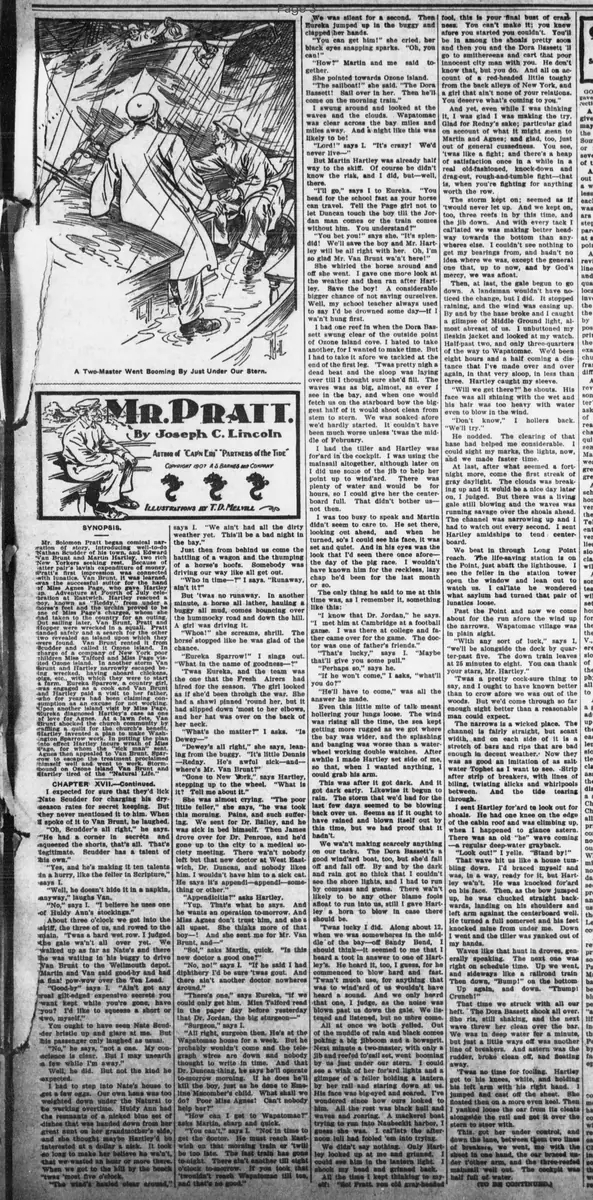
In this chapter continuation, narrator Sol Pratt recounts a stormy night where Martin Hartley and he sail across the bay in the Dora Bassett to fetch Dr. Jordan for sick child Reddy, diagnosed with appendicitis. They endure gales, encounter another vessel, and the boat wrecks on shoals, losing the rudder but reaching Wapatomac amid rising water.
Merged-components note: The images on page 3 with reading_order -1 are illustrations for the serial literary story, as indicated by spatial proximity and context; merging them preserves the complete narrative component.
Clipping
OCR Quality
Full Text
Mr. Solomon Pratt began comical narration of story, introducing well-to-do Nathan Scudder of his town, and Edward Van Brunt and Martin Hartley, two rich New Yorkers seeking rest. Because of latter pair's lavish expenditure of money, Pratt's first impression was connected with lunatics. Van Brunt, it was learned, was the successful suitor for the hand of Miss Agnes Page, who gave Hartley up. Adventure at Fourth of July celebration at Pastwich. Hartley rescued a boy, known as "Reddy," from under a horse's feet and the urchin proved to be one of Miss Page's charges, whom she had taken to the country for an outing. Out sailing later, Van Brunt, Pratt and Hopper were wrecked in a squall. Pratt landed safely and a search for the other two revealed an island upon which they were found. Van Brunt rented it from Scudder and called it Ozone Island. In charge of a company of New York poor children Miss Talford and Miss Page visited Ozone island. In another storm Van Brunt and Hartley narrowly escaped being wrecked, having aboard chickens, pigs, etc., with which they were to start a farm. Eureka Sparrow, a country girl, was engaged as a cook and Van Brunt and Hartley paid a visit to her father, who for years had been claiming consumption as an excuse for not working. Upon another island visit by Miss Page, Eureka diagnosed Hartley's case as one of love for Agnes. At a lawn fete, Van Brunt shocked the church community by gambling in guilt for the church's benefit. Hartley invented a plan to make Washington Sparrow work. In putting the plan into effect Hartley incurs wrath of Miss Page, for whom the "sick man" sent. Agnes then appealed to Van Brunt. Sparrow to escape the treatment proclaimed himself well and went to work. Storm-bound on Ozone Island Van Brunt and Hartley tired of the "Natural" Life.
CHAPTER XVII.-Continued.
I expected for sure that they'd lick Nate Scudder for charging his dry-season rates for secret keeping. But they never mentioned it to him. When I spoke of it to Van Brunt, he laughed.
"Oh, Scudder's all right," he says. "He had a corner in secrets and squeezed the shorts, that's all. That's legitimate. Scudder has a talent of his own."
"Yes, and he's making it ten talents in a hurry, like the feller in Scripture," says I.
"Well, he doesn't hide it in a napkin, anyway," laughs Van.
"No," says I. "I believe he uses one of Huldy Ann's stockings."
About three o'clock we got into the skiff, the three of us, and rowed to the mainland. 'Twas a hard wet row. I judged the gale wa'n't all over yet. We walked up as far as Nate's and there he was waiting in his buggy to drive Van Brunt to the Wellmouth depot. Martin and Van said good-by and had a fine pow-wow over the Tea Lead.
"Good-by" says I. "Ain't got any more gilt-edged expensive secrets you want kept while you're gone, have you? I'd like to squeeze a short or two, myself."
You ought to have seen Nate Scudder bristle up and glare at me. But his passenger only laughed as usual.
"No," he says, "not a one. My conscience is clear. But I may unearth a few while I'm away."
Well, he did. But not the kind he expected.
I had to step into Nate's house to get a few eggs. Our own hens was too weighted down under the Natural to be working overtime. Huldy Ann had the remnants of a nicked blue set of dishes that was handed down from her great aunt on her grandmother's side, and she thought maybe Hartley'd be interested at a dollar a nick. It took so long to make her believe he wa'n't, that we wasted an hour or more there. When we got to the hill by the beach 'twas most five o'clock.
"The wind's hauled closer 'round."
the bay.'
Just then from behind us come the rattling of a wagon and the thumping of a horse's hoofs. Somebody was driving our way like all get out.
"Who in time-?" I says. "Runaway, ain't it?"
But 'twas no runaway. In another minute, a horse all lather, hauling a buggy all mud, comes bouncing over the hummocky road and down the hill. A girl was driving it.
"Whoa!" she screams, shrill. The horse stopped like he was glad of the chance.
"Eureka Sparrow!" I sings out.
"What in the name of goodness-?"
'Twas Eureka, and the team was the one that the Fresh Airers had hired for the season. The girl looked as if she'd been through the war. She had a shawl pinned 'round her, but it had slipped down 'most to her elbows, and her hat was over on the back of her neck.
"What's the matter?" I asks. "Is Dewey—"
"Dewey's all right," she says, leaning from the buggy. "It's little Dennis—Reddy. He's awful sick—and—where's Mr. Van Brunt?"
"Gone to New York," says Hartley, stepping up to the wheel. "What is it? Tell me about it."
She was almost crying.
"The poor little feller," she says, "he was took this morning. Pains, and such suffering. We sent for Dr. Bailey, and he was sick in bed himself. Then James drove over for Dr. Penrose, and he'd gone up to the city to a medical society meeting. There wa'n't nobody left but that new doctor at West Eastwich, Dr. Duncan, and nobody likes him. I wouldn't have him to a sick cat. He says it's appendi—appendi—something or other."
"Appendicitis?" asks Hartley.
"Yup. That's what he says. And he wants an operation to-morrow. And Miss Agnes don't trust him, and she's all upset. She thinks more of that boy—! And she sent me for Mr. Van Brunt, and—"
"Sol," asks Martin, quick. "Is this new doctor a good one?"
"No, no!" says I. "If he said I had diphthery I'd be sure 'twas gout. And there ain't another doctor nowheres around."
"There's one," says Eureka, "if we could only get him. Miss Talford read in the paper day before yesterday that Dr. Jordan, the big sturgeon—"
"Surgeon," says I.
"All right, surgeon then. He's at the Wapatomac house for a week. But he probably wouldn't come and the telegraph wires are down and nobody thought to write in time. And that Dr. Duncan thing, he says he'll operate to-morrow morning. If he does he'll kill the boy, just as he done to Emoline Macomber's child. What shall we do? Poor Miss Agnes! Can't nobody help her?"
"How can I get to Wapatomac?" asks Martin, sharp and quick.
"You can't," says I. "Not in time to get the doctor. He must reach Eastwich on that morning train or 'twill be too late. The last train has gone to-night. There ain't another till eight o'clock to-morrow. If you took that 'twouldn't reach Wapatomac till ten, and that's no good."
We was silent for a second. Then Eureka jumped up in the buggy and clapped her hands.
"You can get him!" she cried, her black eyes snapping sparks. "Oh, you can!"
"How?" Martin and me said together. She pointed towards Ozone island.
"The sailboat!" she said. "The Dora Bassett! Sail over in her. Then he'll come on the morning train."
I swung around and looked at the waves and the clouds. Wapatomac was clear across the bay miles and miles away. And a night like this was likely to be!
"Lord!" says I. "It's crazy! We'd never live—"
But Martin Hartley was already half way to the skiff. Of course he didn't know the risk, and I did, but—well, there.
"I'll go," says I to Eureka. "You head for the school fast as your horse can travel. Tell the Page girl not to let Duncan touch the boy till the Jordan man comes or the train comes without him. You understand?"
"You bet you!" says she, "It's splendid! We'll save the boy and Mr. Hartley will be all right with her. Oh, I'm so glad Mr. Van Brunt wa'n't here!"
She whirled the horse around and off she went. I gave one more look at the weather and then ran after Hartley. Save the boy! A considerable bigger chance of not saving ourselves. Well, my school teacher always used to say I'd be drowned some day—if I wa'n't hung first.
I had one reef in when the Dora Bassett swung clear of the outside point of Ozone Island cove. I hated to take another, for I wanted to make time. But I had to take it before we tackled at the end of the first leg. 'Twas pretty nigh a dead beat and the sloop was laying over till I thought sure she'd fill. The waves was as big, almost, as ever I see in the bay, and when one would fetch us on the starboard bow the biggest half of it would shoot clean from stem to stern. We was soaked afore we'd hardly started. It couldn't have been much worse unless 'twas the middle of February.
I had the tiller and Hartley was for'ard in the cockpit. I was using the mainsail altogether, although later on I did use some of the jib to help her point up to wind'ard. There was plenty of water and would be for hours, so I could give her the centerboard full. That didn't bother us—not then.
I was too busy to speak and Martin didn't seem to care to. He set there, looking out ahead, and when he turned, so's I could see his face, it was set and quiet. And in his eyes was the look that I'd seen there once afore—the day of the pig race. I wouldn't have known him for the reckless, lazy chap he'd been for the last month or so.
The only thing he said to me at this time was, as I remember it, something like this:
"I know that Dr. Jordan," he says. "I met him at Cambridge at a football game. I was there at college and father came over for the game. The doctor was one of father's friends."
"That's lucky," says I. "Maybe that'll give you some pull."
"Perhaps so," says he.
"If he won't come," I asks, "what'll you do?"
"He'll have to come." was all the answer he made.
Even this little mite of talk meant hollering your lungs loose. The wind was rising all the time, the sea kept getting more rugged as we got where the bay was wider, and the splashing and banging was worse than a water-wheel working double watches. After awhile I made Hartley set side of me, so that, when I wanted anything, I could grab his arm.
This was after it got dark. And it got dark early. Likewise it begun to rain. The storm that we'd had for the last few days seemed to be blowing back over us. Seems as if it ought to have rained and blown itself out by this time, but we had proof that it hadn't.
We wa'n't making scarcely anything on our tacks. The Dora Bassett's a good wind'ard boat, too, but she'd fall off and fall off. By and by the dark and rain got so thick that I couldn't see the shore lights, and I had to run by compass and guess. There wa'n't likely to be any other blame fools afloat to run into us, still I gave Hartley a horn to blow in case there should be.
'Twas lucky I did. Along about 12, when we was somewheres in the middle of the bay—off Sandy Bend, I should think—it seemed to me that I heard a toot in answer to one of Hartley's. He heard it, too, I guess, for he commenced to blow hard and fast.
'Twa'n't much use, for anything that was to wind'ard of us wouldn't have heard a sound. And we only heard that one, I judge, as the noise was blown past us down the gale. We listened and listened, but no more come.
All at once we both yelled. Out of the muddle of rain and black comes poking a big jibboom and a bowsprit. Next minute a two-master, with only a jib and reefed fo'sail set, went booming by us just under our stern. I could see a wink of her for'ard lights and a glimpse of a feller holding a lantern by her rail and staring down at us. His face was big-eyed and scared. I've wondered since how ours looked to him. All the rest was black hull and waves and roaring. A mackerel boat trying to run into Nauset harbor, I guess she was. I cal'late the afternoon lull had fooled 'em into trying.
We didn't say nothing. Only Hartley looked up at me and grinned. I could see his in the lantern light. I shook my head and grinned back.
All the time I kept thinking to myself: "Sol Pratt, you old gray-headed fool, this is your final bust of craziness. You can't make it; you knew afore you started you couldn't. You'll be in among the shoals pretty soon and then you and the Dora Bassett'll go to smithereens and cart that poor innocent city man with you. He don't know that, but you do. And all on account of a red-headed little toughy from the back alleys of New York, and a girl that ain't none of your relations. You deserve what's coming to you."
And yet, even while I was thinking it, I was glad I was making the try. Glad for Reddy's sake; particular glad on account of what it might mean to Martin and Agnes; and glad, too, just out of general cussedness. You see, 'twas like a fight: and there's a heap of satisfaction once in a while in a real old-fashioned, knock-down and drag-out, rough-and-tumble fight—that is, when you're fighting for anything worth the row.
The storm kept on; seemed as if 'twould never let up. And we kept on, too, three reefs in by this time, and the jib down. And with every tack I cal'culated we was making better headway towards the bottom than anywhere else. I couldn't see nothing to get my bearings from, and hadn't no idea where we was, except the general one that, up to now, and by God's mercy, we was afloat.
Then, at last, the gale begun to go down. A landsman wouldn't have noticed the change, but I did. It stopped raining, and the wind was easing up. By and by the haze broke and I caught a glimpse of Middle Ground light, almost abreast of us. I unbuttoned my oilskin jacket and looked at my watch. Half-past two, and only three-quarters of the way to Wapatomac. We'd been eight hours and a half coming a distance that I've made over and over again, in that very sloop, in less than three. Hartley caught my sleeve.
"Will we get there?" he shouts. His face was all shining with the wet and his hair was too heavy with water even to blow in the wind.
"Don't know," I hollers back. "We'll try."
He nodded. The clearing of that haze had helped me considerable. I could sight my marks, the lights, now, and we made faster time.
At last, after what seemed a fortnight more, come the first streak of gray daylight. The clouds was breaking up and it would be a nice day later on, I judged. But there was a living gale still blowing and the waves was running savage over the shoals ahead. The channel was narrowing up and I had to watch out every second. I sent Hartley amidships to tend centerboard.
We beat in through Long Point reach. The life-saving station is on the Point, just abaft the lighthouse. I see the feller in the station tower open the window and lean out to watch us. I cal'late he wondered what asylum had turned that pair of lunatics loose.
Past the Point and now we come about for the run afore the wind up the narrows. Wapatomac village was in plain sight.
"With any sort of luck," says I, "we'll be alongside the dock by quarter-past five. The down train leaves at 25 minutes to eight. You can thank your stars, Mr. Hartley."
'Twas a pretty cock-sure thing to say, and I ought to have known better than to crow afore we was out of the woods. But we'd come through so far enough sight better than a reasonable man could expect.
The narrows is a wicked place. The channel is fairly straight, but scant width, and on each side of it is a stretch of bars and rips that are bad enough in decent weather. Now they was as good an imitation of salt water Tophet as I want to see—strip after strip of breakers, with lines of boiling, twisting slicks and whirlpools between. And the tide tearing through.
I sent Hartley for'ard to look out for shoals. He had one knee on the edge of the cabin roof and was climbing up, when I happened to glance astern. There was an old "he" wave coming—a regular deep-water grayback.
"Look out!" I yells. "Stand by!"
That wave hit us like a house tumbling down. I'd braced myself and was, in a way, ready for it, but Hartley wa'n't. He was knocked for'ard on his face. Then, as the bow jumped up, he was chucked straight backwards, landing on his shoulders and left arm against the centerboard well. He turned a full somerset and his feet knocked mine from under me. Down I went and the tiller was yanked out of my hands.
Waves like that hunt in droves, generally speaking. The next one was right on schedule time. Up we went, and sideways like a railroad train. Then down, "Bump!" on the bottom. Up again, and down. "Thump! Crunch!"
That time we struck with all our heft. The Dora Bassett shook all over. She riz, still shaking, and the next wave threw her clean over the bar. We was in deep water for a minute, but just a little ways off was another line of breakers. And astern was the rudder, broke clean off, and floating away.
'Twas no time for fooling. Hartley got to his knees, white, and holding his left arm with his right hand. I jumped and cast off the sheet. She floated then on a more even keel. Then I yanked loose the oar from its cleats alongside the rail and got it over the stern to steer with.
This got her under control, and down the lane, between them two lines of breakers, we went, me with the sheet in one hand, the oar braced under t'other arm, and the three-reefed mainsail well out. The cockpit was half full of water.
What sub-type of article is it?
What themes does it cover?
What keywords are associated?
Literary Details
Title
Chapter Xvii. Continued.
Form / Style
First Person Narrative Adventure
Key Lines