Thank you for visiting SNEWPapers!
Sign up free
Richmond Enquirer
Richmond, Richmond County, Virginia
What is this article about?
Creed Taylor's farewell address to Law School members praises their abilities and the institution's practical training, urges selfless patriotism and divine protection. Members reply gratefully, endorsing the school's merits and committing to public service. (248 characters)
Clipping
OCR Quality
Full Text
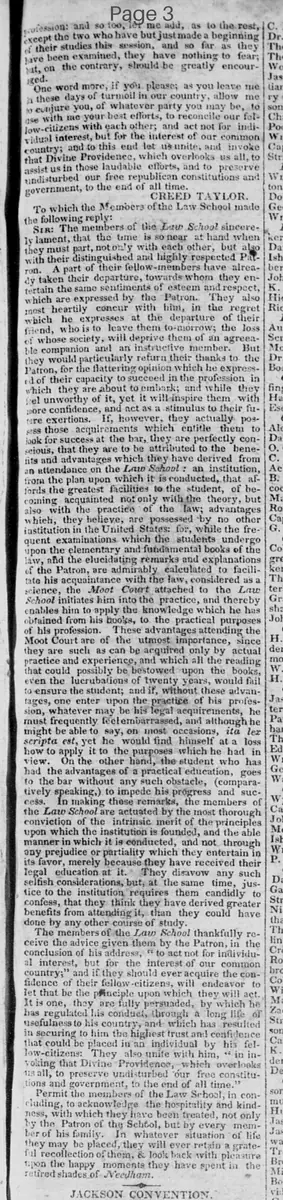
except the two who have but just made beginning of their studies this session, and so far as they have been examined, they have nothing to fear; but, on the contrary, should be greatly encouraged.
One word more, if you please; as you leave me ask with me your best efforts, to reconcile our fellow-citizens with each other; and act not for individual interest, but for the interest of our common country; and to this end let us unite, and invoke that Divine Providence, which overlooks us all, to assist us in those laudable efforts, and to preserve undisturbed our free republican constitutions and government, to the end of all time.
CREED TAYLOR.
To which the Members of the Law School made the following reply:
Sir: The members of the Law School sincerely lament, that the time is so near at hand when they must part, not only with each other, but also with their distinguished and highly respected Patron. A part of their fellow-members have already taken their departure, towards whom they entertain the same sentiments of esteem and respect, which are expressed by the Patron. They also most heartily concur with him, in the regret which he expresses at the departure of their friend, who is to leave them to-morrow; the loss of whose society, will deprive them of an agreeable companion and an instructive member. But they would particularly return their thanks to the Patron, for the flattering opinion which he expressed of their capacity to succeed in the profession in which they are about to embark; and while they feel unworthy of it, yet it will inspire them with more confidence, and act as a stimulus to their future exertions. If, however, they actually possess those acquirements which entitle them to look for success at the bar, they are perfectly conscious, that they are to be attributed to the benefits and advantages which they have derived from an attendance on the Law School: an institution, from the plan upon which it is conducted, that affords the greatest facilities to the student, of becoming acquainted not only with the theory, but also with the practice of the Law; advantages which, they believe, are possessed by no other institution in the United States: or, while the frequent examinations which the students undergo upon the elementary and fundamental books of the law, and the elucidating remarks and explanations of the Patron, are admirably calculated to facilitate his acquaintance with the law, considered as a science, the Moot Court attached to the Law School initiates him into the practice, and thereby enables him to apply the knowledge which he has obtained from his books, to the practical purposes of his profession. These advantages attending the Moot Court are of the utmost importance, since they are such as can be acquired only by actual practice and experience, and which all the reading that could possibly be bestowed upon the books, even the lucubrations of twenty years, would fail to ensure the student; and if, without these advantages, one enter upon the practice of his profession, whatever may be his legal acquirements, he must frequently feel embarrassed, and although he might be able to say, on most occasions, ita lex scripta est, yet he would find himself at a loss how to apply it to the purposes which he had in view. On the other hand, the student who has had the advantages of a practical education, goes to the bar without any such obstacle, (comparatively speaking,) to impede his progress and success. In making these remarks, the members of the Law School are actuated by the most thorough conviction of the intrinsic merit of the principles upon which the institution is founded, and the able manner in which it is conducted, and not through any prejudice or partiality which they entertain in its favor, merely because they have received their legal education at it. They disavow any such selfish considerations, but, at the same time, justice to the institution requires them candidly to confess, that they think they have derived greater benefits from attending it, than they could have done by any other course of study.
The members of the Law School thankfully receive the advice given them by the Patron, in the conclusion of his address, "to act not for individual interest, but for the interest of our common country;" and if they should ever acquire the confidence of their fellow-citizens, will endeavor to let that be the principle upon which they will act. It is one, they are fully persuaded, by which he has regulated his conduct, through a long life of usefulness to his country, and which has resulted in securing to him the highest trust and confidence that could be placed in an individual by his fellow-citizens: They also unite with him, "in invoking that Divine Providence, which overlooks us all, to preserve undisturbed our free constitutions and government, to the end of all time."
Permit the members of the Law School, in concluding, to acknowledge the hospitality and kindness, with which they have been treated, not only by the Patron of the School, but by every member of his family. In whatever situation of life they may be placed, they will ever retain a grateful recollection of them, & look back with pleasure upon the happy moments they have spent in the retired shades of Needham.
What sub-type of article is it?
What themes does it cover?
What keywords are associated?
What entities or persons were involved?
Where did it happen?
Story Details
Key Persons
Location
Needham
Story Details
Creed Taylor delivers an encouraging address to departing Law School members, praising their progress and the institution's value, urging national unity and divine aid. The members reply with thanks, affirming the school's superior practical and theoretical training via Moot Court, committing to patriotic principles, and expressing gratitude for hospitality.