Thank you for visiting SNEWPapers!
Sign up free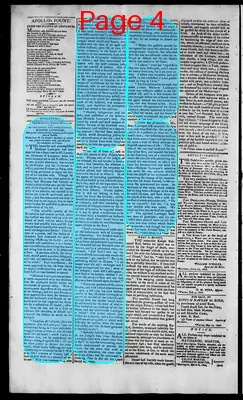
Literary
September 13, 1806
Herald Of The United States
Warren, Bristol County, Rhode Island
What is this article about?
Biographical account of Madame Lavergne, young wife of elderly Governor Lavergne, who pleads desperately for his life during the French Revolution. Despite her eloquent appeals, both are mocked, tried, and executed together, united in death by her loyalty.
Clipping
OCR Quality
95%
Excellent
Full Text
BIOGRAPHY.
From the Boston Weekly Magazine.
OF THE LOVELY BUT UNFORTUNATE
MADAME LAVERGNE,
Wife of the Governor of Fort Longway, in the department of Moselle.
Taken from M. Du Broca's Anecdotes of conspicuous female characters who suffered from the revolution in France.
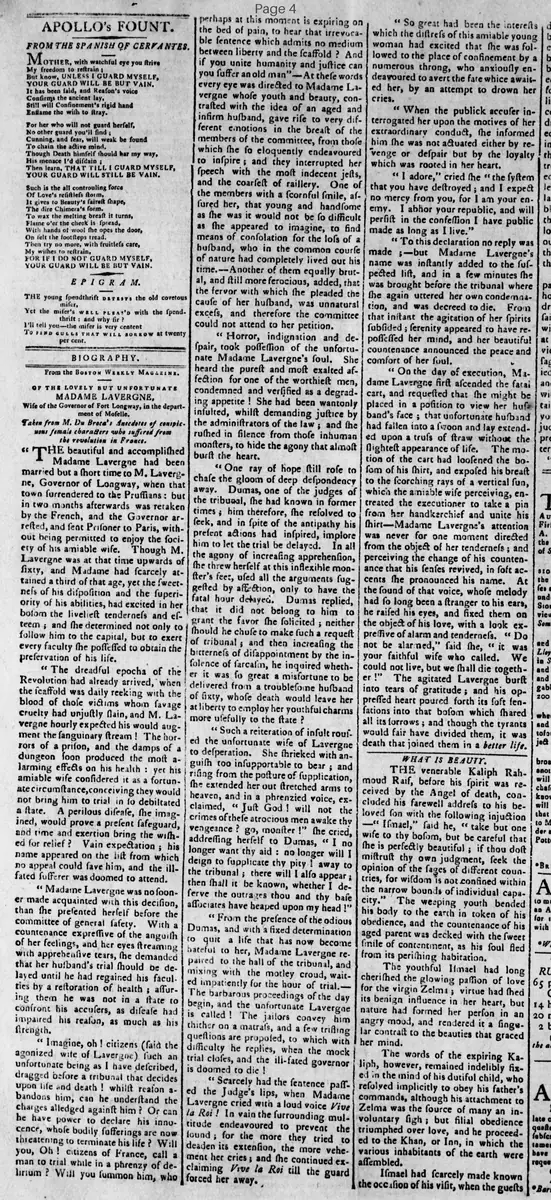
The beautiful and accomplished Madame Lavergne had been married but a short time to M. Lavergne, Governor of Longway, when that town surrendered to the Prussians: but in two months afterwards was retaken by the French, and the Governor arrested, and sent Prisoner to Paris, without being permitted to enjoy the society of his amiable wife. Though M. Lavergne was at that time upwards of sixty, and Madame had scarcely attained a third of that age, yet the Sweetness of his disposition and the superiority of his abilities, had excited in her bosom the liveliest tenderness and esteem; and she determined not only to follow him to the capital, but to exert every faculty she possessed to obtain the preservation of his life.
The dreadful epoch of the Revolution had already arrived, when the scaffold was daily reeking with the blood of those victims whom savage cruelty had unjustly slain, and M. Lavergne hourly expected his would augment the sanguinary stream! The horrors of a prison, and the damps of a dungeon soon produced the most alarming effects on his health: yet his amiable wife considered it as a fortunate circumstance, conceiving they would not bring him to trial in so debilitated a state. A perilous disease, he imagined, would prove a present safeguard, and time and exertion bring the wished for relief? Vain expectation: his name appeared on the list from which no appeal could save him, and the ill-fated sufferer was doomed to attend.
Madame Lavergne was sooner made acquainted with this decision, than she presented herself before the committee of general safety. With a countenance expressive of the anguish of her feelings, and her eyes streaming with apprehensive tears, she demanded that her husband's trial should be delayed until he had regained his faculties by a restoration of health; assuring them he was not in a state to confront his accusers, as disease had impaired his reason, as much as his strength.
"Imagine, oh! citizens (said the agonized wife of Lavergne) such an unfortunate being as I have described, dragged before a tribunal that decides upon life and death! whilst reason abandons him, can he understand the charges alledged against him? Or can he have power to declare his innocence, whose bodily sufferings are now threatening to terminate his life? Will you, Oh! citizens of France, call a man to trial while in a phrenzy of delirium? Will you summon him, who perhaps at this moment is expiring on the bed of pain, to hear that irrevocable sentence which admits no medium between liberty and the scaffold? And if you unite humanity and justice can you suffer an old man"-At these words every eye was directed to Madame Lavergne whose youth and beauty, contrasted with the idea of an aged and infirm husband, gave rise to very different emotions in the breast of the members of the committee, from those which she so eloquently endeavoured to inspire; and they interrupted her speech with the most indecent jests, and the coarsest of raillery. One of the members with a scornful smile, assured her, that young and handsome as she was it would not be so difficult as she appeared to imagine, to find means of consolation for the loss of a husband, who in the common course of nature had completely lived out his time.--Another of them equally brutal, and still more ferocious, added, that the fervor with which she pleaded the cause of her husband, was unnatural excess, and therefore the committee could not attend to her petition.
Horror, indignation and despair, took possession of the unfortunate Madame Lavergne's soul. She heard the purest and most exalted affection for one of the worthiest men, condemned and vilified as a degrading appetite! She had been wantonly insulted, whilst demanding justice by the administrators of the law; and she rushed in silence from those inhuman monsters, to hide the agony that almost burst the heart.
One ray of hope still rose to chase the gloom of deep despondency away. Dumas, one of the judges of the tribunal, she had known in former times: him therefore, she resolved to seek, and in spite of the antipathy his present actions had inspired, implore him to let the trial be delayed. In all the agony of increasing apprehension, she threw herself at this inflexible monster's feet, used all the arguments suggested by affection, only to have the fatal hour delayed. Dumas replied, that it did not belong to him to grant the favor she solicited: neither should he choose to make such a request of tribunal; and then increasing the bitterness of disappointment by the insolence of sarcasm, he inquired whether it was so great a misfortune to be delivered from a troublesome husband of sixty, whose death would leave her at liberty to employ her youthful charms more usefully to the state?
Such a reiteration of insult roused the unfortunate wife of Lavergne to desperation. She shrieked with anguish too insupportable to bear; and rising from the posture of supplication, she extended her out stretched arms to heaven, and in a phrensied voice, exclaimed,
"Just God! will not the crimes of these atrocious men awake thy vengeance? go, monster!" she cried, addressing herself to Dumas, "I no longer want thy aid: no longer will I deign to supplicate thy pity! away to the tribunal; there will I also appear: then shall it be known, whether I deserve the outrages thou and thy base associates have heaped upon my head!"
From the presence of the odious Dumas, and with a fixed determination to quit a life that has now become hateful to her, Madame Lavergne repaired to the hall of the tribunal, and mixing with the motley crowd, waited impatiently for the hour of trial.- The barbarous proceedings of the day begin, and the unfortunate Lavergne is called! The jailors convey him thither on a mattress, and a few trifling questions are proposed, to which with difficulty he replies, when the mock trial closes, and the ill-fated governor is doomed to die!
Scarcely had the sentence passed the Judge's lips, when Madame Lavergne cried with a loud voice Vive la Roi! In vain the surrounding multitude endeavoured to prevent the sound; for the more they tried to deaden its extension, the more vehement her cries; and she continued exclaiming Vive la Roi till the guard forced her away.
So great had been the interest which the distress of this amiable young woman had excited that she was followed to the place of confinement by a numerous throng, who anxiously endeavoured to avert the fate which awaited her, by an attempt to drown her cries.
When the publick accuser interrogated her upon the motives of her extraordinary conduct, she informed him she was not actuated either by revenge or despair but by the loyalty which was rooted in her heart.
"I adore," cried She "the system that you have destroyed; and I expect no mercy from you, for I am your enemy. I abhor your republic, and will persist in the confession I have public made as long as I live."
To this declaration no reply was made;-but Madame Lavergne's name was instantly added to the suspected list, and in a few minutes She was brought before the tribunal where she again uttered her own condemnation, and was decreed to die. From that instant the agitation of her spirits subsided; serenity appeared to have repossessed her mind, and her beautiful countenance announced the peace and comfort of her soul.
On the day of execution, Madame Lavergne first ascended the fatal cart, and requested that she might be placed in a position to view her husband's face; that unfortunate husband had fallen into a swoon and lay extended upon a truss of straw without the slightest appearance of life. The motion of the cart had loosened the bosom of his Shirt, and exposed his breast to the scorching rays of a vertical sun, which the amiable wife perceiving, entreated the executioner to take a pin from her handkerchief and unite his Shirt-Madame Lavergne's attention was never for one moment directed from the object of her tenderness; and perceiving the change of his countenance that his senses revived, in soft accents she pronounced his name. At the sound of that voice, whose melody had so long been a stranger to his ears, he raised his eyes. and fixed them on the object of his love, with a look expressive of alarm and tenderness. "Do not be alarmed," said she, "it was your faithful wife who called. We could not live, but we shall die together!" The agitated Lavergne burst into tears of gratitude; and his oppressed heart poured forth its soft sensations into that bosom which shared all its sorrows; and though the tyrants would fain have divided them, it was death that joined them in a better life.
From the Boston Weekly Magazine.
OF THE LOVELY BUT UNFORTUNATE
MADAME LAVERGNE,
Wife of the Governor of Fort Longway, in the department of Moselle.
Taken from M. Du Broca's Anecdotes of conspicuous female characters who suffered from the revolution in France.
The beautiful and accomplished Madame Lavergne had been married but a short time to M. Lavergne, Governor of Longway, when that town surrendered to the Prussians: but in two months afterwards was retaken by the French, and the Governor arrested, and sent Prisoner to Paris, without being permitted to enjoy the society of his amiable wife. Though M. Lavergne was at that time upwards of sixty, and Madame had scarcely attained a third of that age, yet the Sweetness of his disposition and the superiority of his abilities, had excited in her bosom the liveliest tenderness and esteem; and she determined not only to follow him to the capital, but to exert every faculty she possessed to obtain the preservation of his life.
The dreadful epoch of the Revolution had already arrived, when the scaffold was daily reeking with the blood of those victims whom savage cruelty had unjustly slain, and M. Lavergne hourly expected his would augment the sanguinary stream! The horrors of a prison, and the damps of a dungeon soon produced the most alarming effects on his health: yet his amiable wife considered it as a fortunate circumstance, conceiving they would not bring him to trial in so debilitated a state. A perilous disease, he imagined, would prove a present safeguard, and time and exertion bring the wished for relief? Vain expectation: his name appeared on the list from which no appeal could save him, and the ill-fated sufferer was doomed to attend.
Madame Lavergne was sooner made acquainted with this decision, than she presented herself before the committee of general safety. With a countenance expressive of the anguish of her feelings, and her eyes streaming with apprehensive tears, she demanded that her husband's trial should be delayed until he had regained his faculties by a restoration of health; assuring them he was not in a state to confront his accusers, as disease had impaired his reason, as much as his strength.
"Imagine, oh! citizens (said the agonized wife of Lavergne) such an unfortunate being as I have described, dragged before a tribunal that decides upon life and death! whilst reason abandons him, can he understand the charges alledged against him? Or can he have power to declare his innocence, whose bodily sufferings are now threatening to terminate his life? Will you, Oh! citizens of France, call a man to trial while in a phrenzy of delirium? Will you summon him, who perhaps at this moment is expiring on the bed of pain, to hear that irrevocable sentence which admits no medium between liberty and the scaffold? And if you unite humanity and justice can you suffer an old man"-At these words every eye was directed to Madame Lavergne whose youth and beauty, contrasted with the idea of an aged and infirm husband, gave rise to very different emotions in the breast of the members of the committee, from those which she so eloquently endeavoured to inspire; and they interrupted her speech with the most indecent jests, and the coarsest of raillery. One of the members with a scornful smile, assured her, that young and handsome as she was it would not be so difficult as she appeared to imagine, to find means of consolation for the loss of a husband, who in the common course of nature had completely lived out his time.--Another of them equally brutal, and still more ferocious, added, that the fervor with which she pleaded the cause of her husband, was unnatural excess, and therefore the committee could not attend to her petition.
Horror, indignation and despair, took possession of the unfortunate Madame Lavergne's soul. She heard the purest and most exalted affection for one of the worthiest men, condemned and vilified as a degrading appetite! She had been wantonly insulted, whilst demanding justice by the administrators of the law; and she rushed in silence from those inhuman monsters, to hide the agony that almost burst the heart.
One ray of hope still rose to chase the gloom of deep despondency away. Dumas, one of the judges of the tribunal, she had known in former times: him therefore, she resolved to seek, and in spite of the antipathy his present actions had inspired, implore him to let the trial be delayed. In all the agony of increasing apprehension, she threw herself at this inflexible monster's feet, used all the arguments suggested by affection, only to have the fatal hour delayed. Dumas replied, that it did not belong to him to grant the favor she solicited: neither should he choose to make such a request of tribunal; and then increasing the bitterness of disappointment by the insolence of sarcasm, he inquired whether it was so great a misfortune to be delivered from a troublesome husband of sixty, whose death would leave her at liberty to employ her youthful charms more usefully to the state?
Such a reiteration of insult roused the unfortunate wife of Lavergne to desperation. She shrieked with anguish too insupportable to bear; and rising from the posture of supplication, she extended her out stretched arms to heaven, and in a phrensied voice, exclaimed,
"Just God! will not the crimes of these atrocious men awake thy vengeance? go, monster!" she cried, addressing herself to Dumas, "I no longer want thy aid: no longer will I deign to supplicate thy pity! away to the tribunal; there will I also appear: then shall it be known, whether I deserve the outrages thou and thy base associates have heaped upon my head!"
From the presence of the odious Dumas, and with a fixed determination to quit a life that has now become hateful to her, Madame Lavergne repaired to the hall of the tribunal, and mixing with the motley crowd, waited impatiently for the hour of trial.- The barbarous proceedings of the day begin, and the unfortunate Lavergne is called! The jailors convey him thither on a mattress, and a few trifling questions are proposed, to which with difficulty he replies, when the mock trial closes, and the ill-fated governor is doomed to die!
Scarcely had the sentence passed the Judge's lips, when Madame Lavergne cried with a loud voice Vive la Roi! In vain the surrounding multitude endeavoured to prevent the sound; for the more they tried to deaden its extension, the more vehement her cries; and she continued exclaiming Vive la Roi till the guard forced her away.
So great had been the interest which the distress of this amiable young woman had excited that she was followed to the place of confinement by a numerous throng, who anxiously endeavoured to avert the fate which awaited her, by an attempt to drown her cries.
When the publick accuser interrogated her upon the motives of her extraordinary conduct, she informed him she was not actuated either by revenge or despair but by the loyalty which was rooted in her heart.
"I adore," cried She "the system that you have destroyed; and I expect no mercy from you, for I am your enemy. I abhor your republic, and will persist in the confession I have public made as long as I live."
To this declaration no reply was made;-but Madame Lavergne's name was instantly added to the suspected list, and in a few minutes She was brought before the tribunal where she again uttered her own condemnation, and was decreed to die. From that instant the agitation of her spirits subsided; serenity appeared to have repossessed her mind, and her beautiful countenance announced the peace and comfort of her soul.
On the day of execution, Madame Lavergne first ascended the fatal cart, and requested that she might be placed in a position to view her husband's face; that unfortunate husband had fallen into a swoon and lay extended upon a truss of straw without the slightest appearance of life. The motion of the cart had loosened the bosom of his Shirt, and exposed his breast to the scorching rays of a vertical sun, which the amiable wife perceiving, entreated the executioner to take a pin from her handkerchief and unite his Shirt-Madame Lavergne's attention was never for one moment directed from the object of her tenderness; and perceiving the change of his countenance that his senses revived, in soft accents she pronounced his name. At the sound of that voice, whose melody had so long been a stranger to his ears, he raised his eyes. and fixed them on the object of his love, with a look expressive of alarm and tenderness. "Do not be alarmed," said she, "it was your faithful wife who called. We could not live, but we shall die together!" The agitated Lavergne burst into tears of gratitude; and his oppressed heart poured forth its soft sensations into that bosom which shared all its sorrows; and though the tyrants would fain have divided them, it was death that joined them in a better life.
What sub-type of article is it?
Biography
Anecdote
What themes does it cover?
Political
Death Mortality
Love Romance
What keywords are associated?
French Revolution
Madame Lavergne
Guillotine
Loyalty
Execution
Tribunal
Royalist
What entities or persons were involved?
Taken From M. Du Broca's Anecdotes Of Conspicuous Female Characters Who Suffered From The Revolution In France.
Literary Details
Title
Of The Lovely But Unfortunate Madame Lavergne, Wife Of The Governor Of Fort Longway, In The Department Of Moselle.
Author
Taken From M. Du Broca's Anecdotes Of Conspicuous Female Characters Who Suffered From The Revolution In France.
Subject
Sufferings During The French Revolution
Form / Style
Prose Biographical Narrative
Key Lines
"Imagine, Oh! Citizens (Said The Agonized Wife Of Lavergne) Such An Unfortunate Being As I Have Described, Dragged Before A Tribunal That Decides Upon Life And Death!"
"Just God! Will Not The Crimes Of These Atrocious Men Awake Thy Vengeance? Go, Monster!" She Cried, Addressing Herself To Dumas,
"I Adore," Cried She "The System That You Have Destroyed; And I Expect No Mercy From You, For I Am Your Enemy. I Abhor Your Republic, And Will Persist In The Confession I Have Public Made As Long As I Live."
"Do Not Be Alarmed," Said She, "It Was Your Faithful Wife Who Called. We Could Not Live, But We Shall Die Together!"