Thank you for visiting SNEWPapers!
Sign up free
The Evening Critic
Washington, District Of Columbia
What is this article about?
The first session of the 47th U.S. Congress adjourns amid criticism for extravagant spending ($258M increase, mostly pensions), delays on key bills, and unpassed reforms like currency; praises for rejecting subsidies; detailed Senate and House closing proceedings end orderly at 3 p.m.
Merged-components note: Continuation of the article about the adjournment of the 47th Congress, spanning two adjacent columns on page 1.
Clipping
OCR Quality
Full Text
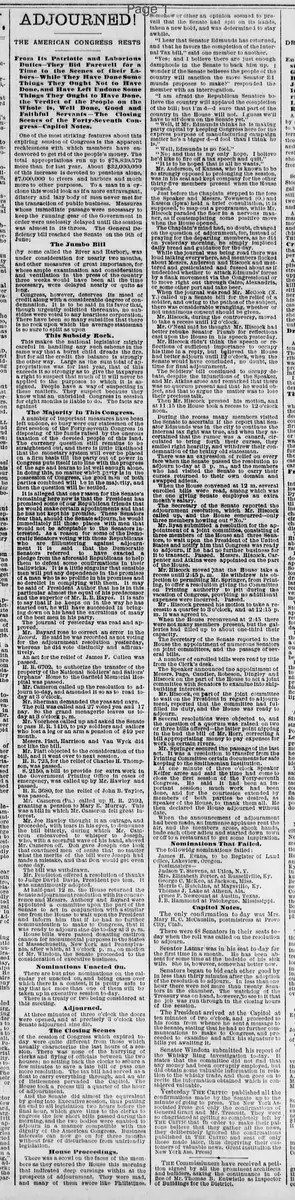
THE AMERICAN CONGRESS RESTS
From Its Patriotic and Laborious
Duties-They Bid Farewell for a
Time to the Scenes of their Labors-While They Have Done Some
Things They Ought Not to Have
Done, and Have Left Undone Some
Things They Ought to Have Done,
the Verdict of the People on the
Whole is, Well Done. Good and
Faithful Servants-The Closing
Scenes of the Forty-Seventh Congress-Capitol Notes.
One of the most striking features about this
expiring session of Congress is the apparent
recklessness with which members have endeavored to get rid of the people's money. The
total appropriations run up to $258,839,579
more than for last year. About $82,000,000
of this increase is devoted to pensions alone,
$7,000,000 to rivers and harbors and much
more to other purposes. To a man in a cyclone this would look as if a more extravagant,
dilatory and lazy body of men never met for
the transaction of public business. Measures
whose immediate passage were necessary to
keep the running gear of the Government in
order were uselessly delayed until the session
was almost in its throes. The General Deficiency bill reached the Senate on the 9th of
June;
The Jumbo Bill
(by some called the River and Harbor), was
under consideration for nearly two months.
and other measures of great importance, for
whose ample examination and consideration
and ventilation in the press of the country
three weeks would have been all the time
necessary, were delayed nearly or quite as
long.
Congress, however, deserves its meed of
credit along with a considerable degree of condemnation. It is to be said in its favor that,
though urgently solicited thereunto, no subsidies were voted to any heartless corporation.
There have been so many subsidies that there
is no rock upon which the average statesman
is so sure to split as upon
This Subsidy Rock.
This makes the national legislator mighty
careful in handling any such scheme in the
same way that a burnt child dreads the fire.
But for all the credit the balance is strongly
the other way. Large as the sum total of appropriations was for last year, that of this
exceeds it so strongly as to give the taxpayers
a right to suspect that much of it will never be
applied to the purposes to which it is assigned. People have a way of suspecting in
these matters. They suspect because they
know what an unbridled Congress in session
for eight months is liable to do. The facts are against
The Majority in This Congress.
A number of important measures have been
left undone, so busy were our statesmen of the
first session of the Forty-seventh Congress in
disposing of the funds raised by the onerous
taxation of the devoted people of this land.
The currency question still remains to be
straightened out, and there is little likelihood
that the monetary system will ever be placed
on a firm basis till the party out of power in
Congress puts itself into line with the progress
of the age and learns to let well enough alone.
In doing this, no matter which party is in the
possession of Congress, the good men of both
parties combined will be in the majority, and
then the question will be settled.
It is alleged that one reason for the Senate's
remaining here now is that the President has
promised some of our Republican friends that
he would make certain appointments and that
he has not kept his promise. These Senators
fear that, should the Senate adjourn, he would
immediately fill those places with men that
would not be acceptable to the Senators interested. As a reason for some of the Democratic Senators voting with those Republicans
who are filibustering against adjournment it is
said that the Democratic
Senators referred to have exacted a
pledge from the aforesaid Republicans to help
them to defeat some confirmations in their
bailiwicks. It is a little singular that sensible
men will put any dependence in the promises
of a man who is so prolific in his promises and
so derelict in complying with them. It may
be said of President Arthur that he is in this
particular almost the equal of his predecessor
and the superior of Mr. R. B. Hayes. It is safe
to say that if he keeps on in the way he has
started out, he will have succeeded in bringing down on his head the execrations of many
of the best men in his party.
The journal of yesterday was read and approved.
Mr. Bayard rose to correct an error in the
Record. He said he was recorded as not voting
for the adjournment resolution yesterday,
whereas he did vote distinctly and affirmatively.
An act for the relief of James F. Cullen was
passed.
H. R. 6702, to authorize the transfer of the
property of the National Soldiers' and Sailors'
Orphans' Home to the Garfield Memorial Hospital was passed.
Mr. Cameron called up the resolution to adjournment to-day, and amended it so as to read to-day at 3 o'clock,
Mr. Sherman demanded the yeas and nays.
The roll was called and 27 voted yea and 17
nay. So the grand menagerie leaves us to-day at 3 o'clock p. m.
Mr. Voorhees called up and asked the Senate
to pass H. R. 1410, to pay soldiers and sailors
who lost a leg or an arm a pension of $40 per
month.
Messrs. Platt, Harrison and Van Wyck did
not like the bill
Mr. Platt objected to the consideration of the
bill, and it went over to next session.
H. R. 723, for the relief of Charles H. Thompson,
was passed.
S. 2150, a bill to provide for extra work in
the Government Printing Office in cases of
emergency, was called up by Mr. Hawley and
passed.
H. R. 3680, for the relief of John B. Taylor,
was passed.
Mr. Cameron (Pa.) called up H. R. 2592
granting a pension to Mary E. Murray. This
was a bill in which Mr. Cameron felt great interest,
Mr. Joe Hawley thought it an outrage, and
proceeded, with tears in his eyes, to denounce
the bill bitterly, during which Mr. Cameron
endeavored to whisper to Joseph,
who, with a scornful wave of his hand, shoved
Mr. Cameron off. Don gave Joseph one look
that convinced men of sense that no matter
what the merits of the bill were Joseph had
made a mistake, and that Don would get even
some day.
The bill was withdrawn.
Mr. Pendleton offered a resolution of thanks
to Judge David Davis, President pro tem. It
was unanimously adopted.
At half-past 12 m. the House returned the
Senate adjournment resolution with its concurrence and Messrs. Anthony and Bayard were
appointed a committee upon the part of the
Senate to act in conjunction with a similar
one from the House to wait upon the President
and inform him that if he had no further
communication to make to Congress, that it
was ready to adjourn sine die to-day at 3 p. m.
House bills were passed donating cast-iron
cannon for monumental purposes in the States
of Massachusetts, New York and Pennsylvania,
after which, at 1 o'clock p. m., on motion
of Mr. Windom, the Senate proceeded to the
consideration of executive business.
Nominations Unacted On.
There are but nine nominations on the calendar yet unacted on, and being cases over
which there is a contest, it is pretty safe to
say that not more than one of them will be
taken up in executive session to-day.
There is a treaty or two being considered at
this meeting.
Adjourned.
At three minutes of three o'clock the doors
were opened, and at precisely 3 o'clock the
Senate adjourned sine die.
The Closing Scenes
of the session of Congress which expired to-day were quite different from those which
usually characterize the last hours of a session. There was none of the hurrying of
clerks and flying of officials between the two
houses; no setting back the clocks to secure a
few minutes to save a late bill or pass one
more resolution. The tax bill had served as a
float to carry everything through, and an air
of listlessness pervaded the Capitol. The
House took a recess till a quarter of the hour
of adjournment.
And the Senate did almost the equivalent
by going into Executive session, thus putting
an end to all legislation two hours before the
final hour, which gave time to the clerks to
engross the few short bills passed during the
morning, and the two bodies were enabled to
adjourn in a manner compatible with the
dignity of the American Congress. Business
interests can now go on for three months
without fear of disturbance from unfriendly
legislation.
House Proceedings.
There was a scowl on the faces of the members as they entered the House this morning
that indicated deep cursings within at the
prospects of adjournment. They were mad,
and many of them swore like Philistines.
Somehow or other an opinion seemed to prevail that the Senate had spit on its hands,
taken a new hold, and was determined to stay
awhile.
"I hear that Senator Edmunds has returned,
and that he favors the completion of the Internal Tax bill," said one member to another.
"Yes; and I believe there are just enough
damphools in the Senate to back him up. I
wonder if the Senate believes the people of the
country will sanction the move Senator Edmunds proposes to make?" responded the
member with an interrogation.
"I am afraid the Republican Senators believe the country will applaud the completion
of the bill; but I'm d--d sure that part of the
country in the House will not. I guess we'll
have to sit down on the Senate yet.
"Well, if Mr. Edmunds thinks he is making
party capital by keeping Congress here for the
express purpose of manufacturing campaign
matter he's a bigger d--d fool than I think he
is."
"Well, Edmunds is no fool."
"No; and that is my only hope. I believe
he'd like to fire off a tax speech and quit."
"It is to be hoped that is all he wants.
Mr. Anderson, of Kansas, who is known to be
so strongly opposed to prolonging the session,
was in his seat and kept company for the other
thirty-five members present when the House
opened.
Just before the Chaplain stepped to the fore
the Speaker and Messrs. Townsend (O.) and
Kasson (Iowa) held a brief consultation, it is
supposed, to map out a programme, while Mr.
Hiscock paraded the floor in a nervous manner, as if contemplating some
positive move
when the House opened.
The Chaplain's mind had, no doubt, changed
on the question of adjournment, for, instead of
praying for the departing members, as he did
on yesterday morning, he simply implored
daily bread and guidance for the day.
While the journal was being read there was
loud talking everywhere, and members flocked
about Messrs. Anderson and Hiscock and muttered and gesticulated and fussed about as if
undecided whether to attack Edmunds' forces
by a flank movement via the Congressional or
to move right out through Cairo, Alexandria,
or some other port and take beer.
When the journal was read Mr. McCook (N.
Y.) called up a Senate bill for the relief of a
soldier, and owing to the pathos of the subject,
there was considerable wrangling, whether or
not unanimous consent should be given.
Mr. Hiscock, during the controversy, moved
to take a recess until 12 o'clock.
Mr. O'Neal said he thought Mr. Hiscock had
better rebuke Senator Plumb for reflections
cast upon the House in his speech yesterday.
Mr. Hiscock didn't think the speech or reflections of sufficient importance to occupy
his time in a reply, but believed the House
had better adjourn until 12 o'clock, when the
Senate would have concluded, no doubt, the
time for final adjournment.
The Soldiers' bill continued to occupy debate, despite the injunctions of the Speaker,
and Mr. Atkins arose and remarked that there
was no quorum present and that he would object, and that to argue the matter was to lose
their precious talk.
Then Mr. Hiscock pressed his motion, and
at 11:15 the House took a recess to 12 o'clock
noon.
During the recess many members visited
the Senate to ascertain if the report that Senator Edmunds was in the city to continue the
internal tax fight was true, and when they ascertained that the rumor was a canard, circulated to bring forth their curses, they
smiled right heartily, and withdrew their condemnation of the brainy old statesman.
There was an expression of relief on every
face when the Senate passed the resolution to
adjourn to-day at 3 p. m., and the members
who had visited the Senate to carry their
curses returned to their own domain and
swapped adieus,
When the House convened at 12 m. several
enrolled bills were read, among which was
the one giving Senate employees an extra
month's salary.
The Secretary of the Senate reported the
adjournment resolution, which Mr. Hiscock
called up, and the House concurred--only
three members howling out "No."
Mr. Ryan submitted a resolution for the appointment of a joint committee, consisting of
three members of the House and three Senators, to wait upon the President of the United
States and notify him that Congress was ready
to adjourn, if he had no further business for
it to transact. Passed. Messrs. Hiscock, Carpenter and Atkins were appointed on the part
of the House.
Mr. Hiscock moved that the House take a
recess until 2:45 p. m. He withdrew his objection to permitting Mr. Springer, from Printing, to offer a resolution giving the Committee
on Printing authority to sit during the
vacation of Congress, providing no additional
expenses were incurred. Passed.
Mr. Hiscock pressed his motion to take a recess to a quarter to 3 o'clock, and at 12:15 p.
m. it was agreed to.
When the House reconvened at 2:45 there
were not many members present, but the galleries had filled up to about one-third their
capacity.
The Secretary of the Senate reported to the
House the appointment of numerous Senators
on joint committees, and the passage of several bills.
A number of enrolled bills were read by title
from the Clerk's desk.
The Speaker announced the appointment of
Messrs. Page, Candler, Robeson, Dingley and
Hiscock on the part of the House to act a joint
committee with Senators to examine into ship-building interests.
Mr. Hiscock, on part of the joint committee
to wait on the President in regard to adjournment, reported that the committee had fulfilled its duty, and the House was ready to
adjourn.
Several resolutions were objected to, and
the question of a quorum was raised on two
or three bills offered the latter point nipping
in the bud the bill of Mr. Horr, correcting a
bill appropriating money to pay expenses for
work on certain rivers.
Mr. Springer secured the passage of the last
act. It was a resolution to transfer from the
Printing Committee certain documents for safe
keeping to the Smithsonian Institution.
At one minute of three o'clock Speaker
Keifer arose and said the time had come to
close the first session of the Forty-seventh
Congress. He said it had been an important session; much work had been
done, and for the courtesies extended by
members of both parties he desired, as
Speaker of the House, to thank them all. He
then declared the House adjourned without
date.
When the announcement of adjournment
had been made, an immense applause rent the
air, and the members arose, shook hands,
bade each other adieu and started down town
or off to a restaurant to get some inspiration.
Nominations That Failed,
The following nominations failed:
James H. Evans, to be Register of Land
Office, Lakeview, Oregon.
Postmasters-
Judson T. Stevens, at Utica, N. Y.
Mrs. Elizabeth Porter, at Russellville, Ky.
George C. McKee, at Jackson, Miss.
Morris C. Hutchins, at Maysville, Ky.
Thomas J. Lake at Athens, Ala.
James P. Newcount at Austin, Texas.
J. B. Hammond at Patchogue, Mississippi.
Capitol Notes.
The only confirmation to-day was Mrs.
Mary H. C. McCaullin, postmistress at Provo
City, Utah.
There were 48 Senators in their seats to-day when the roll was called on the resolution
to adjourn.
Senator Lamar was in his seat to-day for
the first time in a month. He has been absent for some time at the bedside of his sick
wife. She is, however, somewhat better now.
Senators began to bid each other good-by
in less than thirty minutes after the adoption
of the resolution to adjourn. In less than one
hour there were not more than twenty Senators in the chamber. The watchdog of the
Treasury was on hand, however, to see to it that
no job was run through in the closing hours
of the session.
The President arrived at the Capitol at
ten minutes of two o'clock, and proceeded to
his room from whence he sent a message to
the Senate, stating that he had no further communications to make to Congress, and proceeded to examine and affix his signature to
bills yet awaiting it.
Senator Windom submitted his report of
the Whisky Ring investigation to-day. It
states that the committee did not find that
any money had been corruptly employed, but
did obtain some valuable information in relation to the whisky trade, and then goes on to
recite the information obtained which is considered valuable.
Yesterday The Critic published all the
confirmations made by the Senate up to the
minute of going to press. The New York Associated Press got only the confirmations of
General Grant and Mr. Trescott. They were
so chagrined at getting so completely left by
The Critic that in order to make their patrons believe that they gather all the news,
they deliberately ignored the confirmations
published in The Critic and sent off only
those made later, thus depriving their customers of valuable news. Great institution the
New York Ass. Press.
The Commissioners have received a petition signed by all the prominent architects
and builders, asking the continuance in office of Mr. Thomas B. Entwistle as Inspector
of Buildings for the District,
What sub-type of article is it?
What themes does it cover?
What keywords are associated?
What entities or persons were involved?
Where did it happen?
Story Details
Key Persons
Location
Capitol
Event Date
First Session Of The Forty Seventh Congress
Story Details
The Forty-seventh Congress adjourns after extravagant appropriations exceeding last year's by $258,839,579, including pensions and rivers/harbors; criticism for delays and unpassed measures like currency reform; no subsidies granted; Senate and House proceedings include bill passages, objections, and final adjournment at 3 p.m. without chaos.