Thank you for visiting SNEWPapers!
Sign up free
Memphis Daily Appeal
Memphis, Shelby County, Tennessee
What is this article about?
A Southern newspaper article analyzes the Cincinnati Commercial's estimates of Federal army strength in three divisions totaling over 450,000 men, predicting easy victories at Richmond, Raleigh, against Bragg, and at Vicksburg under Grant. It urges the Confederacy to prepare vigorously against this formidable force to avoid past errors of underestimation.
Clipping
OCR Quality
Full Text
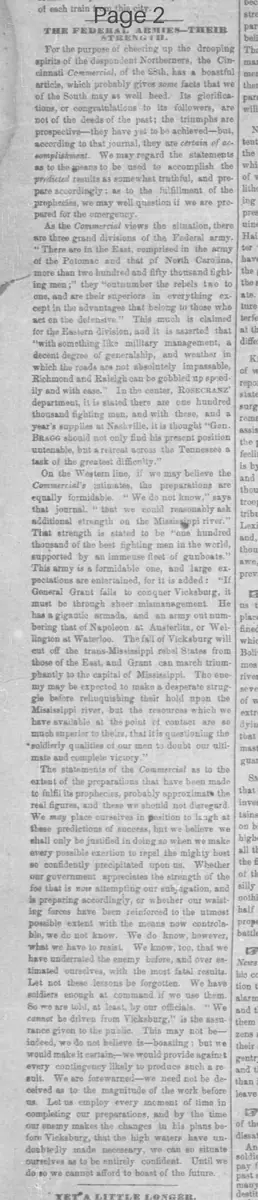
For the purpose of cheering up the drooping spirits of the despondent Northerners, the Cincinnati Commercial, of the 5th, has a boastful article, which probably gives some facts that we of the South may as well heed. Its glorifications, or congratulations to its followers, are not of the deeds of the past; the triumphs are prospective—they have yet to be achieved—but, according to that journal, they are certain of accomplishment. We may regard the statements as to the means to be used to accomplish the predicted results as somewhat truthful, and prepare accordingly; as to the fulfillment of the prophecies, we may well question if we are prepared for the emergency.
As the Commercial views the situation, there are three grand divisions of the Federal army. "There are in the East, comprised in the army of the Potomac and that of North Carolina, more than two hundred and fifty thousand fighting men;" they "outnumber the rebels two to one, and are their superiors in everything except in the advantages that belong to those who act on the defensive." This much is claimed for the Eastern division, and it is asserted that "with something like military management, a decent degree of generalship, and weather in which the roads are not absolutely impassable, Richmond and Raleigh can be gobbled up speedily and with ease."
In the center, Rosecrans' department, it is stated there are one hundred thousand fighting men, and with these, and a year's supplies at Nashville, it is thought "Gen. Bragg should not only find his present position untenable, but a retreat across the Tennessee a task of the greatest difficulty."
On the Western line, if we may believe the Commercial's estimates, the preparations are equally formidable. "We do not know," says that journal, "that we could reasonably ask additional strength on the Mississippi river." That strength is stated to be "one hundred thousand of the best fighting men in the world, supported by an immense fleet of gunboats."
This army is a formidable one, and large expectations are entertained, for it is added: "If General Grant fails to conquer Vicksburg, it must be through sheer mismanagement. He has a gigantic armada, and an army outnumbering that of Napoleon at Austerlitz, or Wellington at Waterloo. The fall of Vicksburg will cut off the trans-Mississippi rebel States from those of the East, and Grant can march triumphantly to the capital of Mississippi. The enemy may be expected to make a desperate struggle before relinquishing their hold upon the Mississippi river, but the resources which we have available at this point to contest are so much superior to theirs, that it is questioning the soldierly qualities of our men to doubt our ultimate and complete victory."
The statements of the Commercial as to the extent of the preparations that have been made to fulfil its prophecies, probably approximate the real figures, and these we should not disregard. We may place ourselves in position to laugh at these predictions of success, but we believe we shall only be justified in doing so when we make every possible exertion to repel the mighty host so confidently precipitated upon us. Whether our government appreciates the strength of the foe that is now attempting our subjugation, and is preparing accordingly, or whether our waiting forces have been reinforced to the utmost possible extent with the means now controllable, we do not know. We do know, however, what we have to resist. We know, too, that we have underrated the enemy before, and over estimated ourselves, with the most fatal results. Let not these lessons be forgotten. We have soldiers enough: command if we use them. So we are told, at least, by our officials. We cannot be driven from Vicksburg," is the assurance given to the public. This may not be—indeed, we do not believe it is—boasting: but we would make it certain—we would provide against every contingency likely to produce such a result. We are forewarned—we need not be deceived as to the magnitude of the work before us. Let us employ every moment of time in completing our preparations, and by the time our enemy makes the changes in his plans before Vicksburg, that the high waters have undoubtedly made necessary, we can so situate ourselves as to be entirely confident. Until we do so we cannot afford to boast of the future.
What sub-type of article is it?
What themes does it cover?
What keywords are associated?
What entities or persons were involved?
Where did it happen?
Story Details
Key Persons
Location
Eastern Division (Potomac And North Carolina), Center (Nashville And Tennessee), Western Line (Mississippi River And Vicksburg)
Story Details
The Cincinnati Commercial boasts of Federal armies' strength: 250,000 in the East to capture Richmond and Raleigh; 100,000 under Rosecrans to push Bragg across Tennessee; 100,000 under Grant with gunboats to take Vicksburg and isolate Confederate states. The article warns the South to heed these estimates, prepare fully, and avoid past underestimations to ensure victory.