Thank you for visiting SNEWPapers!
Sign up free
The Tacoma Times
Tacoma, Pierce County, Washington
What is this article about?
Faculty reps in Seattle reviewed Atherton's purge of 22 freshman athletes for code violations; Stanford protested loss of eight. Rulings likely upheld, proselyting code revisable. 1942 schedule debated, rules relaxed on scholarships and competitions. Joint committee formed.
Clipping
OCR Quality
Full Text
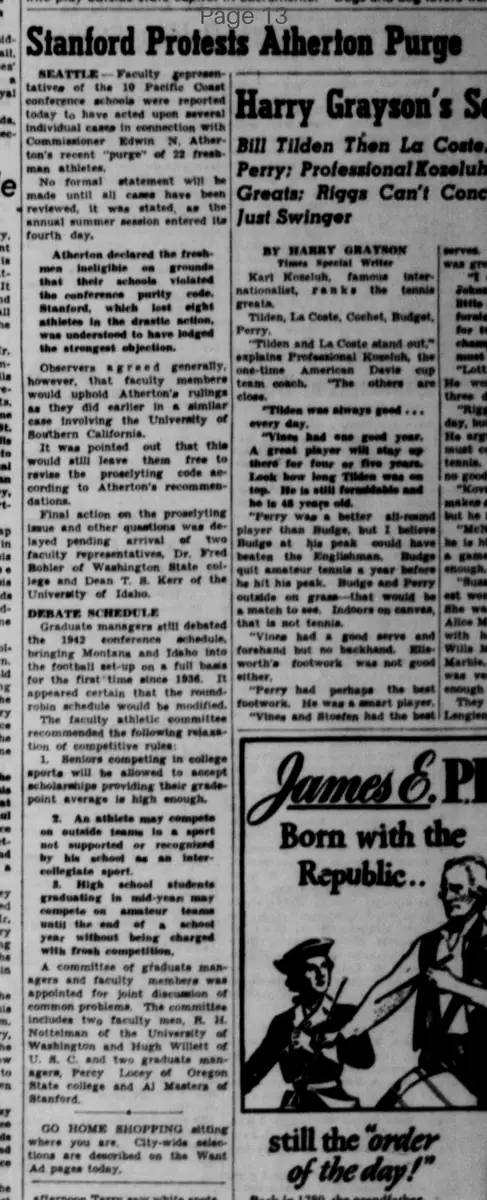
SEATTLE—Faculty representatives of the 10 Pacific Coast conference schools were reported today to have acted upon several individual cases in connection with Commissioner Edwin N. Atherton's recent "purge" of 22 freshman athletes.
No formal statement will be made until all cases have been reviewed, it was stated, as the annual summer session entered its fourth day.
Atherton declared the freshmen ineligible on grounds that their schools violated the conference purity code.
Stanford, which lost eight athletes in the drastic motion, was understood to have lodged the strongest objection.
Observers agreed generally, however, that faculty members would uphold Atherton's rulings as they did earlier in a similar case involving the University of Southern California.
It was pointed out that this would still leave them free to revise the proselyting code according to Atherton's recommendations.
Final action on the proselyting issue and other questions was delayed pending arrival of two faculty representatives, Dr. Fred Bohler of Washington State college and Dean T. B. Kerr of the University of Idaho.
DEBATE SCHEDULE
Graduate managers still debated the 1942 conference schedule, bringing Montana and Idaho into the football set-up on a full basis for the first time since 1935. It appeared certain that the round-robin schedule would be modified.
The faculty athletic committee recommended the following relaxation of competitive rules:
1. Seniors competing in college sports will be allowed to accept scholarships providing their grade-point average is high enough.
2. An athlete may compete on outside teams in a sport not supported or recognized by his school as an intercollegiate sport.
3. High school students graduating in mid-year may compete on amateur teams until the end of a school year without being charged with frosh competition.
A committee of graduate managers and faculty members was appointed for joint discussion of common problems. The committee includes two faculty men, R. H. Nottelman of the University of Washington and Hugh Willett of U. S. C. and two graduate managers, Percy Locey of Oregon State college and Al Masters of Stanford.
What sub-type of article is it?
What themes does it cover?
What keywords are associated?
What entities or persons were involved?
Where did it happen?
Story Details
Key Persons
Location
Seattle
Story Details
Faculty representatives of Pacific Coast conference schools reviewed cases from Commissioner Atherton's purge of 22 freshman athletes for violating the purity code. Stanford objected strongly after losing eight athletes. Rulings expected to be upheld, allowing revision of proselyting code. Debate on 1942 schedule included Montana and Idaho fully. Committee recommended rule relaxations on scholarships, outside teams, and mid-year graduates. Joint committee appointed.