Thank you for visiting SNEWPapers!
Sign up free
Story
April 10, 1958
Greenbelt News Review
Greenbelt, Prince George's County, Maryland
What is this article about?
In 1957, accidents cost Americans $11.8 billion in lost wages, medical fees, insurance, property damage, and production losses. The Institute for Safer Living suggests redirecting these funds to boost education, tax relief, housing, health research, hospitals, UN operations, family insurance, luxuries, and business profits.
Clipping
OCR Quality
98%
Excellent
Full Text
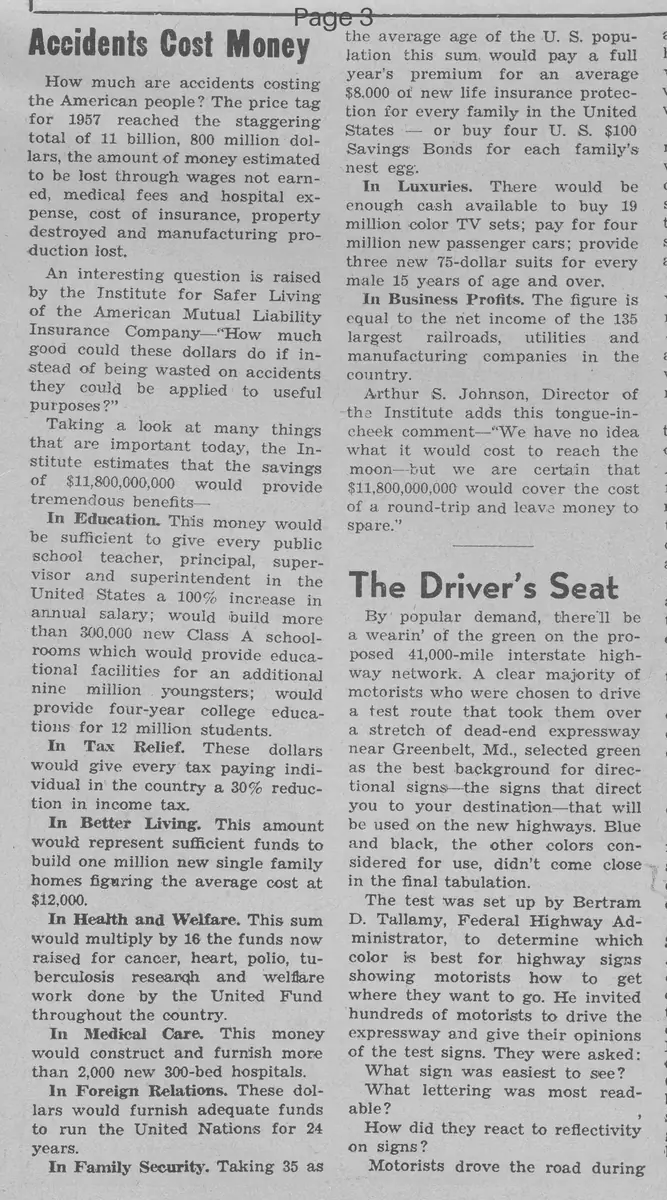
Accidents Cost Money
How much are accidents costing the American people? The price tag for 1957 reached the staggering total of 11 billion, 800 million dollars, the amount of money estimated to be lost through wages not earned, medical fees and hospital expense, cost of insurance, property destroyed and manufacturing production lost.
An interesting question is raised by the Institute for Safer Living of the American Mutual Liability Insurance Company-"How much good could these dollars do if instead of being wasted on accidents they could be applied to useful purposes?"
Taking a look at many things that are important today, the Institute estimates that the savings of $11,800,000,000 would provide tremendous benefits-
In Education. This money would be sufficient to give every public school teacher, principal, supervisor and superintendent in the United States a 100% increase in annual salary; would build more than 300,000 new Class A schoolrooms which would provide educational facilities for an additional nine million youngsters; would provide four-year college educations for 12 million students.
In Tax Relief. These dollars would give every tax paying individual in the country a 30% reduction in income tax.
In Better Living. This amount would represent sufficient funds to build one million new single family homes figuring the average cost at $12,000.
In Health and Welfare. This sum would multiply by 16 the funds now raised for cancer, heart, polio, tuberculosis research and welfare work done by the United Fund throughout the country.
In Medical Care. This money would construct and furnish more than 2,000 new 300-bed hospitals.
In Foreign Relations. These dollars would furnish adequate funds to run the United Nations for 24 years.
In Family Security. Taking 35 as the average age of the U. S. population this sum would pay a full year's premium for an average $8,000 or more life insurance protection for every family in the United States - or buy four U. S. $100 Savings Bonds for each family's nest egg.
In Luxuries. There would be enough cash available to buy 19 million color TV sets; pay for four million new passenger cars; provide three new 75-dollar suits for every male 15 years of age and over.
In Business Profits. The figure is equal to the net income of the 135 largest railroads, utilities and manufacturing companies in the country.
Arthur S. Johnson, Director of the Institute adds this tongue-in-cheek comment-"We have no idea what it would cost to reach the moon-but we are certain that $11,800,000,000 would cover the cost of a round-trip and leave money to spare."
How much are accidents costing the American people? The price tag for 1957 reached the staggering total of 11 billion, 800 million dollars, the amount of money estimated to be lost through wages not earned, medical fees and hospital expense, cost of insurance, property destroyed and manufacturing production lost.
An interesting question is raised by the Institute for Safer Living of the American Mutual Liability Insurance Company-"How much good could these dollars do if instead of being wasted on accidents they could be applied to useful purposes?"
Taking a look at many things that are important today, the Institute estimates that the savings of $11,800,000,000 would provide tremendous benefits-
In Education. This money would be sufficient to give every public school teacher, principal, supervisor and superintendent in the United States a 100% increase in annual salary; would build more than 300,000 new Class A schoolrooms which would provide educational facilities for an additional nine million youngsters; would provide four-year college educations for 12 million students.
In Tax Relief. These dollars would give every tax paying individual in the country a 30% reduction in income tax.
In Better Living. This amount would represent sufficient funds to build one million new single family homes figuring the average cost at $12,000.
In Health and Welfare. This sum would multiply by 16 the funds now raised for cancer, heart, polio, tuberculosis research and welfare work done by the United Fund throughout the country.
In Medical Care. This money would construct and furnish more than 2,000 new 300-bed hospitals.
In Foreign Relations. These dollars would furnish adequate funds to run the United Nations for 24 years.
In Family Security. Taking 35 as the average age of the U. S. population this sum would pay a full year's premium for an average $8,000 or more life insurance protection for every family in the United States - or buy four U. S. $100 Savings Bonds for each family's nest egg.
In Luxuries. There would be enough cash available to buy 19 million color TV sets; pay for four million new passenger cars; provide three new 75-dollar suits for every male 15 years of age and over.
In Business Profits. The figure is equal to the net income of the 135 largest railroads, utilities and manufacturing companies in the country.
Arthur S. Johnson, Director of the Institute adds this tongue-in-cheek comment-"We have no idea what it would cost to reach the moon-but we are certain that $11,800,000,000 would cover the cost of a round-trip and leave money to spare."
What sub-type of article is it?
Curiosity
What themes does it cover?
Misfortune
What keywords are associated?
Accidents Cost
1957
Economic Impact
Safety Institute
Fund Redirection
What entities or persons were involved?
Arthur S. Johnson
Where did it happen?
United States
Story Details
Key Persons
Arthur S. Johnson
Location
United States
Event Date
1957
Story Details
The Institute for Safer Living estimates $11.8 billion lost to accidents in 1957 and calculates hypothetical benefits if redirected to education, tax relief, housing, health, welfare, medical care, foreign relations, family security, luxuries, and business.