Thank you for visiting SNEWPapers!
Sign up free
North Branch Democrat
Tunkhannock, Wyoming County, Pennsylvania
What is this article about?
An opinion piece refutes abolitionists' comparison of Stephen A. Douglas's 1844 defense of General Jackson's limited martial law in New Orleans to President Lincoln's nationwide suspension of habeas corpus in loyal states, calling it absurd due to differing scopes and contexts.
Clipping
OCR Quality
Full Text
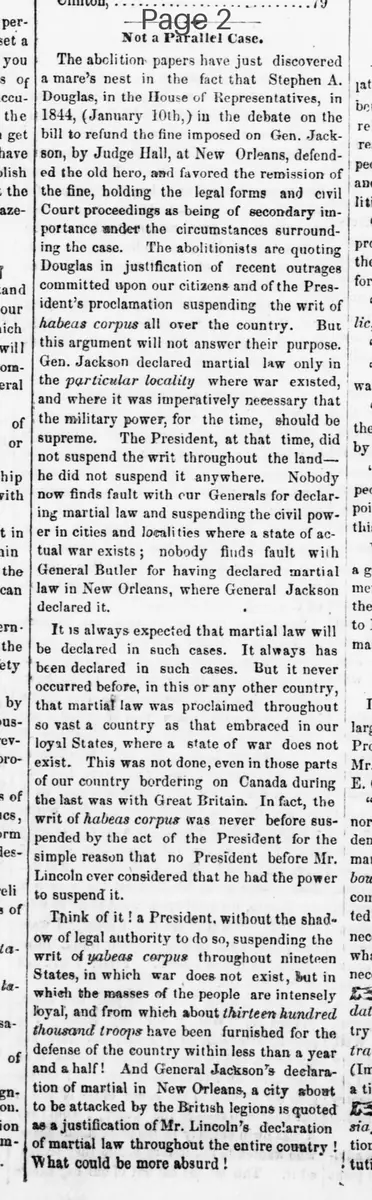
The abolition papers have just discovered a mare's nest in the fact that Stephen A. Douglas, in the House of Representatives, in 1844, (January 10th,) in the debate on the bill to refund the fine imposed on Gen. Jackson, by Judge Hall, at New Orleans, defended the old hero, and favored the remission of the fine, holding the legal forms and civil Court proceedings as being of secondary importance under the circumstances surrounding the case. The abolitionists are quoting Douglas in justification of recent outrages committed upon our citizens and of the President's proclamation suspending the writ of habeas corpus all over the country.
But this argument will not answer their purpose. Gen. Jackson declared martial law only in the particular locality where war existed, and where it was imperatively necessary that the military power, for the time, should be supreme.
The President, at that time, did not suspend the writ throughout the land—he did not suspend it anywhere. Nobody now finds fault with our Generals for declaring martial law and suspending the civil power in cities and localities where a state of actual war exists; nobody finds fault with General Butler for having declared martial law in New Orleans, where General Jackson declared it.
It is always expected that martial law will be declared in such cases. It always has been declared in such cases. But it never occurred before, in this or any other country, that martial law was proclaimed throughout so vast a country as that embraced in our loyal States, where a state of war does not exist. This was not done, even in those parts of our country bordering on Canada during the last war with Great Britain. In fact, the writ of habeas corpus was never before suspended by the act of the President for the simple reason that no President before Mr. Lincoln ever considered that he had the power to suspend it.
Think of it! a President, without the shadow of legal authority to do so, suspending the writ of habeas corpus throughout nineteen States, in which war does not exist, but in which the masses of the people are intensely loyal, and from which about thirteen hundred thousand troops have been furnished for the defense of the country within less than a year and a half! And General Jackson's declaration of martial in New Orleans, a city about to be attacked by the British legions is quoted as a justification of Mr. Lincoln's declaration of martial law throughout the entire country! What could be more absurd!
What sub-type of article is it?
What themes does it cover?
What keywords are associated?
What entities or persons were involved?
Where did it happen?
Story Details
Key Persons
Location
New Orleans And The United States
Event Date
January 10, 1844, And Civil War Era
Story Details
The article criticizes abolitionists for citing Douglas's 1844 defense of Jackson's martial law and fine remission in wartime New Orleans to justify Lincoln's suspension of habeas corpus across loyal states without active war, emphasizing the limited vs. nationwide scope.