Thank you for visiting SNEWPapers!
Sign up free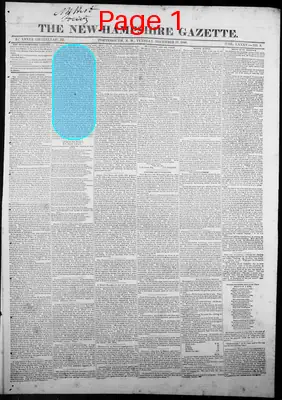
Story
December 17, 1839
The New Hampshire Gazette
Portsmouth, Rockingham County, New Hampshire
What is this article about?
In New York's Marine Court, Judge Schiefflin debates swearing in a young Chinese witness who follows non-Christian oath rituals involving idols, a sacred book, spitting, and breaking a salt saucer, as no such elements exist in court.
Clipping
OCR Quality
98%
Excellent
Full Text
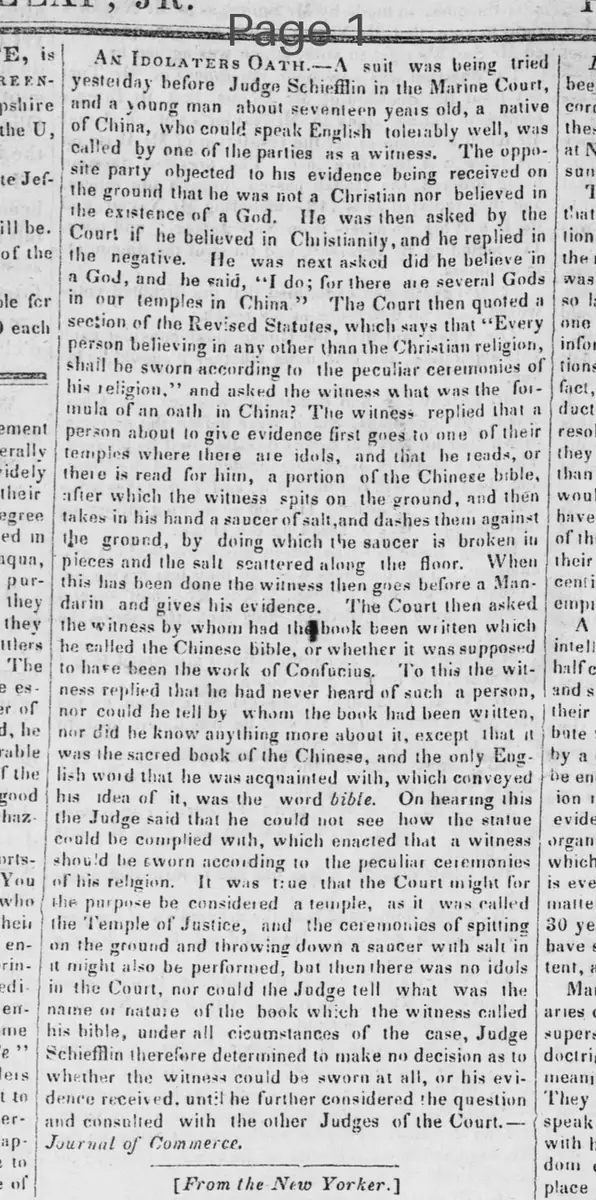
An Idolater's Oath.—A suit was being tried yesterday before Judge Schiefflin in the Marine Court, and a young man about seventeen years old, a native of China, who could speak English tolerably well, was called by one of the parties as a witness.
The opposite party objected to his evidence being received on the ground that he was not a Christian nor believed in the existence of a God. He was then asked by the Court if he believed in Christianity, and he replied in the negative. He was next asked did he believe in a God, and he said, "I do; for there are several Gods in our temples in China."
The Court then quoted a section of the Revised Statutes, which says that "Every person believing in any other than the Christian religion, shall be sworn according to the peculiar ceremonies of his religion," and asked the witness what was the form of an oath in China? The witness replied that a person about to give evidence first goes to one of their temples where there are idols, and that he reads, or there is read for him, a portion of the Chinese bible, after which the witness spits on the ground, and then takes in his hand a saucer of salt, and dashes them against the ground, by doing which the saucer is broken in pieces and the salt scattered along the floor. When this has been done the witness then goes before a Mandarin and gives his evidence.
The Court then asked the witness by whom had the book been written which he called the Chinese bible, or whether it was supposed to have been the work of Confucius. To this the witness replied that he had never heard of such a person, nor could he tell by whom the book had been written, nor did he know anything more about it, except that it was the sacred book of the Chinese, and the only English word that he was acquainted with, which conveyed his idea of it, was the word bible.
On hearing this the Judge said that he could not see how the statute could be complied with, which enacted that a witness should be sworn according to the peculiar ceremonies of his religion. It was true that the Court might for the purpose be considered a temple, as it was called the Temple of Justice, and the ceremonies of spitting on the ground and throwing down a saucer with salt in it might also be performed, but then there was no idols in the Court, nor could the Judge tell what was the name or nature of the book which the witness called his bible, under all circumstances of the case, Judge Schiefflin therefore determined to make no decision as to whether the witness could be sworn at all, or his evidence received, until he further considered the question and consulted with the other Judges of the Court.—Journal of Commerce.
The opposite party objected to his evidence being received on the ground that he was not a Christian nor believed in the existence of a God. He was then asked by the Court if he believed in Christianity, and he replied in the negative. He was next asked did he believe in a God, and he said, "I do; for there are several Gods in our temples in China."
The Court then quoted a section of the Revised Statutes, which says that "Every person believing in any other than the Christian religion, shall be sworn according to the peculiar ceremonies of his religion," and asked the witness what was the form of an oath in China? The witness replied that a person about to give evidence first goes to one of their temples where there are idols, and that he reads, or there is read for him, a portion of the Chinese bible, after which the witness spits on the ground, and then takes in his hand a saucer of salt, and dashes them against the ground, by doing which the saucer is broken in pieces and the salt scattered along the floor. When this has been done the witness then goes before a Mandarin and gives his evidence.
The Court then asked the witness by whom had the book been written which he called the Chinese bible, or whether it was supposed to have been the work of Confucius. To this the witness replied that he had never heard of such a person, nor could he tell by whom the book had been written, nor did he know anything more about it, except that it was the sacred book of the Chinese, and the only English word that he was acquainted with, which conveyed his idea of it, was the word bible.
On hearing this the Judge said that he could not see how the statute could be complied with, which enacted that a witness should be sworn according to the peculiar ceremonies of his religion. It was true that the Court might for the purpose be considered a temple, as it was called the Temple of Justice, and the ceremonies of spitting on the ground and throwing down a saucer with salt in it might also be performed, but then there was no idols in the Court, nor could the Judge tell what was the name or nature of the book which the witness called his bible, under all circumstances of the case, Judge Schiefflin therefore determined to make no decision as to whether the witness could be sworn at all, or his evidence received, until he further considered the question and consulted with the other Judges of the Court.—Journal of Commerce.
What sub-type of article is it?
Curiosity
Historical Event
What themes does it cover?
Justice
Social Manners
What keywords are associated?
Chinese Oath
Witness Swearing
Marine Court
Religious Ceremony
Judge Schiefflin
What entities or persons were involved?
Judge Schiefflin
Young Chinese Witness
Where did it happen?
Marine Court
Story Details
Key Persons
Judge Schiefflin
Young Chinese Witness
Location
Marine Court
Event Date
Yesterday
Story Details
A young Chinese man is called as a witness in a suit before Judge Schiefflin. Objection raised due to his non-Christian beliefs. He describes Chinese oath ceremony involving temple idols, sacred book, spitting, and breaking a salt saucer. Judge questions the book's origin and defers decision on allowing the oath or evidence.