Thank you for visiting SNEWPapers!
Sign up free
The Virginia Gazette
Richmond, Williamsburg, Richmond County, Virginia
What is this article about?
In a 1766 letter to Virginia Gazette printers Purdie and Dixon, Dikephilos defends press freedom while urging decency in public writing. He criticizes a 'Man of Principle' for virulent attacks on local figures and printers, preferring established locals like Purdie over newcomer Rind, and calls for moral, just discourse to benefit society.
Clipping
OCR Quality
Full Text
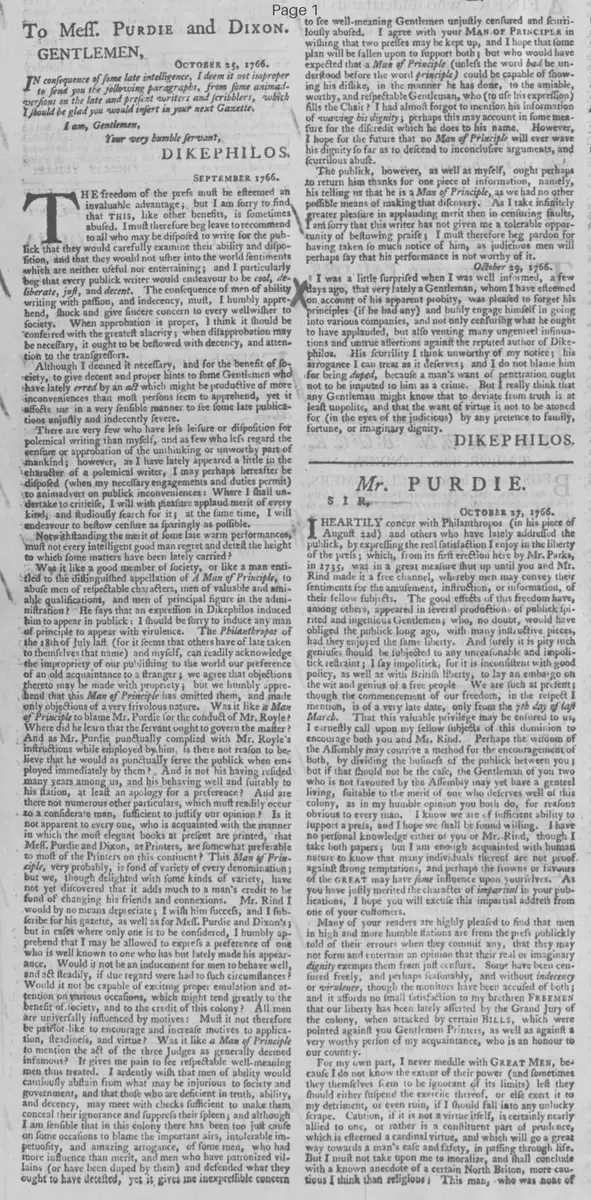
GENTLEMEN,
OCTOBER 25, 1766.
IN consequence of some late intelligence, I deem it not improper to send you the following paragraphs, from some animadversions on the late and present writers and scribblers, which I should be glad you would insert in your next Gazette.
I am, Gentlemen,
Your very humble servant,
DIKEPHILOS
SEPTEMBER 1766.
THE freedom of the press must be esteemed an invaluable advantage; but I am sorry to find that this, like other benefits, is sometimes abused. I must therefore beg leave to recommend to all who may be disposed to write for the public that they would carefully examine their ability and disposition, and that they would not usher into the world sentiments which are neither useful nor entertaining; and I particularly beg that every publick writer would endeavour to be cool, deliberate, just, and decent. The consequence of men of ability writing with passion, and indecency, must, I humbly apprehend, shock and give sincere concern to every well-wisher to society. When approbation is proper, I think it should be conferred with the greatest alacrity; when disapprobation may be necessary, it ought to be bestowed with decency, and attention to the transgressors.
Although I deemed it necessary, and for the benefit of society, to give decent and proper hints to some Gentlemen who have lately erred by an act which might be productive of more inconveniences than most persons seem to apprehend, yet it affects me in a very sensible manner to see some late publications unjustly and indecently severe.
There are very few who have less leisure or disposition for polemical writing than myself, and as few who less regard the censure or approbation of the unthinking or unworthy part of mankind; however, as I have lately appeared a little in the character of a polemical writer, I may perhaps hereafter be disposed (when my necessary engagements and duties permit) to animadvert on publick inconveniences: Where I shall undertake to criticise, I will with pleasure applaud merit of every kind; and studiously search for it; at the same time, I will endeavour to bestow censure as sparingly as possible.
Notwithstanding the merit of some late warm performances, must not every intelligent good man regret and detest the height to which some matters have been lately carried?
Was it like a good member of society, or like a man entitled to the distinguished appellation of A Man of Principle, to abuse men of respectable characters, men of valuable and amiable qualifications, and men of principal figure in the administration? - He says that an expression in Dikephilos induced him to appear in publick: I should be sorry to induce any man of principle to appear with virulence. The Philanthropos of the 18th of July last (for it seems that others have of late taken to themselves that name) and myself, can readily acknowledge -the impropriety of our publishing to the world our preference of an old acquaintance to a stranger; we agree that objections thereto may be made with propriety; but we humbly apprehend that this Man of Principle has omitted them, and made only objections of a very frivolous nature. Was it like a Man of Principle to blame Mr. Purdie for the conduct of Mr. Royle? Where did he learn that the servant ought to govern the master? And as Mr. Purdie punctually complied with Mr. Royle's instructions while employed by him, is there not reason to believe that he would as punctually serve the publick when employed immediately by them? And is not his having resided many years among us, and his behaving well and suitably to his station, at least an apology for a preference? And are there not numerous other particulars, which must readily occur to a considerate man, sufficient to justify our opinion? Is it not apparent to every one, who is acquainted with the manner in which the most elegant books at present are printed, that Mess. Purdie and Dixon, as Printers, are somewhat preferable to most of the Printers on this continent? This Man of Principle, very probably, is fond of variety of every denomination; but we, though delighted with some kinds of variety, have not yet discovered that it adds much to a man's credit to be fond of changing his friends and connexions. Mr. Rind I would by no means depreciate; I wish him success, and I subscribe for his gazette, as well as for Mess. Purdie and Dixon's; but in cases where only one is to be considered, I humbly apprehend that I may be allowed to express a preference of one who is well known to one who has but lately made his appearance. Would it not be an inducement for men to behave well, and act steadily, if due regard were had to such circumstances? Would it not be capable of exciting proper emulation and attention on various occasions, which might tend greatly to the benefit of society, and to the credit of this colony? All men are universally influenced by motives: Must it not therefore be patriot-like to encourage and increase motives to application, steadiness, and virtue? Was it like a Man of Principle to mention the act of the three Judges as generally deemed infamous? It gives me pain to see respectable well-meaning men thus treated. I ardently wish that men of ability would cautiously abstain from what may be injurious to society and government, and that those who are deficient in truth, ability, and decency, may meet with checks sufficient to make them conceal their ignorance and suppress their spleen; and although I am sensible that in this colony there has been too just cause on some occasions to blame the important airs, intolerable impertuosity, and amazing arrogance, of some men, who had more influence than merit, and men who have patronized villains (or have been duped by them) and defended what they ought to have detested, yet it gives me inexpressible concern
What sub-type of article is it?
What themes does it cover?
What keywords are associated?
What entities or persons were involved?
Letter to Editor Details
Author
Dikephilos
Recipient
Mess. Purdie And Dixon
Main Argument
while valuing press freedom, writers should exercise decency and justice; criticizes a 'man of principle' for indecent attacks on respected figures and defends preference for established local printers like purdie and dixon over newcomers, promoting societal benefit through moral encouragement.
Notable Details