Thank you for visiting SNEWPapers!
Sign up free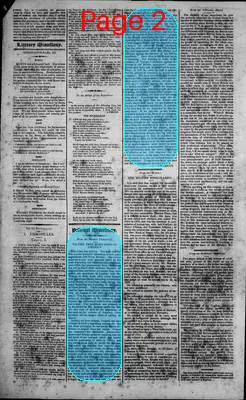
Editorial
August 16, 1809
The Rhode Island Republican
Newport, Newport County, Rhode Island
What is this article about?
An editorial from the Boston Chronicle criticizes British trade policies and diplomatic insults toward the U.S., arguing that America has been too submissive and must now act decisively to defend its independence and trade rights against restrictions favoring British merchants.
Clipping
OCR Quality
95%
Excellent
Full Text
Political Miscellany.
From the Boston Chronicle.
TO THE FREE BORN SONS OF AMERICA.
The crisis has arrived. You have now before you the probable ultimatum of four years negociation with Great Britain. She seems resolved to test your national spirit by the most degrading and contemptuous conditions. And while the government have disavowed the act by which their minister imposed on the president, and threw our nation from their guard, the merchants in London, with Mr. Wilson at their head, have come forward with resolves, evidently intending to annihilate every vestige of American trade, except the mere importing and exporting to the Island of Great Britain. Their remonstrances and resolves have abridged your reprieve from the 10th of August to the 20th of July (now past.). You are now to do—what?—wait the orders of the court of St. James, to know whether any remnant of trade is to be allowed you or not. The conditions are probably to be forwarded by Mr. Jackson under the title of a new code of laws for the regulation of the trade of the colonies of America, (they certainly will no longer think of calling us states.)
Indeed, we have dodged, cringed, and succumbed in such a degrading manner for the last three years, that we can hardly expect deference or respect from any nation. France has suspended her diplomatic communications—and Britain seems to conclude that the last spark of our national spirit was buried with our suspension of arms in 1783; and late events seem fully to justify the opinion. She orders her ships on our coast to overhaul, and regulate our trade, to bring to our ships, (even coasters)—to kill, destroy, and capture such as she chooses—we complain, scold a little, talk high and bloated sentences—our secretary writes to her minister—our ambassadour makes known our complaints to the minister of foreign affairs—he answers, talks of rights, amicable affections, of the broad seas, of the narrow seas, until some new insult, and some new degradation pushes the old injury out of sight, and we deliberately begin again on the new subject, and act over the same as before; hitherto it has produced the same effect—viz. Nothing.
It now appears, that the order of the 26th of April, was all that the government intended in our favor; while the merchants say that even that order was conceding too much. Here follow their own words—“That good faith is as necessary to be exercised by government to natives as to aliens; and that the orders of council of Nov. 1807, were a pledge to the British merchants, that the system of rigor adapted to those orders, should be exercised against France and her dependencies, as long as the edicts of Berlin continued. That the order of council of the 26th of April last, was inconsistent with that pledge, and militated against the interest of the British merchants.” Here then is the British mode of reasoning.—For America to trade to the continent of Europe, “militates against the interest of the British merchants.” Consequently they must not be permitted to trade. Thus, it will be seen at half a glance, that the ground of reasoning is narrowed to a tangent. We, as a nominal (I wish I could say actual independent nation,) are not permitted to trade to friendly nations, because the trade may “militate against the interest of the British merchant.” Is this the language held out to a nation, containing eight millions of daring, hardy, and Independent people—Or is the chastising rod, held over the trembling slave? It certainly has more the appearance of the latter than the former,—and clearly shews how much we are belittled in the eyes of European calculators. It remains to be seen how far we acquiesce in this arrangement. If we concede to the terms, laughable indeed, is the farce of our independence—even to pause, is political suicide.—But we have reasoned, spouted, talked, and written enough on the subject—it is time to rouse from our reveries—it is time to ACT—it is time to shew that if our simple, unsuspeting and faithful peace-loving policy, has been treacherously abused, that we will submit no longer—it is time to convince the world that we have not forfeited the character that produced the peace of '83, and established us as a nation—we must resort to more energetic measures to accomplish this necessary reformation, than the mere, vaporings and resolves of the 10th congress, that we would not submit, at the same time they took no measure to secure our national honour or Independence. I repeat—we have spouted and talked enough—IT IS TIME TO ACT.
AMERICUS.
From the Boston Chronicle.
TO THE FREE BORN SONS OF AMERICA.
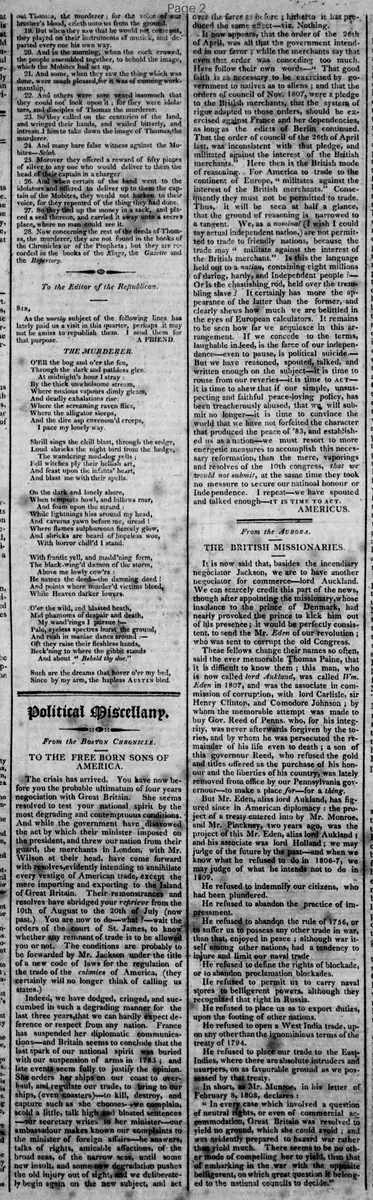
The crisis has arrived. You have now before you the probable ultimatum of four years negociation with Great Britain. She seems resolved to test your national spirit by the most degrading and contemptuous conditions. And while the government have disavowed the act by which their minister imposed on the president, and threw our nation from their guard, the merchants in London, with Mr. Wilson at their head, have come forward with resolves, evidently intending to annihilate every vestige of American trade, except the mere importing and exporting to the Island of Great Britain. Their remonstrances and resolves have abridged your reprieve from the 10th of August to the 20th of July (now past.). You are now to do—what?—wait the orders of the court of St. James, to know whether any remnant of trade is to be allowed you or not. The conditions are probably to be forwarded by Mr. Jackson under the title of a new code of laws for the regulation of the trade of the colonies of America, (they certainly will no longer think of calling us states.)
Indeed, we have dodged, cringed, and succumbed in such a degrading manner for the last three years, that we can hardly expect deference or respect from any nation. France has suspended her diplomatic communications—and Britain seems to conclude that the last spark of our national spirit was buried with our suspension of arms in 1783; and late events seem fully to justify the opinion. She orders her ships on our coast to overhaul, and regulate our trade, to bring to our ships, (even coasters)—to kill, destroy, and capture such as she chooses—we complain, scold a little, talk high and bloated sentences—our secretary writes to her minister—our ambassadour makes known our complaints to the minister of foreign affairs—he answers, talks of rights, amicable affections, of the broad seas, of the narrow seas, until some new insult, and some new degradation pushes the old injury out of sight, and we deliberately begin again on the new subject, and act over the same as before; hitherto it has produced the same effect—viz. Nothing.
It now appears, that the order of the 26th of April, was all that the government intended in our favor; while the merchants say that even that order was conceding too much. Here follow their own words—“That good faith is as necessary to be exercised by government to natives as to aliens; and that the orders of council of Nov. 1807, were a pledge to the British merchants, that the system of rigor adapted to those orders, should be exercised against France and her dependencies, as long as the edicts of Berlin continued. That the order of council of the 26th of April last, was inconsistent with that pledge, and militated against the interest of the British merchants.” Here then is the British mode of reasoning.—For America to trade to the continent of Europe, “militates against the interest of the British merchants.” Consequently they must not be permitted to trade. Thus, it will be seen at half a glance, that the ground of reasoning is narrowed to a tangent. We, as a nominal (I wish I could say actual independent nation,) are not permitted to trade to friendly nations, because the trade may “militate against the interest of the British merchant.” Is this the language held out to a nation, containing eight millions of daring, hardy, and Independent people—Or is the chastising rod, held over the trembling slave? It certainly has more the appearance of the latter than the former,—and clearly shews how much we are belittled in the eyes of European calculators. It remains to be seen how far we acquiesce in this arrangement. If we concede to the terms, laughable indeed, is the farce of our independence—even to pause, is political suicide.—But we have reasoned, spouted, talked, and written enough on the subject—it is time to rouse from our reveries—it is time to ACT—it is time to shew that if our simple, unsuspeting and faithful peace-loving policy, has been treacherously abused, that we will submit no longer—it is time to convince the world that we have not forfeited the character that produced the peace of '83, and established us as a nation—we must resort to more energetic measures to accomplish this necessary reformation, than the mere, vaporings and resolves of the 10th congress, that we would not submit, at the same time they took no measure to secure our national honour or Independence. I repeat—we have spouted and talked enough—IT IS TIME TO ACT.
AMERICUS.
What sub-type of article is it?
Foreign Affairs
Trade Or Commerce
Economic Policy
What keywords are associated?
British Trade Restrictions
American Independence
Foreign Insults
Call To Action
National Honor
What entities or persons were involved?
Great Britain
British Merchants
Mr. Wilson
Mr. Jackson
President
France
Editorial Details
Primary Topic
Critique Of British Trade Impositions And Call For American Action
Stance / Tone
Strongly Pro American, Urging Resistance To British Degradation
Key Figures
Great Britain
British Merchants
Mr. Wilson
Mr. Jackson
President
France
Key Arguments
Britain Resolved To Test American Spirit With Degrading Conditions
American Government Has Cringed And Succumbed Degradingly
British Merchants Seek To Annihilate American Trade
Time To Act Rather Than Talk And Complain Ineffectually
American Trade To Europe Militates Against British Interests Per Their Reasoning