Thank you for visiting SNEWPapers!
Sign up free
Editorial
May 30, 1854
The Camden Weekly Journal
Camden, Kershaw County, South Carolina
What is this article about?
Editorial from The Journal in Camden, South Carolina, dated May 30, 1854, endorses the Central Committee's address calling for the complete suppression of the liquor traffic. It defends the proposal as moral, patriotic, and republican, refuting claims of being anti-republican or revolutionary, and highlights the traffic's societal harms like crime, poverty, and pauperism.
Clipping
OCR Quality
95%
Excellent
Full Text
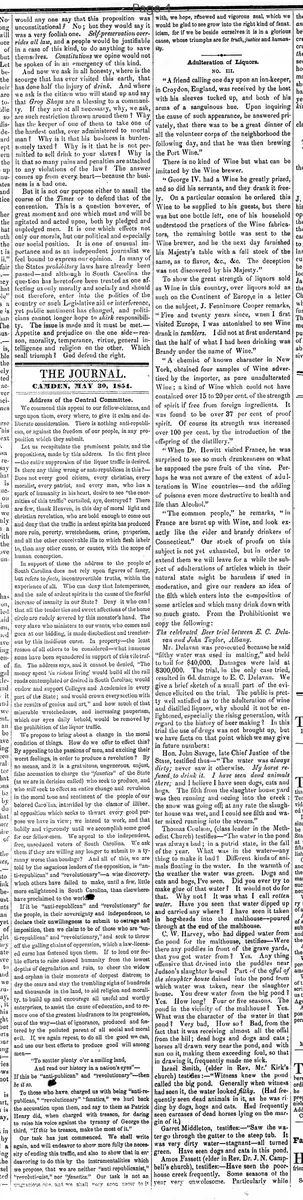
THE JOURNAL
CAMDEN, MAY 30, 1854.
Address of the Central Committee.
We commend this appeal to our fellow-citizens, and urge upon them, every where, to give it calm and deliberate consideration. There is nothing anti-republican, or against the freedom of our people, in any proposition which they submit.
Let us recapitulate the prominent points, and the propositions, made by this address. In the first place—the entire suppression of the liquor traffic is desired. Is there any thing wrong or anti-republican in this?—Does not every good citizen, every christian, every moralist, every patriot, and every man, who has a spark of humanity in his heart, desire to see "the enormities of this traffic" curtailed, aye, destroyed? There are few, thank Heaven, in this day of moral light and christian revelation, who are bold enough to come out and deny that the traffic in ardent spirits has produced more ruin, poverty, wretchedness, crime, pauperism, and all the other conceivable ills to which flesh is heir to, than any other cause, or causes, with the scope of human conception.
In support of these the address to the people of South Carolina does not rely upon figures of fancy but refers to facts, incontrovertible truths, within the experience of all. Who can deny that Intemperance, and the sale of ardent spirits is the cause of the fearful increase of insanity in our State? Deny it who can! that all the tender ties and sweet affections of the home circle are rudely severed by this monster's hand. The very slave who ministers to our wants, who comes and goes at our bidding, is made disobedient and treacherous by this insidious curse. In property—the least reason of all others to be considered—what immense sums have been squandered in support of this vile traffic. The address says, and it cannot be denied, "The money spent 'in riotous living' would build all the rail roads contemplated or desired in South Carolina; would endow and support Colleges and Academies in every part of the State; and would crown every section with the results of genius and art," and how much of that miserable wretchedness, and increasing pauperism, which our eyes daily behold, would be removed by the prohibition of the liquor traffic.
We propose to bring about a change in the moral condition of things. How do we offer to effect this? By appealing to the passions of men, and exciting their worst feelings, in order to produce a revolution? By no means, and it is a gratuitous, ungenerous, unjust, false accusation to charge the "fanatics" of the State (as we are in derision called) who seek to produce, and who will seek to effect an entire change and revulsion in the moral tone and sentiment of the people of our beloved Carolina, intimidated by the clamor of illiberal opposition which seeks to thwart every good purpose we have in view; we intend to work, and that boldly and vigorously until we accomplish some good for our fellow-men. We appeal to the independent free, unseduced voters of South Carolina. We ask them if they are willing any longer to submit to a tyranny worse than bondage? And all of this, we are told by the sagacious leaders of the opposition, is "anti-republican" and "revolutionary"—a wise discovery which others have failed to make, until a few, little more enlightened in South Carolina, than elsewhere have proclaimed to the world.
If it be "anti-republican" and "revolutionary" for the people, in their sovereignty and independence, to declare their unwillingness to submit to outrage and imposition, then we claim to be of those who are "anti-republican" and "revolutionary," and seek to throw off the galling chains of oppression, which a law-licensed curse has fastened upon them. If to lend our feeble efforts to raise abused humanity from the lowest depths of degradation and ruin, to cheer the widow and orphan in their moments of deepest distress; to dry the tears and stay the trembling sighs of hundreds and thousands in the land, to aid religion and morality, to build up and encourage all useful and worthy enterprises, to assist the cause of education, and to remove one of the greatest hindrances to its progression, out of the way—that of ignorance, produced and fostered by the polluted parent of all social and moral evil. If, we again repeat, to do all the good we can, and use our best efforts to produce good will among men
"To scatter plenty o'er a smiling land,
And read our history in a nation's eyes"—
If this be "anti-republican" and "revolutionary"—then be it so.
To those who have, charged us with being "anti-republican," "revolutionary" "fanatics," we hurl back the accusation upon them, and say to them as Patrick Henry did, when charged with treason, for daring to raise his voice against the tyranny of George the third, "If this be treason, make the most of it."
Our task has just commenced. We shall write again, and will endeavor to show more fully the necessity of ending this traffic, and also to show that in endeavoring to do this by the instrumentalities which we propose, that we are neither "anti republican," "revolutionist," nor "fanatics." Our task is not an ungracious one, and we shall very soon recur to it with, we hope, renewed and vigorous zeal, which we would be glad to see grow into the right kind of fanaticism, for if we be beside ourselves it is in a glorious cause, whose triumphs are for truth, justice and humanity.
CAMDEN, MAY 30, 1854.
Address of the Central Committee.
We commend this appeal to our fellow-citizens, and urge upon them, every where, to give it calm and deliberate consideration. There is nothing anti-republican, or against the freedom of our people, in any proposition which they submit.
Let us recapitulate the prominent points, and the propositions, made by this address. In the first place—the entire suppression of the liquor traffic is desired. Is there any thing wrong or anti-republican in this?—Does not every good citizen, every christian, every moralist, every patriot, and every man, who has a spark of humanity in his heart, desire to see "the enormities of this traffic" curtailed, aye, destroyed? There are few, thank Heaven, in this day of moral light and christian revelation, who are bold enough to come out and deny that the traffic in ardent spirits has produced more ruin, poverty, wretchedness, crime, pauperism, and all the other conceivable ills to which flesh is heir to, than any other cause, or causes, with the scope of human conception.
In support of these the address to the people of South Carolina does not rely upon figures of fancy but refers to facts, incontrovertible truths, within the experience of all. Who can deny that Intemperance, and the sale of ardent spirits is the cause of the fearful increase of insanity in our State? Deny it who can! that all the tender ties and sweet affections of the home circle are rudely severed by this monster's hand. The very slave who ministers to our wants, who comes and goes at our bidding, is made disobedient and treacherous by this insidious curse. In property—the least reason of all others to be considered—what immense sums have been squandered in support of this vile traffic. The address says, and it cannot be denied, "The money spent 'in riotous living' would build all the rail roads contemplated or desired in South Carolina; would endow and support Colleges and Academies in every part of the State; and would crown every section with the results of genius and art," and how much of that miserable wretchedness, and increasing pauperism, which our eyes daily behold, would be removed by the prohibition of the liquor traffic.
We propose to bring about a change in the moral condition of things. How do we offer to effect this? By appealing to the passions of men, and exciting their worst feelings, in order to produce a revolution? By no means, and it is a gratuitous, ungenerous, unjust, false accusation to charge the "fanatics" of the State (as we are in derision called) who seek to produce, and who will seek to effect an entire change and revulsion in the moral tone and sentiment of the people of our beloved Carolina, intimidated by the clamor of illiberal opposition which seeks to thwart every good purpose we have in view; we intend to work, and that boldly and vigorously until we accomplish some good for our fellow-men. We appeal to the independent free, unseduced voters of South Carolina. We ask them if they are willing any longer to submit to a tyranny worse than bondage? And all of this, we are told by the sagacious leaders of the opposition, is "anti-republican" and "revolutionary"—a wise discovery which others have failed to make, until a few, little more enlightened in South Carolina, than elsewhere have proclaimed to the world.
If it be "anti-republican" and "revolutionary" for the people, in their sovereignty and independence, to declare their unwillingness to submit to outrage and imposition, then we claim to be of those who are "anti-republican" and "revolutionary," and seek to throw off the galling chains of oppression, which a law-licensed curse has fastened upon them. If to lend our feeble efforts to raise abused humanity from the lowest depths of degradation and ruin, to cheer the widow and orphan in their moments of deepest distress; to dry the tears and stay the trembling sighs of hundreds and thousands in the land, to aid religion and morality, to build up and encourage all useful and worthy enterprises, to assist the cause of education, and to remove one of the greatest hindrances to its progression, out of the way—that of ignorance, produced and fostered by the polluted parent of all social and moral evil. If, we again repeat, to do all the good we can, and use our best efforts to produce good will among men
"To scatter plenty o'er a smiling land,
And read our history in a nation's eyes"—
If this be "anti-republican" and "revolutionary"—then be it so.
To those who have, charged us with being "anti-republican," "revolutionary" "fanatics," we hurl back the accusation upon them, and say to them as Patrick Henry did, when charged with treason, for daring to raise his voice against the tyranny of George the third, "If this be treason, make the most of it."
Our task has just commenced. We shall write again, and will endeavor to show more fully the necessity of ending this traffic, and also to show that in endeavoring to do this by the instrumentalities which we propose, that we are neither "anti republican," "revolutionist," nor "fanatics." Our task is not an ungracious one, and we shall very soon recur to it with, we hope, renewed and vigorous zeal, which we would be glad to see grow into the right kind of fanaticism, for if we be beside ourselves it is in a glorious cause, whose triumphs are for truth, justice and humanity.
What sub-type of article is it?
Temperance
Moral Or Religious
Social Reform
What keywords are associated?
Liquor Traffic
Temperance Movement
South Carolina
Moral Reform
Intemperance Harms
Prohibition Appeal
What entities or persons were involved?
Central Committee
Patrick Henry
George The Third
Editorial Details
Primary Topic
Suppression Of The Liquor Traffic In South Carolina
Stance / Tone
Strongly Supportive Of Temperance, Defensive Against Accusations Of Anti Republicanism
Key Figures
Central Committee
Patrick Henry
George The Third
Key Arguments
Liquor Traffic Causes Ruin, Poverty, Crime, Pauperism, And Insanity.
Suppression Would Fund Railroads, Colleges, And Reduce Wretchedness.
Proposal Appeals To Voters' Sovereignty, Not Revolution.
Efforts Aid Humanity, Religion, Morality, Education, And Social Good.
Accusations Of Fanaticism Are Hurled Back, Echoing Patrick Henry.