Thank you for visiting SNEWPapers!
Sign up free
Alexandria Daily Gazette, Commercial & Political
Alexandria, Virginia
What is this article about?
On January 13, 1809, in the U.S. House of Representatives, Mr. Burwell presented a bill authorizing the President to permit vessels to import salt during the embargo. Accompanied by a January 7 letter from Treasury Secretary Albert Gallatin analyzing salt consumption, imports, and advocating for immediate imports and long-term domestic production via duties or bounties.
Clipping
OCR Quality
Full Text
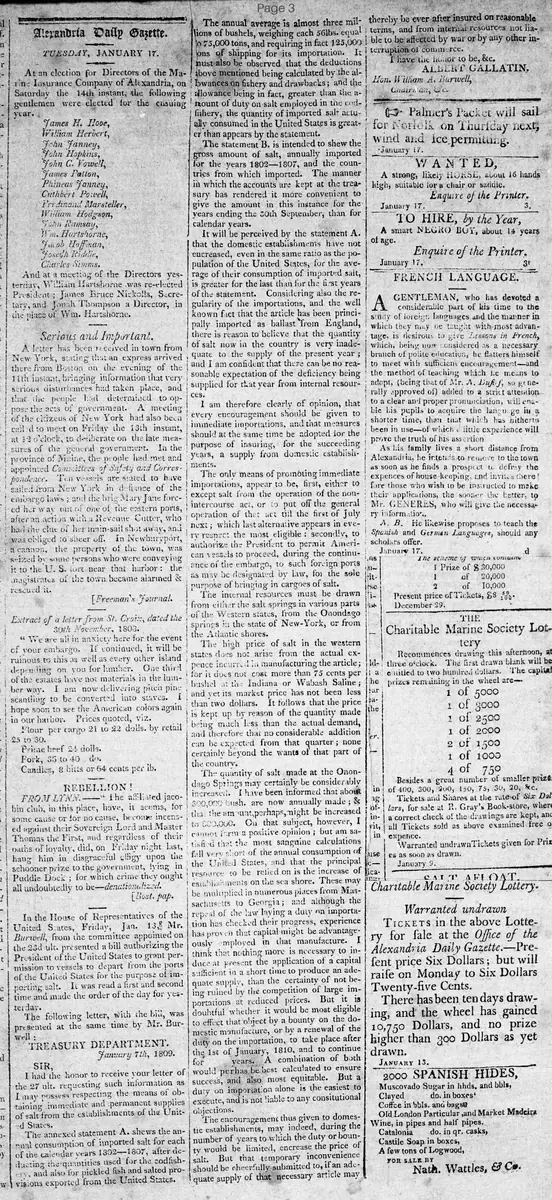
The following letter, with the bill, was presented at the same time by Mr. Burwell:
TREASURY DEPARTMENT.
January 7th, 1809.
SIR,
I had the honor to receive your letter of the 27 ult. requesting such information as I may possess respecting the means of obtaining immediate and permanent supplies of salt from the establishments of the United States.
The annexed statement A. shews the annual consumption of imported salt for each of the calendar years 1802-1807, after deducting the quantities used for the cod fishery, and also for pickled fish and salted provisions exported from the United States.
The annual average is almost three millions of bushels, weighing each 56lbs. equal to 75,000 tons, and requiring in fact 125,000 tons of shipping for its importation. It must also be observed that the deductions above mentioned being calculated by the allowances on fishery and drawbacks; and the allowance being in fact, greater than the amount of duty on salt employed in the cod fishery, the quantity of imported salt actually consumed in the United States is greater than appears by the statement.
The statement B. is intended to shew the gross amount of salt, annually imported for the years 1802-1807, and the countries from which imported. The manner in which the accounts are kept at the treasury has rendered it more convenient to give the amount in this instance for the years ending the 30th September, than for calendar years.
It will be perceived by the statement A. that the domestic establishments have not increased, even in the same ratio as the population of the United States, for the average of their consumption of imported salt, is greater for the last than for the first years of the statement. Considering also the regularity of the importations, and the well known fact that the article has been principally imported as ballast from England, there is reason to believe that the quantity of salt now in the country is very inadequate to the supply of the present year; and I am confident that there can be no reasonable expectation of the deficiency being supplied for that year from internal resources.
I am therefore clearly of opinion, that every encouragement should be given to immediate importations, and that measures should at the same time be adopted for the purpose of ensuring, for the succeeding years, a supply from domestic establishments.
The only means of promoting immediate importations, appear to be, first, either to except salt from the operation of the non-intercourse act, or to put off the general operation of that act till the first of July next; which last alternative appears in every respect the most eligible: secondly, to authorize the President to permit American vessels to proceed, during the continuance of the embargo, to such foreign ports as may be designated by law, for the sole purpose of bringing in cargoes of salt.
The internal resources must be drawn from either the salt springs in various parts of the Western states, from the Onondaga springs in the state of New-York, or from the Atlantic shores.
The high price of salt in the western states does not arise from the actual expense incurred in manufacturing the article; for it does not cost more than 75 cents per bushel at the Indiana or Wabash Saline; and yet its market price has not been less than two dollars. It follows that the price is kept up by reason of the quantity made being much less than the actual demand, and therefore that no considerable addition can be expected from that quarter; none certainly beyond the wants of that part of the country.
The quantity of salt made at the Onondaga Springs may certainly be considerably increased. I have been informed that about 300,000 bush. are now annually made; & that the amount, perhaps, might be increased to 500,000. On that subject, however, I cannot form a positive opinion; but am satisfied that the most sanguine calculations fall very short of the annual consumption of the United States, and that the principal resource to be relied on is the increase of establishments on the sea shore. These may be multiplied in numerous places from Massachusetts to Georgia; and although the repeal of the law laying a duty on importation has checked their progress, experience has proven that capital might be advantageously employed in that manufacture. I think that nothing more is necessary to induce at present the application of a capital sufficient in a short time to produce an adequate supply, than the certainty of not being ruined by the competition of large importations at reduced prices. But it is doubtful whether it would be most eligible to effect that object by a bounty on the domestic manufacture, or by a renewal of the duty on the importation, to take place after the 1st of January, 1810, and to continue for years. A combination of both would perhaps be best calculated to ensure success, and also most equitable. But a duty on importation alone is the easiest to execute, and is not liable to any constitutional objections.
The encouragement thus given to domestic establishments, may indeed, during the number of years to which the duty or bounty would be limited, increase the price of salt. But that temporary inconvenience should be cheerfully submitted to, if an adequate supply of that necessary article may thereby be ever after insured on reasonable terms, and from internal resources not liable to be affected by war or by any other interruption of commerce.
I have the honor to be, &c.
ALBERT GALLATIN.
Hon. William A. Burwell.
Union and, &c.
What sub-type of article is it?
What keywords are associated?
What entities or persons were involved?
Where did it happen?
Domestic News Details
Primary Location
United States
Event Date
January 13, 1809
Key Persons
Outcome
bill read first and second time; ordered for discussion the following day. gallatin recommends permitting salt imports and incentivizing domestic production to ensure future supply.
Event Details
Mr. Burwell presented a bill authorizing the President to permit U.S. vessels to depart ports for importing salt. Accompanied by Gallatin's letter detailing annual salt consumption (avg. 3 million bushels), import sources, inadequacy of current domestic production, and suggestions for immediate imports via exceptions to embargo and long-term duties or bounties on domestic salt.