Thank you for visiting SNEWPapers!
Sign up free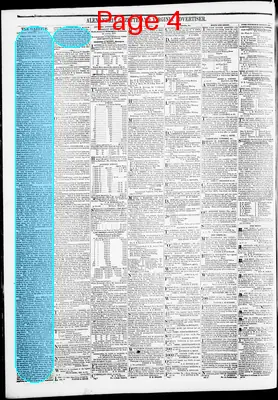
Literary
August 22, 1857
Alexandria Gazette
Alexandria, Alexandria County, District Of Columbia
What is this article about?
Newspaper article from August 22, 1857, discussing historian William H. Prescott's challenges with eyesight loss and his methods for writing histories, including an excerpt from his letter to Rev. Geo. E. Ellis detailing his process of study, reading with assistants, and using a special writing apparatus.
Clipping
OCR Quality
95%
Excellent
Full Text
THE GAZETTE:
SATURDAY MORNING, AUGUST 22, 1857
PRESCOTT, THE HISTORIAN.
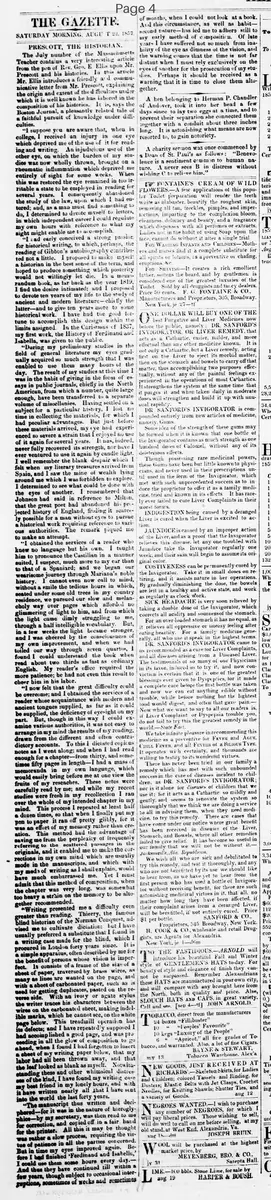
The July number of the Massachusetts Teacher contains a very interesting article from the pen of Rev. Geo. E. Ellis upon Mr. Prescott and his histories. In this article Mr. Ellis introduces a friendly and communicative letter from Mr. Prescott, explaining the origin and extent of the difficulties under which it is well known he has labored in the composition of his histories. It is, says the Boston Journal, a pleasantly related tale of a faithful pursuit of knowledge under difficulties.
"I suppose you are aware that, when in college, I received an injury in one eye which deprived me of the use of it for reading and writing. An injudicious use of the other eye, on which the burden of my studies was now wholly thrown, brought on a rheumatic inflammation which deprived me entirely of sight for some weeks. When this was restored the eye remained in too irritable a state to be employed in reading for several years. I consequently abandoned the study of the law, upon which I had entered; and, as a man must find something to do, I determined to devote myself to letters, in which independent career I could regulate my own hours with reference to what my sight might enable me to accomplish.
"I had early conceived a strong passion for historical writing, to which, perhaps, the reading of Gibbon's autobiography contributed not a little. I proposed to make myself a historian in the best sense of the term, and hoped to produce something which posterity would not willingly let die. In memorandum book, as far back as the year 1819, I find the desire intimated: and I proposed to devote ten years of my life to the study of ancient and modern literature-chiefly the latter-and to give ten years more to some historical work. I have had the good fortune to accomplish this design within the limits assigned. In the Christmas of 1837, my first work, the History of Ferdinand and Isabella, was given to the public.
"During my preliminary studies in the field of general literature my eyes gradually acquired so much strength that I was enabled to use them many hours of the day. The result of my studies at this time I was in the habit of giving in the form of essays in public journals, chiefly in the North American, from which a number, quite large enough, have been transferred to a separate volume of miscellanies. Having settled on a subject for a particular history, I lost no time in collecting the materials, for which I had peculiar advantages. But just before these materials arrived, my eye had experienced so severe a strain that I enjoyed no use of it again for several years. It has, indeed, never fully recovered its strength, nor have I ever ventured to use it again by candle light. I well remember the blank despair which I felt when my literary treasures arrived from Spain, and I saw the mine of wealth lying around me which I was forbidden to explore. I determined to see what could be done with the eyes of another. I remembered that Johnson had said in reference to Milton, that the great poet had abandoned his projected history of England, finding it scarce by possible for a man without eyes to pursue a historical work requiring reference to various authorities. The remark piqued me to make an attempt. I obtained the services of a reader who knew no language but his own. I taught him to pronounce the Castilian in a manner suited, I suspect, much more to my ear than to that of a Spaniard; and we began our wearisome journey through Mariana's noble history. I cannot even now call to mind, without a smile, the tedious hours in which, seated under some old trees in my country residence, we pursued our slow and melancholy way over pages which afforded no glimmering of light to him, and from which the light came dimly struggling to me, through a half intelligible vocabulary. But, in a few weeks the light became stronger, and I was cheered by the consciousness of my own improvement, and when we had toiled our way through seven quartos, I found I could understand the book when read about two thirds as fast as ordinary English. My reader's office required the more patience; he had not even this result to cheer him in his labor.
"I now felt that the great difficulty could be overcome; and I obtained the services of a reader whose acquaintance with modern and ancient tongues supplied, as far as it could be supplied, the deficiency of eyesight on my part. But, though in this way I could examine various authorities, it was not easy to arrange in my mind the results of my reading, drawn from the different and often contradictory accounts. To this I dictated copious notes as I went along; and when I had read enough for a chapter-from thirty, and sometimes fifty pages in length-I had a mass of memoranda in my own language, which would easily bring before me at one view the fruits of my researches. These notes were carefully read by me; and while my recent studies were fresh in my recollection I ran over the whole of my intended chapter in my mind. This process I repeated at least half a dozen times, so that when I finally put my pen to paper it ran off pretty glibly, for it was an effort of my memory rather than creation. This method had the advantage of saving me from the perplexity of frequently referring to the scattered passages in the originals, and it enabled me to make the corrections in my modes of writing as I shall explain, would have much embarrassed me. Yet I must admit that this method of composition, when the chapter was very long, was somewhat greater than reading. Thierry, the famous blind historian of the Norman Conquest, advised me to cultivate dictation: but I have usually preferred a substitute that I found in a writing case made for the blind, which I procured in London forty years since. It is a simple apparatus, often described by me for the benefit of persons whose vision is imperfect. It consists of a frame of the size of a sheet of paper, traversed by brass wires, as many as lines are wanted on the page, and with a sheet of carbonated paper, such as is needed for getting duplicates, pasted on the reverse side. With an ivory or agate stylus the writer traces his characters between the wires on the carbonated sheet, making indelible marks, which he cannot see, on the white page below. This threadbare operation has its defects; and I have repeatedly supposed I had accomplished a good page, and was proceeding in all the glow of composition to go ahead, when I found I had forgotten to insert the sheet of my writing paper below, that my labor had all been thrown away, and that the leaf looked as blank as myself. Notwithstanding these and other whimsical distresses of the kind, I have found my writing case my best friend in my lonely hours, and with it have written nearly all that I have sent into the world the last forty years.
"The manuscript thus written and deciphered-for it was in the nature of hieroglyphics-by my secretary, was then read to me for correction, and copied off in a fair hand for the printer. All this it may be thought was rather a slow process, requiring the virtue of patience in all the parties concerned. But in time my eyes improved again. Before I had finished Ferdinand and Isabella, I could use them some hours every day. And thus they have continued till within a few years, though subject to occasional interruptions, sometimes of weeks and sometimes
SATURDAY MORNING, AUGUST 22, 1857
PRESCOTT, THE HISTORIAN.
The July number of the Massachusetts Teacher contains a very interesting article from the pen of Rev. Geo. E. Ellis upon Mr. Prescott and his histories. In this article Mr. Ellis introduces a friendly and communicative letter from Mr. Prescott, explaining the origin and extent of the difficulties under which it is well known he has labored in the composition of his histories. It is, says the Boston Journal, a pleasantly related tale of a faithful pursuit of knowledge under difficulties.
"I suppose you are aware that, when in college, I received an injury in one eye which deprived me of the use of it for reading and writing. An injudicious use of the other eye, on which the burden of my studies was now wholly thrown, brought on a rheumatic inflammation which deprived me entirely of sight for some weeks. When this was restored the eye remained in too irritable a state to be employed in reading for several years. I consequently abandoned the study of the law, upon which I had entered; and, as a man must find something to do, I determined to devote myself to letters, in which independent career I could regulate my own hours with reference to what my sight might enable me to accomplish.
"I had early conceived a strong passion for historical writing, to which, perhaps, the reading of Gibbon's autobiography contributed not a little. I proposed to make myself a historian in the best sense of the term, and hoped to produce something which posterity would not willingly let die. In memorandum book, as far back as the year 1819, I find the desire intimated: and I proposed to devote ten years of my life to the study of ancient and modern literature-chiefly the latter-and to give ten years more to some historical work. I have had the good fortune to accomplish this design within the limits assigned. In the Christmas of 1837, my first work, the History of Ferdinand and Isabella, was given to the public.
"During my preliminary studies in the field of general literature my eyes gradually acquired so much strength that I was enabled to use them many hours of the day. The result of my studies at this time I was in the habit of giving in the form of essays in public journals, chiefly in the North American, from which a number, quite large enough, have been transferred to a separate volume of miscellanies. Having settled on a subject for a particular history, I lost no time in collecting the materials, for which I had peculiar advantages. But just before these materials arrived, my eye had experienced so severe a strain that I enjoyed no use of it again for several years. It has, indeed, never fully recovered its strength, nor have I ever ventured to use it again by candle light. I well remember the blank despair which I felt when my literary treasures arrived from Spain, and I saw the mine of wealth lying around me which I was forbidden to explore. I determined to see what could be done with the eyes of another. I remembered that Johnson had said in reference to Milton, that the great poet had abandoned his projected history of England, finding it scarce by possible for a man without eyes to pursue a historical work requiring reference to various authorities. The remark piqued me to make an attempt. I obtained the services of a reader who knew no language but his own. I taught him to pronounce the Castilian in a manner suited, I suspect, much more to my ear than to that of a Spaniard; and we began our wearisome journey through Mariana's noble history. I cannot even now call to mind, without a smile, the tedious hours in which, seated under some old trees in my country residence, we pursued our slow and melancholy way over pages which afforded no glimmering of light to him, and from which the light came dimly struggling to me, through a half intelligible vocabulary. But, in a few weeks the light became stronger, and I was cheered by the consciousness of my own improvement, and when we had toiled our way through seven quartos, I found I could understand the book when read about two thirds as fast as ordinary English. My reader's office required the more patience; he had not even this result to cheer him in his labor.
"I now felt that the great difficulty could be overcome; and I obtained the services of a reader whose acquaintance with modern and ancient tongues supplied, as far as it could be supplied, the deficiency of eyesight on my part. But, though in this way I could examine various authorities, it was not easy to arrange in my mind the results of my reading, drawn from the different and often contradictory accounts. To this I dictated copious notes as I went along; and when I had read enough for a chapter-from thirty, and sometimes fifty pages in length-I had a mass of memoranda in my own language, which would easily bring before me at one view the fruits of my researches. These notes were carefully read by me; and while my recent studies were fresh in my recollection I ran over the whole of my intended chapter in my mind. This process I repeated at least half a dozen times, so that when I finally put my pen to paper it ran off pretty glibly, for it was an effort of my memory rather than creation. This method had the advantage of saving me from the perplexity of frequently referring to the scattered passages in the originals, and it enabled me to make the corrections in my modes of writing as I shall explain, would have much embarrassed me. Yet I must admit that this method of composition, when the chapter was very long, was somewhat greater than reading. Thierry, the famous blind historian of the Norman Conquest, advised me to cultivate dictation: but I have usually preferred a substitute that I found in a writing case made for the blind, which I procured in London forty years since. It is a simple apparatus, often described by me for the benefit of persons whose vision is imperfect. It consists of a frame of the size of a sheet of paper, traversed by brass wires, as many as lines are wanted on the page, and with a sheet of carbonated paper, such as is needed for getting duplicates, pasted on the reverse side. With an ivory or agate stylus the writer traces his characters between the wires on the carbonated sheet, making indelible marks, which he cannot see, on the white page below. This threadbare operation has its defects; and I have repeatedly supposed I had accomplished a good page, and was proceeding in all the glow of composition to go ahead, when I found I had forgotten to insert the sheet of my writing paper below, that my labor had all been thrown away, and that the leaf looked as blank as myself. Notwithstanding these and other whimsical distresses of the kind, I have found my writing case my best friend in my lonely hours, and with it have written nearly all that I have sent into the world the last forty years.
"The manuscript thus written and deciphered-for it was in the nature of hieroglyphics-by my secretary, was then read to me for correction, and copied off in a fair hand for the printer. All this it may be thought was rather a slow process, requiring the virtue of patience in all the parties concerned. But in time my eyes improved again. Before I had finished Ferdinand and Isabella, I could use them some hours every day. And thus they have continued till within a few years, though subject to occasional interruptions, sometimes of weeks and sometimes
What sub-type of article is it?
Essay
Epistolary
What themes does it cover?
Moral Virtue
What keywords are associated?
Prescott
Historian
Blindness
Historical Writing
Reader Assistant
Writing Apparatus
What entities or persons were involved?
Rev. Geo. E. Ellis (Article); Mr. Prescott (Letter)
Literary Details
Title
Prescott, The Historian.
Author
Rev. Geo. E. Ellis (Article); Mr. Prescott (Letter)
Subject
Difficulties In Composing Histories Due To Eyesight Loss
Form / Style
Biographical Essay With Embedded Personal Letter
Key Lines
I Proposed To Make Myself A Historian In The Best Sense Of The Term, And Hoped To Produce Something Which Posterity Would Not Willingly Let Die.
I Well Remember The Blank Despair Which I Felt When My Literary Treasures Arrived From Spain, And I Saw The Mine Of Wealth Lying Around Me Which I Was Forbidden To Explore.
This Threadbare Operation Has Its Defects; And I Have Repeatedly Supposed I Had Accomplished A Good Page... That The Leaf Looked As Blank As Myself.