Thank you for visiting SNEWPapers!
Sign up free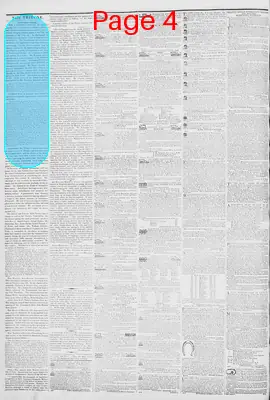
New York Daily Tribune
New York, New York County, New York
What is this article about?
European news from London papers: Parliament passes Canada corn bill (150-75), debates Ireland arms bill; approves £3000 allowance for Princess Augusta's marriage (223-57); rejects Corn Laws committee (244-145). Discussions reference US negotiator Webster's speech on trade.
Clipping
OCR Quality
Full Text
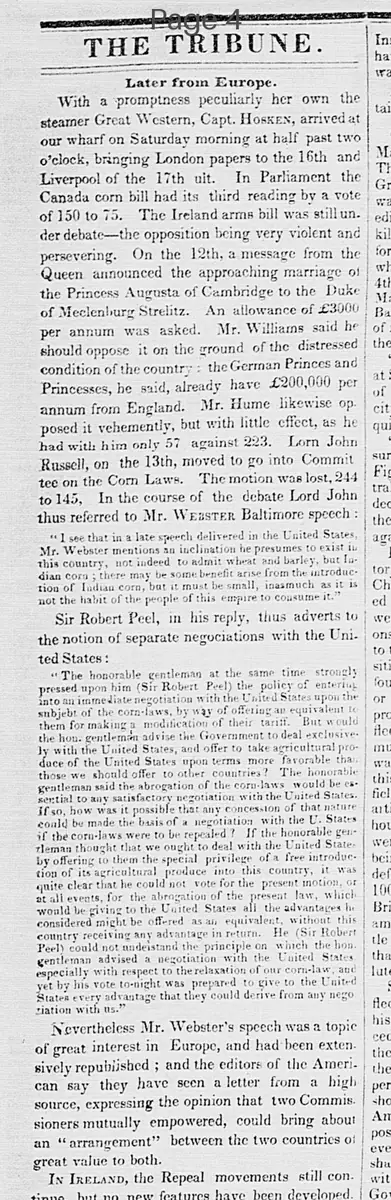
Later from Europe.
With a promptness peculiarly her own the steamer Great Western, Capt. Hosken, arrived at our wharf on Saturday morning at half past two o'clock, bringing London papers to the 16th and Liverpool of the 17th ult.
In Parliament the Canada corn bill had its third reading by a vote of 150 to 75. The Ireland arms bill was still under debate-the opposition being very violent and persevering.
On the 12th, a message from the Queen announced the approaching marriage of the Princess Augusta of Cambridge to the Duke of Mecklenburg Strelitz. An allowance of £3000 per annum was asked. Mr. Williams said he should oppose it on the ground of the distressed condition of the country: the German Princes and Princesses, he said, already have £200,000 per annum from England. Mr. Hume likewise opposed it vehemently, but with little effect, as he had with him only 57 against 223.
Lord John Russell, on the 13th, moved to go into Committee on the Corn Laws. The motion was lost, 244 to 145.
In the course of the debate Lord John thus referred to Mr. Webster Baltimore speech: "I see that in a late speech delivered in the United States. Mr. Webster mentions an inclination he presumes to exist in this country, not indeed to admit wheat and barley, but Indian corn; there may be some benefit arise from the introduction of Indian corn, but it must be small, inasmuch as it is not the habit of the people of this empire to consume it."
Sir Robert Peel, in his reply. thus adverts to the notion of separate negotiations with the United States: "The honorable gentleman at the same time strongly pressed upon him (Sir Robert Peel) the policy of entering into an immediate negotiation with the United States upon the subject of the corn-laws, by way of offering an equivalent to them for making a modification of their tariff. But would the hon. gentleman advise the Government to deal exclusively with the United States, and offer to take agricultural produce of the United States upon terms more favorable than those we should offer to other countries? The honorable gentleman said the abrogation of the corn-laws would be essential to any satisfactory negotiation with the United States. If so, how was it possible that any concession of that nature could be made the basis of a negotiation with the U. States if the corn-laws were to be repealed? If the honorable gentleman thought that we ought to deal with the United States by offering to them the special privilege of a free introduction of its agricultural produce into this country, it was quite clear that he could not vote for the present motion, or at all events, for the abrogation of the present law, which considered might be offered as an equivalent, without this country receiving any advantage in return. He (Sir Robert Peel) could not understand the principle on which the hon. gentleman advised a negotiation with the United States especially with respect to the relaxation of our corn-law, and yet by his vote to-night was prepared to give to the United States every advantage that they could derive from any negotiation with us."
Nevertheless Mr. Webster's speech was a topic of great interest in Europe, and had been extensively republished; and the editors of the American say they have seen a letter from a high source, expressing the opinion that two Commissioners mutually empowered, could bring about an "arrangement" between the two countries of great value to both.
What sub-type of article is it?
What keywords are associated?
What entities or persons were involved?
Where did it happen?
Foreign News Details
Primary Location
London
Event Date
16th And 17th Ult.
Key Persons
Outcome
canada corn bill third reading by vote of 150 to 75. ireland arms bill under debate. princess augusta marriage allowance of £3000 per annum passed 223 to 57. corn laws committee motion lost 244 to 145.
Event Details
Steamer Great Western arrived with London papers to 16th and Liverpool to 17th ult. Parliament passed Canada corn bill third reading 150-75. Ireland arms bill debated with violent opposition. Queen announced Princess Augusta of Cambridge's marriage to Duke of Mecklenburg Strelitz, allowance £3000 opposed by Mr. Williams and Mr. Hume but passed 223-57. Lord John Russell's motion for Corn Laws committee lost 244-145. Debate referenced Mr. Webster's Baltimore speech on US negotiations for corn laws and tariff modifications, with Sir Robert Peel responding on separate dealings with US.