Thank you for visiting SNEWPapers!
Sign up free
Literary
May 21, 1803
The Recorder
Richmond, Virginia
What is this article about?
An 18th-century essay critiques the British government's Botany Bay penal colony scheme as absurdly expensive and impractical, estimating costs at hundreds of thousands of pounds per convict over decades, and advocates for local bridewells instead.
Clipping
OCR Quality
95%
Excellent
Full Text
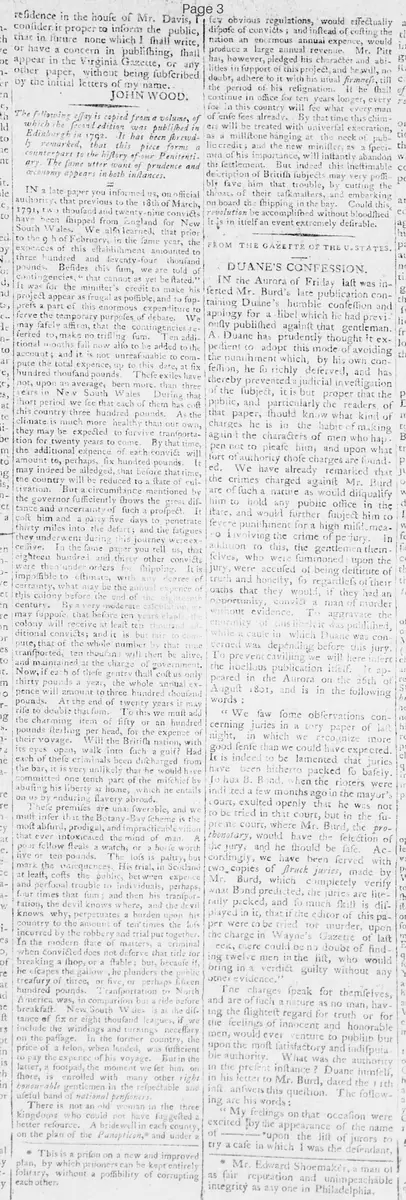
The following essay is copied from a volume, of which the second edition was published in Edinburgh in 1792. It has been shrewdly remarked, that this piece forms a counterpart to the history of our Penitentiary. The same utter want of prudence and oeconomy appears in both instances.
IN a late paper you informed us, on official authority, that previous to the 18th of March, 1791, two thousand and twenty-nine convicts have been shipped from England for New South Wales. We also learned, that prior to the 9th of February, in the same year, the expences of this establishment amounted to three hundred and seventy-four thousand pounds. Besides this sum, we are told of contingencies, "that cannot as yet be stated."
It was for the minister's credit to make his project appear as frugal as possible, and to suppress a part of this enormous expenditure to serve the temporary purposes of debate. We may safely affirm, that the contingencies referred to, make no trifling sum. Ten additional months shall now also to be added to the account; and it is not unreasonable to compute the total expence, up to this date, at six hundred thousand pounds. These exiles have not, upon an average, been more than three years in New South Wales. During that short period we see that each of them has cost this country three hundred pounds. As the climate is much more healthy than our own, they may be expected to survive transportation for twenty years to come. By that time, the additional expence of each convict will amount to, perhaps, six hundred pounds. It may indeed be alledged, that before that time, the country will be reduced to a state of cultivation. But a circumstance mentioned by the governor sufficiently shows the great distance and uncertainty of such a prospect. It cost him and a party five days to penetrate thirty miles into the desert; and the fatigues they underwent during this journey were excessive. In the same paper you tell us, that eighteen hundred and thirty other convicts were then under orders for shipping. It is impossible to estimate, with any degree of certainty, what may be the annual expence of this colony before the end of the present century. By a very moderate calculation we may suppose, that before ten years elapse the colony will receive at least ten thousand additional convicts; and it is but fair to compute, that of the whole number by that time transported, ten thousand will then be alive, and maintained at the charge of government.
Now, if each of these gentlemen shall cost us only thirty pounds a year, the whole annual expence will amount to three hundred thousand pounds. At the end of twenty years it may rise to double that sum. To this we must add the charming item of fifty or an hundred pounds sterling per head, for the expence of their voyage. Will the British nation, with its eyes open, walk into such a gulf? Had each of these criminals been discharged from the bar, it is very unlikely that he would have committed one tenth part of the mischief by abusing his liberty at home, which he entails on us by enduring slavery abroad.
These premises are unanswerable, and we must infer that the Botany-Bay scheme is the most absurd, prodigal, and impracticable vision that ever intoxicated the mind of man. A poor fellow steals a watch, or a horse worth five or ten pounds. The loss is partly, but mark the consequences. His trial, in Scotland at least, costs the public, between expence and personal trouble to individuals, perhaps, four times that sum; and then his transportation, the devil knows where, and the devil knows why, perpetuates a burden upon his country to the amount of ten times the loss incurred by the robbery and trial put together.
In the modern state of matters, a criminal when convicted does not deserve that title for breaking a shop, or a stable; but, because if he escapes the gallows, he plunders the public treasury of three, or five, or perhaps fifteen hundred pounds, Transportation to North America was, in comparison but a ride before breakfast. New South Wales is at the distance of six or eight thousand leagues, if we include the windings and turnings necessary on the passage. In the former country, the price of a felon, when landed, was sufficient to pay the expence of his voyage. But in the latter, a footpad, the moment we set him on shore, is enrolled with many other right honourable gentlemen in the respectable and useful band of national pensioners.
There is not an old woman in the three kingdoms who could not have suggested a better resource. A bridewell in each county, on the plan of the Panopticon,* and under a few obvious regulations, would effectually dispose of convicts; and instead of costing the nation an enormous annual expence, would produce a large annual revenue. Mr. Pitt has, however, pledged his character and abilities in support of this project, and he will, no doubt, adhere to it with his usual firmness, till the period of his resignation. If he shall continue in office for ten years longer, every fool in this country will see what every man of sense sees already. By that time this chimera will be treated with universal execration, as a millstone hanging at the neck of public credit; and the new minister, as a specimen of his importance, will instantly abandon the settlement. But indeed this inestimable description of British subjects may very possibly save him that trouble, by cutting the throat of their taskmasters, and embarking on board the shipping in the bay. Could this revolution be accomplished without bloodshed it is in itself an event extremely desirable.
* This is a prison on a new and improved plan, by which prisoners can be kept entirely solitary, without a possibility of corrupting each other.
IN a late paper you informed us, on official authority, that previous to the 18th of March, 1791, two thousand and twenty-nine convicts have been shipped from England for New South Wales. We also learned, that prior to the 9th of February, in the same year, the expences of this establishment amounted to three hundred and seventy-four thousand pounds. Besides this sum, we are told of contingencies, "that cannot as yet be stated."
It was for the minister's credit to make his project appear as frugal as possible, and to suppress a part of this enormous expenditure to serve the temporary purposes of debate. We may safely affirm, that the contingencies referred to, make no trifling sum. Ten additional months shall now also to be added to the account; and it is not unreasonable to compute the total expence, up to this date, at six hundred thousand pounds. These exiles have not, upon an average, been more than three years in New South Wales. During that short period we see that each of them has cost this country three hundred pounds. As the climate is much more healthy than our own, they may be expected to survive transportation for twenty years to come. By that time, the additional expence of each convict will amount to, perhaps, six hundred pounds. It may indeed be alledged, that before that time, the country will be reduced to a state of cultivation. But a circumstance mentioned by the governor sufficiently shows the great distance and uncertainty of such a prospect. It cost him and a party five days to penetrate thirty miles into the desert; and the fatigues they underwent during this journey were excessive. In the same paper you tell us, that eighteen hundred and thirty other convicts were then under orders for shipping. It is impossible to estimate, with any degree of certainty, what may be the annual expence of this colony before the end of the present century. By a very moderate calculation we may suppose, that before ten years elapse the colony will receive at least ten thousand additional convicts; and it is but fair to compute, that of the whole number by that time transported, ten thousand will then be alive, and maintained at the charge of government.
Now, if each of these gentlemen shall cost us only thirty pounds a year, the whole annual expence will amount to three hundred thousand pounds. At the end of twenty years it may rise to double that sum. To this we must add the charming item of fifty or an hundred pounds sterling per head, for the expence of their voyage. Will the British nation, with its eyes open, walk into such a gulf? Had each of these criminals been discharged from the bar, it is very unlikely that he would have committed one tenth part of the mischief by abusing his liberty at home, which he entails on us by enduring slavery abroad.
These premises are unanswerable, and we must infer that the Botany-Bay scheme is the most absurd, prodigal, and impracticable vision that ever intoxicated the mind of man. A poor fellow steals a watch, or a horse worth five or ten pounds. The loss is partly, but mark the consequences. His trial, in Scotland at least, costs the public, between expence and personal trouble to individuals, perhaps, four times that sum; and then his transportation, the devil knows where, and the devil knows why, perpetuates a burden upon his country to the amount of ten times the loss incurred by the robbery and trial put together.
In the modern state of matters, a criminal when convicted does not deserve that title for breaking a shop, or a stable; but, because if he escapes the gallows, he plunders the public treasury of three, or five, or perhaps fifteen hundred pounds, Transportation to North America was, in comparison but a ride before breakfast. New South Wales is at the distance of six or eight thousand leagues, if we include the windings and turnings necessary on the passage. In the former country, the price of a felon, when landed, was sufficient to pay the expence of his voyage. But in the latter, a footpad, the moment we set him on shore, is enrolled with many other right honourable gentlemen in the respectable and useful band of national pensioners.
There is not an old woman in the three kingdoms who could not have suggested a better resource. A bridewell in each county, on the plan of the Panopticon,* and under a few obvious regulations, would effectually dispose of convicts; and instead of costing the nation an enormous annual expence, would produce a large annual revenue. Mr. Pitt has, however, pledged his character and abilities in support of this project, and he will, no doubt, adhere to it with his usual firmness, till the period of his resignation. If he shall continue in office for ten years longer, every fool in this country will see what every man of sense sees already. By that time this chimera will be treated with universal execration, as a millstone hanging at the neck of public credit; and the new minister, as a specimen of his importance, will instantly abandon the settlement. But indeed this inestimable description of British subjects may very possibly save him that trouble, by cutting the throat of their taskmasters, and embarking on board the shipping in the bay. Could this revolution be accomplished without bloodshed it is in itself an event extremely desirable.
* This is a prison on a new and improved plan, by which prisoners can be kept entirely solitary, without a possibility of corrupting each other.
What sub-type of article is it?
Essay
Satire
What themes does it cover?
Political
Taxation Oppression
What keywords are associated?
Botany Bay
Convict Transportation
Penal Colony
Government Expense
New South Wales
Panopticon Prison
Literary Details
Subject
Critique Of The Botany Bay Convict Transportation Scheme
Form / Style
Argumentative Prose Essay With Ironic Critique
Key Lines
These Premises Are Unanswerable, And We Must Infer That The Botany Bay Scheme Is The Most Absurd, Prodigal, And Impracticable Vision That Ever Intoxicated The Mind Of Man.
There Is Not An Old Woman In The Three Kingdoms Who Could Not Have Suggested A Better Resource. A Bridewell In Each County, On The Plan Of The Panopticon,* And Under A Few Obvious Regulations, Would Effectually Dispose Of Convicts; And Instead Of Costing The Nation An Enormous Annual Expence, Would Produce A Large Annual Revenue.