Thank you for visiting SNEWPapers!
Sign up free
Literary
April 20, 1944
The Camas Hot Springs Exchange
Hot Springs, Camas, Sanders County, Montana
What is this article about?
Chapter III of 'Black Sombrero' by Clifford Knight depicts family tensions in the Chatfield lineage, focusing on Aunt Kitty's disdain for niece Elsa over inheritance and family pride. Narrator encounters Elsa's provocative caricatures in Hollywood, leading to confrontations. Characters prepare for a cruise to Mazatlan, Mexico, encountering unexpected arrivals.
Clipping
OCR Quality
95%
Excellent
Full Text
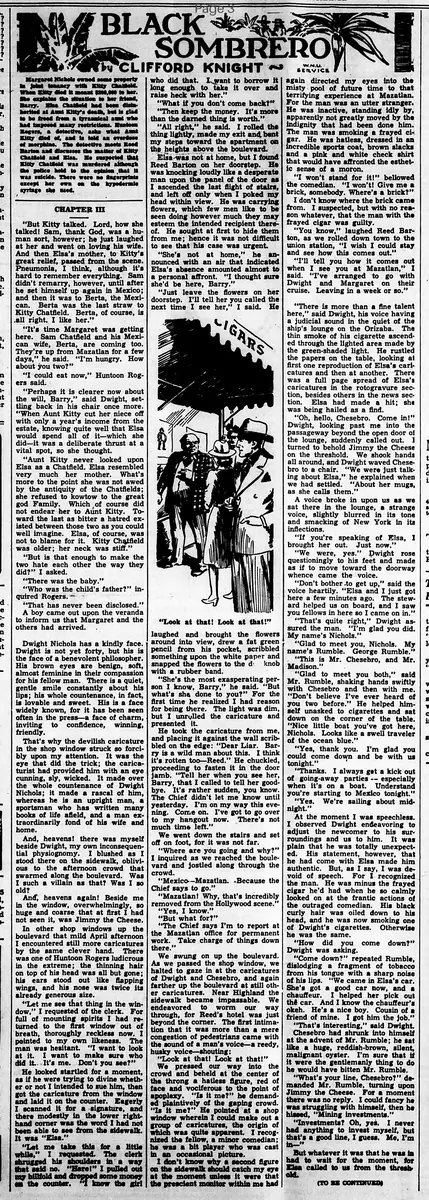
BLACK SOMBRERO
W.N.U.
By CLIFFORD KNIGHT
SERVICE
CHAPTER III
"But Kitty talked. Lord, how she talked! Sam, thank God, was a human sort, however: he just laughed at her and went on loving his wife. And then Elsa's mother, to Kitty's great relief, passed from the scene. Pneumonia, I think, although it's hard to remember everything. Sam didn't remarry, however, until after he set himself up again in Mexico; and then it was to Berta, the Mexican. Berta was the last straw to Kitty Chatfield. Berta, of course, is all right. I like her."
"It's time Margaret was getting here. Sam Chatfield and his Mexican wife, Berta, are coming too. They're up from Mazatlan for a few days," he said. "I'm hungry. How about you two?"
"I could eat now," Huntoon Rogers said.
"Perhaps it is clearer now about the will, Barry," said Dwight, settling back in his chair once more. "When Aunt Kitty cut her niece off with only a year's income from the estate, knowing quite well that Elsa would spend all of it—which she did—it was a deliberate thrust at a vital spot, so she thought."
"Aunt Kitty never looked upon Elsa as a Chatfield. Elsa resembled very much her mother. What's more to the point she was not awed by the antiquity of the Chatfields; she refused to kowtow to the great god Family. Which of course did not endear her to Aunt Kitty. Toward the last as bitter a hatred existed between those two as you could well imagine. Elsa, of course, was not to blame for it. Kitty Chatfield was older; her neck was stiff."
"But is that enough to make the two hate each other the way they did?" I asked.
"There was the baby."
"Who was the child's father?" inquired Rogers.
"That has never been disclosed."
A boy came out upon the veranda to inform us that Margaret and the others had arrived.
Dwight Nichols has a kindly face. Dwight is not yet forty, but his is the face of a benevolent philosopher. His brown eyes are benign, soft, almost feminine in their compassion for his fellow man. There is a quiet, gentle smile constantly about his lips; his whole countenance, in fact, is lovable and sweet. His is a face widely known, for it has been seen often in the press—a face of charm, inviting to confidence, winning, friendly.
That's why the devilish caricature in the shop window struck so forcibly upon my attention. It was the eye that did the trick; the caricaturist had provided him with an eye cunning, sly, wicked. It made over the whole countenance of Dwight Nichols: it made a rascal of him, whereas he is an upright man, a sportsman who has written many books of life afield, and a man extraordinarily fond of his wife and home.
And, heavens! there was myself beside Dwight, my own inconsequential physiognomy. I blushed as I stood there on the sidewalk, oblivious to the afternoon crowd that swarmed along the boulevard. Was I such a villain as that? Was I so old?
And, heavens again! Beside me in the window, overwhelmingly, so huge and coarse that at first I had not seen it, was Jimmy the Cheese. In other shop windows up the boulevard that mild April afternoon I encountered still more caricatures by the same clever hand. There was one of Huntoon Rogers ludicrous in the extreme; the thinning hair on top of his head was all but gone; his ears stood out like flapping wings, and his nose was twice its already generous size.
"Let me see that thing in the window," I requested of the clerk. For full of mounting spirits I had returned to the first window out of breath, thoroughly reckless now. I pointed to my own likeness. The man was hesitant. "I want to look at it. I want to make sure who did it... It's me. Don't you see?"
He looked startled for a moment, as if he were trying to divine whether or not I intended to sue him, then got the caricature from the window and laid it on the counter. Eagerly I scanned it for a signature, and there modestly in the lower right-hand corner was the word I had not been able to see from the sidewalk. It was "Elsa."
"Let me take this for a little while," I requested. The clerk shrugged his shoulders in a way that said no. "Here!" I pulled out my billfold and dropped some money on the counter.
"I know the girl who did that. I want to borrow it long enough to take it over and raise heck with her."
"What if you don't come back?"
"Then keep the money. It's more than the darned thing is worth."
"All right," he said. I rolled the thing lightly, made my exit and bent my steps toward the apartment on the heights above the boulevard.
Elsa was not at home, but I found Reed Barton on her doorstep. He was knocking loudly like a desperate man upon the panel of the door as I ascended the last flight of stairs, and left off only when I poked my head within view. He was carrying flowers, which few men like to be seen doing however much they may esteem the intended recipient thereof. He sought at first to hide them from me; hence it was not difficult to see that his case was urgent.
"She's not at home," he announced with an air that indicated Elsa's absence amounted almost to a personal affront. "I thought sure she'd be here, Barry."
"Just leave the flowers on her doorstep. I'll tell her you called the next time I see her," I said. He laughed and brought the flowers around into view, drew a fat green pencil from his pocket, scribbled something upon the white paper and snapped the flowers to the doorknob with a rubber band.
"She's the most exasperating person I know, Barry," he said. "But what's she done to you?" For the first time he realized I had reason for being there. The light was dim, but I unrolled the caricature and presented it.
He took the caricature from me, and placing it against the wall scribbled on the edge: "Dear Liar. Barry is a wildman about this. I think it's rotten too Reed." He chuckled, proceeding to fasten it in the door jamb. "Tell her when you see her, Barry, that I called to tell her good-bye. It's rather sudden, you know. The Chief didn't let me know until yesterday. I'm on my way this evening. Come on. I've got to go over to my hangout now. There's not much time left."
We went down the stairs and set off on foot, for it was not far.
"Where are you going and why?" I inquired as we reached the boulevard and jostled along through the crowd.
"Mexico—Mazatlan. Because the Chief says to go."
"Mazatlan! Why, that's incredibly removed from the Hollywood scene."
"Yes, I know."
"But what for?"
"The Chief says I'm to report at the Mazatlan office for permanent work. Take charge of things down there."
We swung on up the boulevard. As we passed the shop window, we halted to gaze in at the caricatures of Dwight and Chesebro, and again farther up the boulevard at still other caricatures. Near Highland the sidewalk became impassable. We endeavored to worm our way through, for Reed's hotel was just beyond the corner. The first intimation that it was more than a mere congestion of pedestrians came with the sound of a man's voice—a reedy, husky voice—shouting:
"Look at that! Look at that!"
We pressed our way into the crowd and beheld at the center of the throng a hatless figure, red of face and vociferous to the point of apoplexy. "Is it me?" he demanded plaintively of the gaping crowd. "Is it me?" He pointed at a shop window wherein I could make out a group of caricatures, the origin of which was quite apparent. I recognized the fellow, a minor comedian; he was a bit player who was cast in an occasional picture.
I don't know why a second figure on the sidewalk should catch my eye at the moment unless it were that the prescient monitor within me had again directed my eyes into the misty pool of future time to that terrifying experience at Mazatlan. For the man was an utter stranger. He was inactive, standing idly by, apparently not greatly moved by the indignity that had been done him. The man was smoking a frayed cigar. He was hatless, dressed in an incredible sports coat, brown slacks and a pink and white check shirt that would have affronted the esthetic sense of a moron.
"I won't stand for it!" bellowed the comedian. "I won't! Give me a brick, somebody. Where's a brick?"
I don't know where the brick came from. I suspected, but with no reason whatever, that the man with the frayed cigar was guilty.
"You know," laughed Reed Barton, as we rolled down town to the union station, "I wish I could stay and see how this comes out."
"I'll tell you how it comes out when I see you at Mazatlan," I said. "I've arranged to go with Dwight and Margaret on their cruise. Leaving in a week or so."
"There is more than a fine talent here," said Dwight, his voice having a judicial sound in the quiet of the ship's lounge on the Orizaba. The thin smoke of his cigarette ascended through the lighted area made by the green-shaded light. He rustled the papers on the table, looking at first one reproduction of Elsa's caricatures and then at another. There was a full page spread of Elsa's caricatures in the rotogravure section, besides others in the news section. Elsa had made a hit; she was being hailed as a find.
"Oh, hello, Chesebro. Come in!"
Dwight, looking past me into the passageway beyond the open door of the lounge, suddenly called out. I turned to behold Jimmy the Cheese on the threshold. We shook hands all around, and Dwight waved Chesebro to a chair. "We were just talking about Elsa," he explained when we had settled. "About her mugs, as she calls them."
A voice broke in upon us as we sat there in the lounge, a strange voice, slightly blurred in its tone and smacking of New York in its inflections.
"If you're speaking of Elsa, I brought her out. Just now."
"We were, yes." Dwight rose questioningly to his feet and made as if to move toward the doorway whence came the voice.
"Don't bother to get up," said the voice heartily. "Elsa and I just got here a few minutes ago. The steward helped us on board, and I saw you fellows in here so I came on in."
"That's quite right," Dwight assured the man. "I'm glad you did. My name's Nichols."
"Glad to meet you, Nichols. My name's Rumble. George Rumble."
"This is Mr. Chesebro, and Mr. Madison."
"Glad to meet you both," said Mr. Rumble, shaking hands swiftly with Chesebro and then with me. "Don't believe I've ever heard of you two before." He helped himself unasked to cigarettes and sat down on the corner of the table.
"Nice little boat you've got here, Nichols. Looks like a swell traveler of the ocean blue."
"Yes, thank you. I'm glad you could come down and be with us tonight."
"Thanks. I always got a kick out of going-away parties—especially when it's on a boat. Understand you're starting to Mexico tonight."
"Yes. We're sailing about midnight."
At the moment I was speechless. I observed Dwight endeavoring to adjust the newcomer to his surroundings and us to him. It was plain that he was totally unexpected. His statement, however, that he had come with Elsa made him authentic. But, as I say, I was devoid of speech. For I recognized the man. He was minus the frayed cigar he'd had when he so calmly looked on at the frantic actions of the outraged comedian. His black curly hair was oiled down to his head, and he was now smoking one of Dwight's cigarettes. Otherwise he was the same.
"How did you come down?" Dwight was asking.
"Come down?" repeated Rumble, dislodging a fragment of tobacco from his tongue with a sharp noise of his lips. "We came in Elsa's car. She's got a good car now, and a chauffeur. I helped her pick out the car. And I know the chauffeur okeh. He's a nice boy. Cousin of friend of mine. I got him the job."
"That's interesting," said Dwight. Chesebro had shrunk into himself at the advent of Mr. Rumble; he sat like a huge, reddish-brown, silent, malignant oyster. I'm sure that if it were the gentlemanly thing to do he would have bitten Mr. Rumble.
"What's your line, Chesebro?" demanded Mr. Rumble, turning upon Jimmy the Cheese. For a moment there was no reply. I could fancy he was struggling with himself, then he hissed, "Mining investments."
"Investments? Oh, yes. I never had anything to invest myself, but that's a good line, I guess. Me, I'm
W.N.U.
By CLIFFORD KNIGHT
SERVICE
CHAPTER III
"But Kitty talked. Lord, how she talked! Sam, thank God, was a human sort, however: he just laughed at her and went on loving his wife. And then Elsa's mother, to Kitty's great relief, passed from the scene. Pneumonia, I think, although it's hard to remember everything. Sam didn't remarry, however, until after he set himself up again in Mexico; and then it was to Berta, the Mexican. Berta was the last straw to Kitty Chatfield. Berta, of course, is all right. I like her."
"It's time Margaret was getting here. Sam Chatfield and his Mexican wife, Berta, are coming too. They're up from Mazatlan for a few days," he said. "I'm hungry. How about you two?"
"I could eat now," Huntoon Rogers said.
"Perhaps it is clearer now about the will, Barry," said Dwight, settling back in his chair once more. "When Aunt Kitty cut her niece off with only a year's income from the estate, knowing quite well that Elsa would spend all of it—which she did—it was a deliberate thrust at a vital spot, so she thought."
"Aunt Kitty never looked upon Elsa as a Chatfield. Elsa resembled very much her mother. What's more to the point she was not awed by the antiquity of the Chatfields; she refused to kowtow to the great god Family. Which of course did not endear her to Aunt Kitty. Toward the last as bitter a hatred existed between those two as you could well imagine. Elsa, of course, was not to blame for it. Kitty Chatfield was older; her neck was stiff."
"But is that enough to make the two hate each other the way they did?" I asked.
"There was the baby."
"Who was the child's father?" inquired Rogers.
"That has never been disclosed."
A boy came out upon the veranda to inform us that Margaret and the others had arrived.
Dwight Nichols has a kindly face. Dwight is not yet forty, but his is the face of a benevolent philosopher. His brown eyes are benign, soft, almost feminine in their compassion for his fellow man. There is a quiet, gentle smile constantly about his lips; his whole countenance, in fact, is lovable and sweet. His is a face widely known, for it has been seen often in the press—a face of charm, inviting to confidence, winning, friendly.
That's why the devilish caricature in the shop window struck so forcibly upon my attention. It was the eye that did the trick; the caricaturist had provided him with an eye cunning, sly, wicked. It made over the whole countenance of Dwight Nichols: it made a rascal of him, whereas he is an upright man, a sportsman who has written many books of life afield, and a man extraordinarily fond of his wife and home.
And, heavens! there was myself beside Dwight, my own inconsequential physiognomy. I blushed as I stood there on the sidewalk, oblivious to the afternoon crowd that swarmed along the boulevard. Was I such a villain as that? Was I so old?
And, heavens again! Beside me in the window, overwhelmingly, so huge and coarse that at first I had not seen it, was Jimmy the Cheese. In other shop windows up the boulevard that mild April afternoon I encountered still more caricatures by the same clever hand. There was one of Huntoon Rogers ludicrous in the extreme; the thinning hair on top of his head was all but gone; his ears stood out like flapping wings, and his nose was twice its already generous size.
"Let me see that thing in the window," I requested of the clerk. For full of mounting spirits I had returned to the first window out of breath, thoroughly reckless now. I pointed to my own likeness. The man was hesitant. "I want to look at it. I want to make sure who did it... It's me. Don't you see?"
He looked startled for a moment, as if he were trying to divine whether or not I intended to sue him, then got the caricature from the window and laid it on the counter. Eagerly I scanned it for a signature, and there modestly in the lower right-hand corner was the word I had not been able to see from the sidewalk. It was "Elsa."
"Let me take this for a little while," I requested. The clerk shrugged his shoulders in a way that said no. "Here!" I pulled out my billfold and dropped some money on the counter.
"I know the girl who did that. I want to borrow it long enough to take it over and raise heck with her."
"What if you don't come back?"
"Then keep the money. It's more than the darned thing is worth."
"All right," he said. I rolled the thing lightly, made my exit and bent my steps toward the apartment on the heights above the boulevard.
Elsa was not at home, but I found Reed Barton on her doorstep. He was knocking loudly like a desperate man upon the panel of the door as I ascended the last flight of stairs, and left off only when I poked my head within view. He was carrying flowers, which few men like to be seen doing however much they may esteem the intended recipient thereof. He sought at first to hide them from me; hence it was not difficult to see that his case was urgent.
"She's not at home," he announced with an air that indicated Elsa's absence amounted almost to a personal affront. "I thought sure she'd be here, Barry."
"Just leave the flowers on her doorstep. I'll tell her you called the next time I see her," I said. He laughed and brought the flowers around into view, drew a fat green pencil from his pocket, scribbled something upon the white paper and snapped the flowers to the doorknob with a rubber band.
"She's the most exasperating person I know, Barry," he said. "But what's she done to you?" For the first time he realized I had reason for being there. The light was dim, but I unrolled the caricature and presented it.
He took the caricature from me, and placing it against the wall scribbled on the edge: "Dear Liar. Barry is a wildman about this. I think it's rotten too Reed." He chuckled, proceeding to fasten it in the door jamb. "Tell her when you see her, Barry, that I called to tell her good-bye. It's rather sudden, you know. The Chief didn't let me know until yesterday. I'm on my way this evening. Come on. I've got to go over to my hangout now. There's not much time left."
We went down the stairs and set off on foot, for it was not far.
"Where are you going and why?" I inquired as we reached the boulevard and jostled along through the crowd.
"Mexico—Mazatlan. Because the Chief says to go."
"Mazatlan! Why, that's incredibly removed from the Hollywood scene."
"Yes, I know."
"But what for?"
"The Chief says I'm to report at the Mazatlan office for permanent work. Take charge of things down there."
We swung on up the boulevard. As we passed the shop window, we halted to gaze in at the caricatures of Dwight and Chesebro, and again farther up the boulevard at still other caricatures. Near Highland the sidewalk became impassable. We endeavored to worm our way through, for Reed's hotel was just beyond the corner. The first intimation that it was more than a mere congestion of pedestrians came with the sound of a man's voice—a reedy, husky voice—shouting:
"Look at that! Look at that!"
We pressed our way into the crowd and beheld at the center of the throng a hatless figure, red of face and vociferous to the point of apoplexy. "Is it me?" he demanded plaintively of the gaping crowd. "Is it me?" He pointed at a shop window wherein I could make out a group of caricatures, the origin of which was quite apparent. I recognized the fellow, a minor comedian; he was a bit player who was cast in an occasional picture.
I don't know why a second figure on the sidewalk should catch my eye at the moment unless it were that the prescient monitor within me had again directed my eyes into the misty pool of future time to that terrifying experience at Mazatlan. For the man was an utter stranger. He was inactive, standing idly by, apparently not greatly moved by the indignity that had been done him. The man was smoking a frayed cigar. He was hatless, dressed in an incredible sports coat, brown slacks and a pink and white check shirt that would have affronted the esthetic sense of a moron.
"I won't stand for it!" bellowed the comedian. "I won't! Give me a brick, somebody. Where's a brick?"
I don't know where the brick came from. I suspected, but with no reason whatever, that the man with the frayed cigar was guilty.
"You know," laughed Reed Barton, as we rolled down town to the union station, "I wish I could stay and see how this comes out."
"I'll tell you how it comes out when I see you at Mazatlan," I said. "I've arranged to go with Dwight and Margaret on their cruise. Leaving in a week or so."
"There is more than a fine talent here," said Dwight, his voice having a judicial sound in the quiet of the ship's lounge on the Orizaba. The thin smoke of his cigarette ascended through the lighted area made by the green-shaded light. He rustled the papers on the table, looking at first one reproduction of Elsa's caricatures and then at another. There was a full page spread of Elsa's caricatures in the rotogravure section, besides others in the news section. Elsa had made a hit; she was being hailed as a find.
"Oh, hello, Chesebro. Come in!"
Dwight, looking past me into the passageway beyond the open door of the lounge, suddenly called out. I turned to behold Jimmy the Cheese on the threshold. We shook hands all around, and Dwight waved Chesebro to a chair. "We were just talking about Elsa," he explained when we had settled. "About her mugs, as she calls them."
A voice broke in upon us as we sat there in the lounge, a strange voice, slightly blurred in its tone and smacking of New York in its inflections.
"If you're speaking of Elsa, I brought her out. Just now."
"We were, yes." Dwight rose questioningly to his feet and made as if to move toward the doorway whence came the voice.
"Don't bother to get up," said the voice heartily. "Elsa and I just got here a few minutes ago. The steward helped us on board, and I saw you fellows in here so I came on in."
"That's quite right," Dwight assured the man. "I'm glad you did. My name's Nichols."
"Glad to meet you, Nichols. My name's Rumble. George Rumble."
"This is Mr. Chesebro, and Mr. Madison."
"Glad to meet you both," said Mr. Rumble, shaking hands swiftly with Chesebro and then with me. "Don't believe I've ever heard of you two before." He helped himself unasked to cigarettes and sat down on the corner of the table.
"Nice little boat you've got here, Nichols. Looks like a swell traveler of the ocean blue."
"Yes, thank you. I'm glad you could come down and be with us tonight."
"Thanks. I always got a kick out of going-away parties—especially when it's on a boat. Understand you're starting to Mexico tonight."
"Yes. We're sailing about midnight."
At the moment I was speechless. I observed Dwight endeavoring to adjust the newcomer to his surroundings and us to him. It was plain that he was totally unexpected. His statement, however, that he had come with Elsa made him authentic. But, as I say, I was devoid of speech. For I recognized the man. He was minus the frayed cigar he'd had when he so calmly looked on at the frantic actions of the outraged comedian. His black curly hair was oiled down to his head, and he was now smoking one of Dwight's cigarettes. Otherwise he was the same.
"How did you come down?" Dwight was asking.
"Come down?" repeated Rumble, dislodging a fragment of tobacco from his tongue with a sharp noise of his lips. "We came in Elsa's car. She's got a good car now, and a chauffeur. I helped her pick out the car. And I know the chauffeur okeh. He's a nice boy. Cousin of friend of mine. I got him the job."
"That's interesting," said Dwight. Chesebro had shrunk into himself at the advent of Mr. Rumble; he sat like a huge, reddish-brown, silent, malignant oyster. I'm sure that if it were the gentlemanly thing to do he would have bitten Mr. Rumble.
"What's your line, Chesebro?" demanded Mr. Rumble, turning upon Jimmy the Cheese. For a moment there was no reply. I could fancy he was struggling with himself, then he hissed, "Mining investments."
"Investments? Oh, yes. I never had anything to invest myself, but that's a good line, I guess. Me, I'm
What sub-type of article is it?
Prose Fiction
What themes does it cover?
Social Manners
Moral Virtue
What keywords are associated?
Family Feud
Inheritance Will
Caricatures
Hollywood Scandal
Mexico Trip
Chatfield Family
Elsa Talent
What entities or persons were involved?
By Clifford Knight
Literary Details
Title
Chapter Iii
Author
By Clifford Knight
Key Lines
"When Aunt Kitty Cut Her Niece Off With Only A Year's Income From The Estate, Knowing Quite Well That Elsa Would Spend All Of It—Which She Did—It Was A Deliberate Thrust At A Vital Spot, So She Thought."
"Aunt Kitty Never Looked Upon Elsa As A Chatfield. Elsa Resembled Very Much Her Mother. What's More To The Point She Was Not Awed By The Antiquity Of The Chatfields; She Refused To Kowtow To The Great God Family."
It Was "Elsa."
"I Won't Stand For It!" Bellowed The Comedian. "I Won't! Give Me A Brick, Somebody. Where's A Brick?"
"There Is More Than A Fine Talent Here," Said Dwight... Elsa Had Made A Hit; She Was Being Hailed As A Find.