Thank you for visiting SNEWPapers!
Sign up free
Story
December 25, 1938
Imperial Valley Press
El Centro, Imperial County, California
What is this article about?
Feature article on lesser-known crops in Imperial Valley, including apricots, olives, plums, and others, with acreage data from extension service and historical notes on their success or failure.
Clipping
OCR Quality
98%
Excellent
Full Text
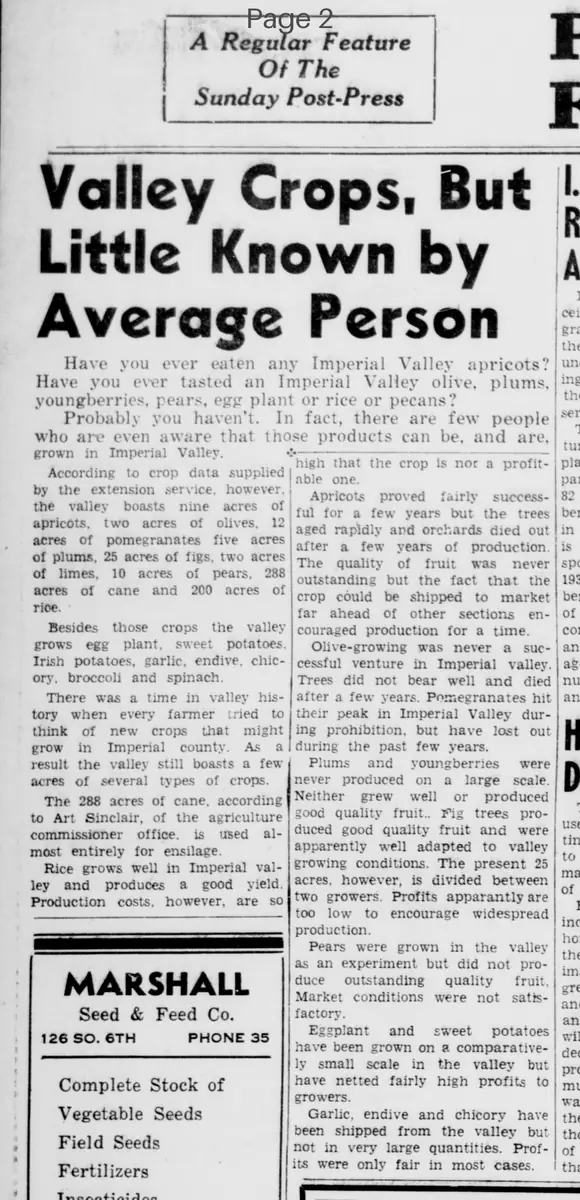
A Regular Feature Of The Sunday Post-Press
Valley Crops, But Little Known by Average Person
Have you ever eaten any Imperial Valley apricots?
Have you ever tasted an Imperial Valley olive, plums, youngberries, pears, eggplant or rice or pecans?
Probably you haven't. In fact, there are few people who are even aware that those products can be, and are, grown in Imperial Valley.
According to crop data supplied by the extension service, however, the valley boasts nine acres of apricots, two acres of olives, 12 acres of pomegranates, five acres of plums, 25 acres of figs, two acres of limes, 10 acres of pears, 288 acres of cane and 200 acres of rice.
Besides those crops the valley grows eggplant, sweet potatoes, Irish potatoes, garlic, endive, chicory, broccoli and spinach.
There was a time in valley history when every farmer tried to think of new crops that might grow in Imperial county. As a result the valley still boasts a few acres of several types of crops.
The 288 acres of cane, according to Art Sinclair, of the agriculture commissioner office, is used almost entirely for ensilage.
Rice grows well in Imperial valley and produces a good yield. Production costs, however, are so high that the crop is not a profitable one.
Apricots proved fairly successful for a few years but the trees aged rapidly and orchards died out after a few years of production.
The quality of fruit was never outstanding but the fact that the crop could be shipped to market far ahead of other sections encouraged production for a time.
Olive-growing was never a successful venture in Imperial valley. Trees did not bear well and died after a few years. Pomegranates hit their peak in Imperial Valley during prohibition, but have lost out during the past few years.
Plums and youngberries were never produced on a large scale. Neither grew well or produced good quality fruit. Fig trees produced good quality fruit and were apparently well adapted to valley growing conditions. The present 25 acres, however, is divided between two growers. Profits apparently are too low to encourage widespread production.
Pears were grown in the valley as an experiment but did not produce outstanding quality fruit. Market conditions were not satisfactory.
Eggplant and sweet potatoes have been grown on a comparatively small scale in the valley but have netted fairly high profits to growers.
Garlic, endive and chicory have been shipped from the valley but not in very large quantities. Profits were only fair in most cases.
Valley Crops, But Little Known by Average Person
Have you ever eaten any Imperial Valley apricots?
Have you ever tasted an Imperial Valley olive, plums, youngberries, pears, eggplant or rice or pecans?
Probably you haven't. In fact, there are few people who are even aware that those products can be, and are, grown in Imperial Valley.
According to crop data supplied by the extension service, however, the valley boasts nine acres of apricots, two acres of olives, 12 acres of pomegranates, five acres of plums, 25 acres of figs, two acres of limes, 10 acres of pears, 288 acres of cane and 200 acres of rice.
Besides those crops the valley grows eggplant, sweet potatoes, Irish potatoes, garlic, endive, chicory, broccoli and spinach.
There was a time in valley history when every farmer tried to think of new crops that might grow in Imperial county. As a result the valley still boasts a few acres of several types of crops.
The 288 acres of cane, according to Art Sinclair, of the agriculture commissioner office, is used almost entirely for ensilage.
Rice grows well in Imperial valley and produces a good yield. Production costs, however, are so high that the crop is not a profitable one.
Apricots proved fairly successful for a few years but the trees aged rapidly and orchards died out after a few years of production.
The quality of fruit was never outstanding but the fact that the crop could be shipped to market far ahead of other sections encouraged production for a time.
Olive-growing was never a successful venture in Imperial valley. Trees did not bear well and died after a few years. Pomegranates hit their peak in Imperial Valley during prohibition, but have lost out during the past few years.
Plums and youngberries were never produced on a large scale. Neither grew well or produced good quality fruit. Fig trees produced good quality fruit and were apparently well adapted to valley growing conditions. The present 25 acres, however, is divided between two growers. Profits apparently are too low to encourage widespread production.
Pears were grown in the valley as an experiment but did not produce outstanding quality fruit. Market conditions were not satisfactory.
Eggplant and sweet potatoes have been grown on a comparatively small scale in the valley but have netted fairly high profits to growers.
Garlic, endive and chicory have been shipped from the valley but not in very large quantities. Profits were only fair in most cases.
What sub-type of article is it?
Agricultural Report
Regional Curiosity
What keywords are associated?
Imperial Valley
Crops
Apricots
Olives
Pomegranates
Rice
Agriculture
Farming Experiments
What entities or persons were involved?
Art Sinclair
Where did it happen?
Imperial Valley
Story Details
Key Persons
Art Sinclair
Location
Imperial Valley
Story Details
The article highlights little-known crops grown in Imperial Valley, providing acreage figures and discussing historical experiments with various fruits, vegetables, and grains, noting successes, failures, and profitability.