Thank you for visiting SNEWPapers!
Sign up free
Story
July 21, 1862
The Portland Daily Press
Portland, Cumberland County, Maine
What is this article about?
Mr. Converse A. Babcock of the 51st Massachusetts Regiment recounts his wounding at the Battle of Manassas, capture by rebels, harsh imprisonment in Richmond and Salisbury, and eventual parole after ten months, returning to Union lines on May 25, 1862.
Clipping
OCR Quality
88%
Good
Full Text
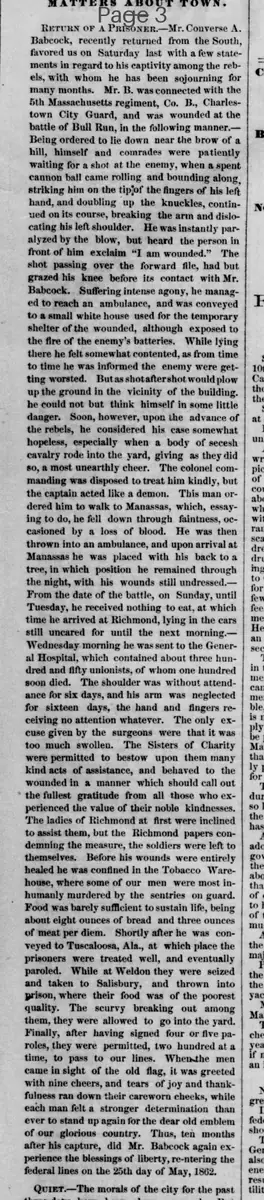
MATTERS ABOUT TOWN.
Remark of a Prisoner — Mr. Converse A. Babcock's statements in regard to his captivity among the rebels.
51st Massachusetts regiment, Co. B., Charlestown City Guard, and was wounded at the
Being ordered to lie down near the brow of a
hill, himself and comrades were patiently
waiting for a shot at the enemy, when a spent
ball striking him on the tip of the fingers of his left
continued on its course, breaking the arm and dislocating
his left shoulder. He was instantly paralyzed by the blow, but heard the person in
front of him exclaim "I am wounded." The
shot passing over the forward file, had but
grazed his knee before its contact with Mr.
Babcock. Suffering intense agony, he managed
to reach an ambulance, and was conveyed
to a small white house used for the temporary
shelter of the wounded, although exposed to
the fire of the enemy's batteries. While lying
there he felt somewhat contented, as from time
to time he was informed the enemy were getting
worst. But as shot after shot would plow
up the ground in the vicinity of the building.
he could not but think himself in some little
danger. Soon, however, upon the advance of
the rebels, he considered his case somewhat
hopeless, especially when a body of secesh
cavalry rode into the yard, giving as they did
so, a most unearthly cheer. The colonel commanding
was disposed to treat him kindly, but
the captain acted like a demon. This man ordered
him to walk to Manassas, which, essaying
to do, he fell down through faintness, occasioned
by a loss of blood. He was then
thrown into an ambulance, and upon arrival at
Manassas he was placed with his back to a
tree, in which position he remained through
the night with his wounds still undressed.
From the date of the battle, on Sunday, until
Tuesday, he received nothing to eat, at which
time he arrived at Richmond, lying in the cars
still uncared for until the next morning.
Wednesday morning he was sent to the General
Hospital, which contained about three hundred
and fifty unionists, of whom one hundred
soon died. The shoulder was without attendance
for six days, and his arm was neglected
for sixteen days, the hand and fingers receiving
no attention whatever. The only excuse
given by the surgeons were that it was
too much swelled. The Sisters of Charity
were permitted to bestow upon them many
kind acts of assistance, and behaved to the
wounded in a manner which should call out
the fullest gratitude from all those who experienced
the value of their noble kindnesses.
The ladies of Richmond at first were inclined
to assist them, but the Richmond papers condemning
the measure, the soldiers were left to
themselves. Before his wounds were entirely
healed he was confined in the Tobacco Warehouse,
where some of our men were most inhumanly
murdered by the sentries on guard.
Food was barely sufficient to sustain life, being
about eight ounces of bread and three ounces
of meat per diem. Shortly after he was conveyed
to Tobacco Factory. At which place the
prisoners were treated well, and eventually
paroled. While at Weldon they were seized
and taken into Salisbury, and thrown into
prison, where their food was of the poorest
quality. The scurvy breaking out among
them, they were allowed to go into the yard.
Finally, after having signed four or five paroles,
they were permitted, two hundred at a
time, to pass to our lines. When the men
came in sight of the old flag, it was greeted
with loud cheers, and tears of joy and thankfulness
ran down their careworn cheeks, while
each man felt a stronger determination than
ever to stand up again for the dear old emblem
of our glorious country. Thus, ten months
after his capture, did Mr. Babcock again experience
the blessings of liberty, re-entering the
federal lines on the 25th day of May, 1862.
Remark of a Prisoner — Mr. Converse A. Babcock's statements in regard to his captivity among the rebels.
51st Massachusetts regiment, Co. B., Charlestown City Guard, and was wounded at the
Being ordered to lie down near the brow of a
hill, himself and comrades were patiently
waiting for a shot at the enemy, when a spent
ball striking him on the tip of the fingers of his left
continued on its course, breaking the arm and dislocating
his left shoulder. He was instantly paralyzed by the blow, but heard the person in
front of him exclaim "I am wounded." The
shot passing over the forward file, had but
grazed his knee before its contact with Mr.
Babcock. Suffering intense agony, he managed
to reach an ambulance, and was conveyed
to a small white house used for the temporary
shelter of the wounded, although exposed to
the fire of the enemy's batteries. While lying
there he felt somewhat contented, as from time
to time he was informed the enemy were getting
worst. But as shot after shot would plow
up the ground in the vicinity of the building.
he could not but think himself in some little
danger. Soon, however, upon the advance of
the rebels, he considered his case somewhat
hopeless, especially when a body of secesh
cavalry rode into the yard, giving as they did
so, a most unearthly cheer. The colonel commanding
was disposed to treat him kindly, but
the captain acted like a demon. This man ordered
him to walk to Manassas, which, essaying
to do, he fell down through faintness, occasioned
by a loss of blood. He was then
thrown into an ambulance, and upon arrival at
Manassas he was placed with his back to a
tree, in which position he remained through
the night with his wounds still undressed.
From the date of the battle, on Sunday, until
Tuesday, he received nothing to eat, at which
time he arrived at Richmond, lying in the cars
still uncared for until the next morning.
Wednesday morning he was sent to the General
Hospital, which contained about three hundred
and fifty unionists, of whom one hundred
soon died. The shoulder was without attendance
for six days, and his arm was neglected
for sixteen days, the hand and fingers receiving
no attention whatever. The only excuse
given by the surgeons were that it was
too much swelled. The Sisters of Charity
were permitted to bestow upon them many
kind acts of assistance, and behaved to the
wounded in a manner which should call out
the fullest gratitude from all those who experienced
the value of their noble kindnesses.
The ladies of Richmond at first were inclined
to assist them, but the Richmond papers condemning
the measure, the soldiers were left to
themselves. Before his wounds were entirely
healed he was confined in the Tobacco Warehouse,
where some of our men were most inhumanly
murdered by the sentries on guard.
Food was barely sufficient to sustain life, being
about eight ounces of bread and three ounces
of meat per diem. Shortly after he was conveyed
to Tobacco Factory. At which place the
prisoners were treated well, and eventually
paroled. While at Weldon they were seized
and taken into Salisbury, and thrown into
prison, where their food was of the poorest
quality. The scurvy breaking out among
them, they were allowed to go into the yard.
Finally, after having signed four or five paroles,
they were permitted, two hundred at a
time, to pass to our lines. When the men
came in sight of the old flag, it was greeted
with loud cheers, and tears of joy and thankfulness
ran down their careworn cheeks, while
each man felt a stronger determination than
ever to stand up again for the dear old emblem
of our glorious country. Thus, ten months
after his capture, did Mr. Babcock again experience
the blessings of liberty, re-entering the
federal lines on the 25th day of May, 1862.
What sub-type of article is it?
Biography
Historical Event
Survival
What themes does it cover?
Misfortune
Survival
Triumph
What keywords are associated?
Civil War Captivity
Wounded Soldier
Prisoner Parole
Richmond Hospital
Salisbury Prison
Union Prisoner
What entities or persons were involved?
Mr. Converse A. Babcock
Where did it happen?
Manassas Battlefield, Richmond, Salisbury
Story Details
Key Persons
Mr. Converse A. Babcock
Location
Manassas Battlefield, Richmond, Salisbury
Event Date
July 1861 To May 25, 1862
Story Details
Wounded by a spent ball at Manassas, captured by rebels, endured neglect in Richmond hospital and prisons, suffered from poor food and scurvy in Salisbury, paroled after ten months and joyfully returned to Union lines.