Thank you for visiting SNEWPapers!
Sign up free
Editorial
June 24, 1823
Richmond Enquirer
Richmond, Richmond County, Virginia
What is this article about?
Editorial advocates for a caucus by Republican members of Congress to select a single presidential candidate, avoiding election by the House of Representatives, which disadvantages large states. References past successful caucuses for Jefferson, Madison, and Monroe.
Clipping
OCR Quality
95%
Excellent
Full Text
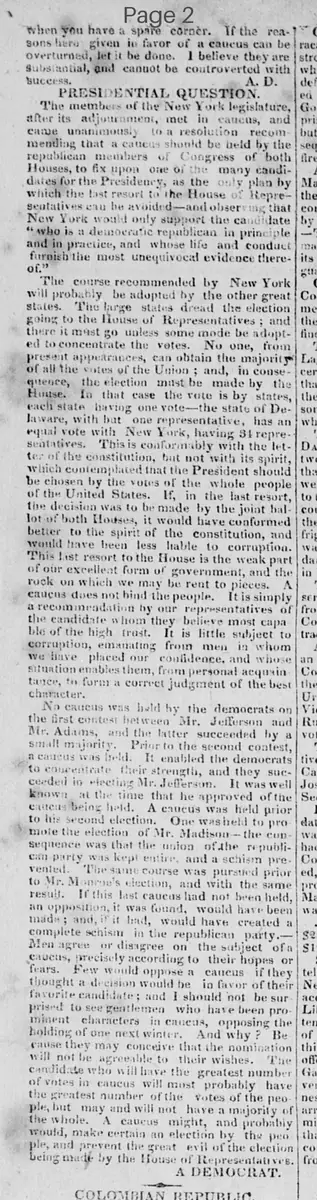
When you have a spare corner. If the reasons here given in favor of a caucus can be overturned, let it be done. I believe they are substantial, and cannot be controverted with success.
A. D.
PRESIDENTIAL QUESTION.
The members of the New York legislature, after its adjournment, met in caucus, and came unanimously to a resolution recommending that a caucus should be held by the republican members of Congress of both Houses, to fix upon one of the many candidates for the Presidency, as the only plan by which the last resort to the House of Representatives can be avoided—and observing that New York would only support the candidate "who is a democratic republican in principle and in practice, and whose life and conduct furnish the most unequivocal evidence thereof."
The course recommended by New York will probably be adopted by the other great states. The large states dread the election going to the House of Representatives: and there it must go unless some mode be adopted to concentrate the votes. No one, from present appearances, can obtain the majority of all the votes of the Union: and, in consequence, the election must be made by the House. In that case the vote is by states, each state having one vote—the state of Delaware, with but one representative, has an equal vote with New York, having 34 representatives. This is conformably with the letter of the constitution, but not with its spirit which contemplated that the President should be chosen by the votes of the whole people of the United States. If, in the last resort, the decision was to be made by the joint ballot of both Houses, it would have conformed better to the spirit of the constitution, and would have been less liable to corruption.
This last resort to the House is the weak part of our excellent form of government, and the rock on which we may be rent to pieces. A caucus does not bind the people. It is simply a recommendation by our representatives of the candidate whom they believe most capable of the high trust. It is little subject to corruption, emanating from men in whom we have placed our confidence, and whose situation enables them, from personal acquaintance, to form a correct judgment of the best character.
No caucus was held by the democrats on the first contest between Mr. Jefferson and Mr. Adams, and the latter succeeded by a small minority. Prior to the second contest, a caucus was held. It enabled the democrats to concentrate their strength, and they succeeded in electing Mr. Jefferson. It was well known at the time that he approved of the caucus being held. A caucus was held prior to his second election. One was held to promote the election of Mr. Madison—the consequence was that the union of the republican party was kept entire, and a schism prevented. The same course was pursued prior to Mr. Monroe's election, and with the same result. If this last caucus had not been held, an opposition, it was found, would have been made: and, if it had, would have created a complete schism in the republican party.
Men agree or disagree on the subject of a caucus, precisely according to their hopes or fears. Few would oppose a caucus if they thought a decision would be in favor of their favorite candidate: and I should not be surprised to see gentlemen who have been prominent characters in caucus, opposing the holding of one next winter. And why? Because they may conceive that the nomination will not be agreeable to their wishes. The candidate who will have the greatest number of votes in caucus will most probably have the greatest number of the votes of the people, but may and will not have a majority of the whole. A caucus might, and probably would, make certain an election by the people, and prevent the great evil of the election being made by the House of Representatives.
A DEMOCRAT.
A. D.
PRESIDENTIAL QUESTION.
The members of the New York legislature, after its adjournment, met in caucus, and came unanimously to a resolution recommending that a caucus should be held by the republican members of Congress of both Houses, to fix upon one of the many candidates for the Presidency, as the only plan by which the last resort to the House of Representatives can be avoided—and observing that New York would only support the candidate "who is a democratic republican in principle and in practice, and whose life and conduct furnish the most unequivocal evidence thereof."
The course recommended by New York will probably be adopted by the other great states. The large states dread the election going to the House of Representatives: and there it must go unless some mode be adopted to concentrate the votes. No one, from present appearances, can obtain the majority of all the votes of the Union: and, in consequence, the election must be made by the House. In that case the vote is by states, each state having one vote—the state of Delaware, with but one representative, has an equal vote with New York, having 34 representatives. This is conformably with the letter of the constitution, but not with its spirit which contemplated that the President should be chosen by the votes of the whole people of the United States. If, in the last resort, the decision was to be made by the joint ballot of both Houses, it would have conformed better to the spirit of the constitution, and would have been less liable to corruption.
This last resort to the House is the weak part of our excellent form of government, and the rock on which we may be rent to pieces. A caucus does not bind the people. It is simply a recommendation by our representatives of the candidate whom they believe most capable of the high trust. It is little subject to corruption, emanating from men in whom we have placed our confidence, and whose situation enables them, from personal acquaintance, to form a correct judgment of the best character.
No caucus was held by the democrats on the first contest between Mr. Jefferson and Mr. Adams, and the latter succeeded by a small minority. Prior to the second contest, a caucus was held. It enabled the democrats to concentrate their strength, and they succeeded in electing Mr. Jefferson. It was well known at the time that he approved of the caucus being held. A caucus was held prior to his second election. One was held to promote the election of Mr. Madison—the consequence was that the union of the republican party was kept entire, and a schism prevented. The same course was pursued prior to Mr. Monroe's election, and with the same result. If this last caucus had not been held, an opposition, it was found, would have been made: and, if it had, would have created a complete schism in the republican party.
Men agree or disagree on the subject of a caucus, precisely according to their hopes or fears. Few would oppose a caucus if they thought a decision would be in favor of their favorite candidate: and I should not be surprised to see gentlemen who have been prominent characters in caucus, opposing the holding of one next winter. And why? Because they may conceive that the nomination will not be agreeable to their wishes. The candidate who will have the greatest number of votes in caucus will most probably have the greatest number of the votes of the people, but may and will not have a majority of the whole. A caucus might, and probably would, make certain an election by the people, and prevent the great evil of the election being made by the House of Representatives.
A DEMOCRAT.
What sub-type of article is it?
Partisan Politics
Constitutional
What keywords are associated?
Presidential Caucus
Republican Party
House Election
Constitutional Spirit
Party Unity
Historical Elections
What entities or persons were involved?
New York Legislature
Republican Members Of Congress
Mr. Jefferson
Mr. Adams
Mr. Madison
Mr. Monroe
Democratic Republicans
Editorial Details
Primary Topic
Advocacy For Republican Congressional Caucus To Select Presidential Candidate
Stance / Tone
Supportive Of Caucus To Avoid Election By House Of Representatives
Key Figures
New York Legislature
Republican Members Of Congress
Mr. Jefferson
Mr. Adams
Mr. Madison
Mr. Monroe
Democratic Republicans
Key Arguments
Caucus Recommended By New York To Concentrate Votes And Avoid House Election
House Election Gives Equal Vote To Small States Like Delaware As Large Ones Like New York, Contrary To Constitutional Spirit
Caucus Is A Recommendation By Trusted Representatives, Less Liable To Corruption
Historical Caucuses Enabled Success Of Jefferson, Madison, And Monroe, Preventing Schisms
Opposition To Caucus Based On Hopes Or Fears For Favorite Candidates
Caucus Likely Ensures Election By People Rather Than House