Thank you for visiting SNEWPapers!
Sign up free
Story
November 6, 1950
Trainman News
Indianapolis, Marion County, Indiana
What is this article about?
Organized labor opposes General Motors President C. E. Wilson's proposal for a 45-hour work week without overtime pay during the defense emergency, citing industry profits and potential layoffs in auto sector.
Clipping
OCR Quality
100%
Excellent
Full Text
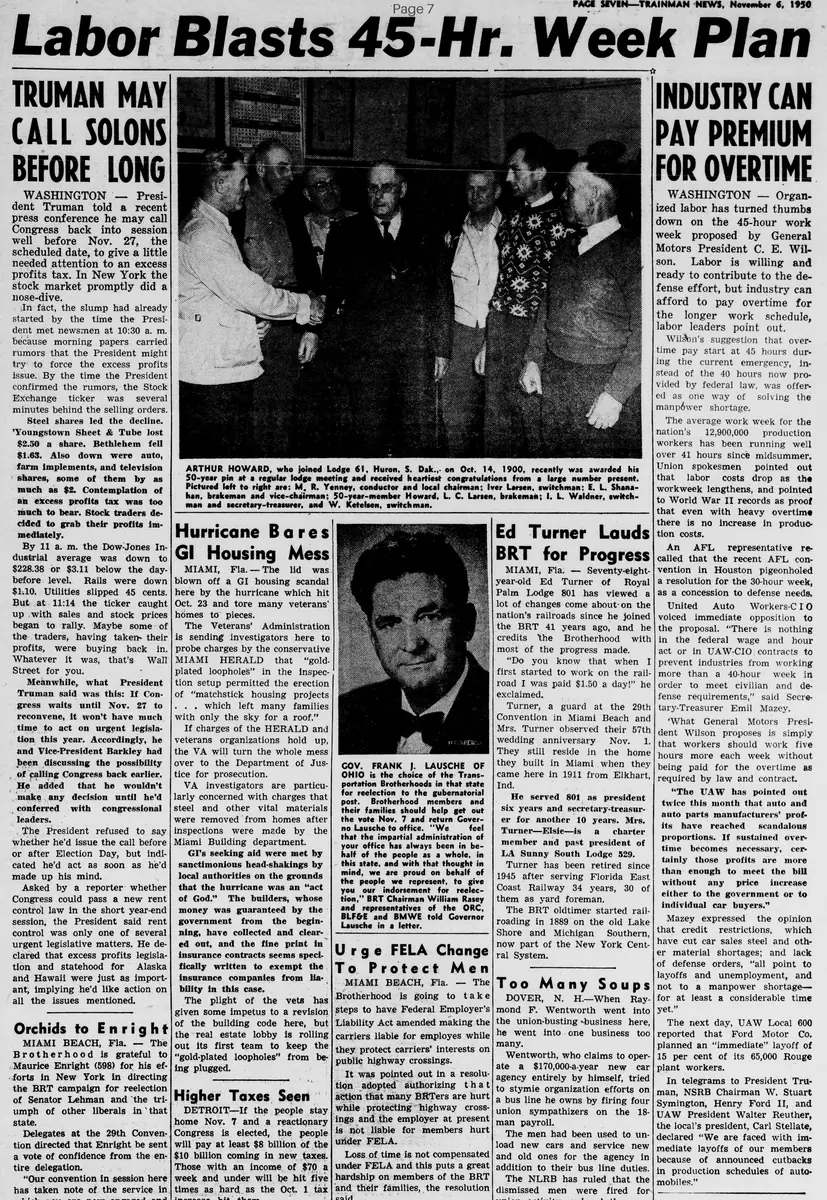
Labor Blasts 45-Hr. Week Plan
WASHINGTON Organized labor has turned thumbs down on the 45-hour work week proposed by General Motors President C. E. Wilson.
Labor is willing and ready to contribute to the defense effort, but industry can afford to pay overtime for the longer work schedule, labor leaders point out.
Wilson's suggestion that overtime pay start at 45 hours during the current emergency, instead of the 40 hours now provided by federal law, was offered as one way of solving the manpower shortage.
The average work week for the nation's 12,900,000 production workers has been running well over 41 hours since midsummer.
Union spokesmen pointed out that labor costs drop as the workweek lengthens, and pointed to World War II records as proof that even with heavy overtime there is no increase in production costs.
An AFL representative recalled that the recent AFL convention in Houston pigeonholed a resolution for the 30-hour week, as a concession to defense needs.
United Auto Workers-CIO voiced immediate opposition to the proposal, "There is nothing in the federal wage and hour act or in UAW-CIO contracts to prevent industries from working more than a 40-hour week in order to meet civilian and defense requirements," said Secretary-Treasurer Emil Mazey.
"What General Motors President Wilson proposes is simply that workers should work five hours more each week without being paid for the overtime as required by law and contract.
"The UAW has pointed out twice this month that auto and auto parts manufacturers' profits have reached scandalous proportions. If sustained overtime becomes necessary, certainly those profits are more than enough to meet the bill without any price increase either to the government or to individual car buyers."
Mazey expressed the opinion that credit restrictions, which have cut car sales steel and other material shortages; and lack of defense orders, "all point to layoffs and unemployment, and not to a manpower shortage--for at least a considerable time yet."
The next day, UAW Local 600 reported that Ford Motor Co. planned an "immediate" layoff of 15 per cent of its 65,000 Rouge plant workers.
In telegrams to President Truman, NSRB Chairman W. Stuart Symington, Henry Ford II, and UAW President Walter Reuther, the local's president, Carl Stellate, declared "We are faced with immediate layoffs of our members because of announced cutbacks in production schedules of automobiles."
WASHINGTON Organized labor has turned thumbs down on the 45-hour work week proposed by General Motors President C. E. Wilson.
Labor is willing and ready to contribute to the defense effort, but industry can afford to pay overtime for the longer work schedule, labor leaders point out.
Wilson's suggestion that overtime pay start at 45 hours during the current emergency, instead of the 40 hours now provided by federal law, was offered as one way of solving the manpower shortage.
The average work week for the nation's 12,900,000 production workers has been running well over 41 hours since midsummer.
Union spokesmen pointed out that labor costs drop as the workweek lengthens, and pointed to World War II records as proof that even with heavy overtime there is no increase in production costs.
An AFL representative recalled that the recent AFL convention in Houston pigeonholed a resolution for the 30-hour week, as a concession to defense needs.
United Auto Workers-CIO voiced immediate opposition to the proposal, "There is nothing in the federal wage and hour act or in UAW-CIO contracts to prevent industries from working more than a 40-hour week in order to meet civilian and defense requirements," said Secretary-Treasurer Emil Mazey.
"What General Motors President Wilson proposes is simply that workers should work five hours more each week without being paid for the overtime as required by law and contract.
"The UAW has pointed out twice this month that auto and auto parts manufacturers' profits have reached scandalous proportions. If sustained overtime becomes necessary, certainly those profits are more than enough to meet the bill without any price increase either to the government or to individual car buyers."
Mazey expressed the opinion that credit restrictions, which have cut car sales steel and other material shortages; and lack of defense orders, "all point to layoffs and unemployment, and not to a manpower shortage--for at least a considerable time yet."
The next day, UAW Local 600 reported that Ford Motor Co. planned an "immediate" layoff of 15 per cent of its 65,000 Rouge plant workers.
In telegrams to President Truman, NSRB Chairman W. Stuart Symington, Henry Ford II, and UAW President Walter Reuther, the local's president, Carl Stellate, declared "We are faced with immediate layoffs of our members because of announced cutbacks in production schedules of automobiles."
What sub-type of article is it?
Historical Event
What themes does it cover?
Justice
Misfortune
What keywords are associated?
Labor Opposition
45 Hour Week
Overtime Pay
Manpower Shortage
Auto Industry Profits
Layoffs
Uaw
What entities or persons were involved?
C. E. Wilson
Emil Mazey
Walter Reuther
Carl Stellate
Henry Ford Ii
W. Stuart Symington
President Truman
Where did it happen?
Washington
Story Details
Key Persons
C. E. Wilson
Emil Mazey
Walter Reuther
Carl Stellate
Henry Ford Ii
W. Stuart Symington
President Truman
Location
Washington
Story Details
Organized labor rejects GM's 45-hour work week proposal, arguing for overtime pay based on industry profits; UAW highlights potential layoffs at Ford amid production cutbacks.