Thank you for visiting SNEWPapers!
Sign up free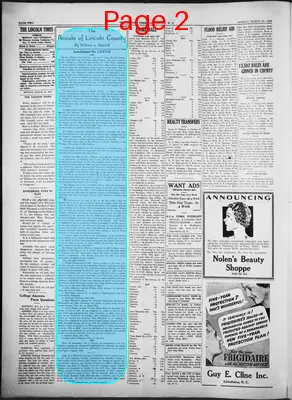
Literary
March 23, 1936
The Lincoln Times
Lincolnton, Lincoln County, North Carolina
What is this article about?
Installment LXXVII of The Annals of Lincoln County chronicles the life, Civil War service, legal and Episcopal ministry career, and death of Rev. William Shipp Bynum in 1898, including Bishop Cheshire's tribute and family details. It also notes a 1899 constitutional amendment on suffrage qualifications and the biography of Judge M. L. McCorkle.
Clipping
OCR Quality
98%
Excellent
Full Text
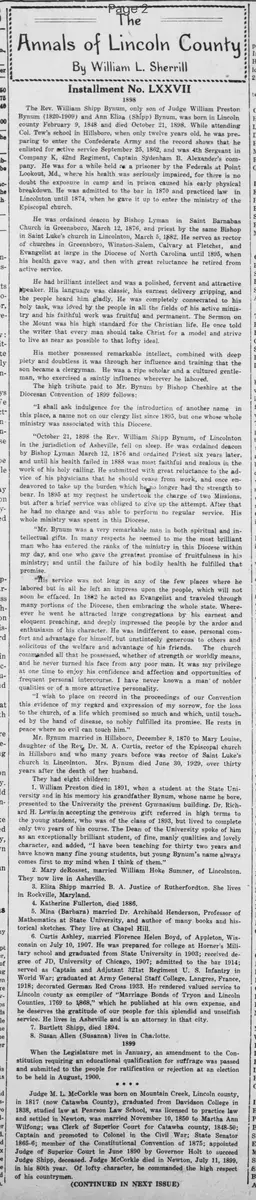
The Annals of Lincoln County
By William L. Sherrill
Installment No. LXXVII
1898
The Rev. William Shipp Bynum, only son of Judge William Preston Bynum (1820-1909) and Ann Eliza (Shipp) Bynum, was born in Lincoln county February 9, 1848 and died October 21, 1898. While attending Col. Tew's school in Hillsboro, when only twelve years old, he was preparing to enter the Confederate Army and the record shows that he enlisted for active service September 25, 1862, and was 4th Sergeant in Company K, 42nd Regiment, Captain Sydenham B. Alexander's company. He was for a while held as a prisoner by the Federals at Point Lookout, Md., where his health was seriously impaired, for there is no doubt the exposure in camp and in prison caused his early physical breakdown. He was admitted to the bar in 1870 and practiced law in Lincolnton until 1874, when he gave it up to enter the ministry of the Episcopal church.
He was ordained deacon by Bishop Lyman in Saint Barnabas Church in Greensboro, March 12, 1876, and priest by the same Bishop in Saint Luke's church in Lincolnton, March 5, 1882. He served as rector of churches in Greensboro, Winston-Salem, Calvary at Fletcher, and Evangelist at large in the Diocese of North Carolina until 1895, when his health gave way, and then with great reluctance he retired from active service.
He had brilliant intellect and was a polished, fervent and attractive speaker. His language was classic, his earnest delivery gripping, and the people heard him gladly. He was completely consecrated to his holy task, was loved by the people in all the fields of his active ministry and his faithful work was fruitful and permanent. The Sermon on the Mount was his high standard for the Christian life. He once told the writer that every man should take Christ for a model and strive to live as near as possible to that lofty ideal.
His mother possessed remarkable intellect, combined with deep piety and doubtless it was through her influence and training that the son became a clergyman. He was a ripe scholar and a cultured gentleman, who exercised a saintly influence wherever he labored.
The high tribute paid to Mr. Bynum by Bishop Cheshire at the Diocesan Convention of 1899 follows:
"I shall ask indulgence for the introduction of another name in this place, a name not on our clergy list since 1895, but one whose whole ministry was associated with this Diocese.
"October 21, 1898 the Rev. William Shipp Bynum, of Lincolnton in the jurisdiction of Asheville, fell on sleep. He was ordained deacon by Bishop Lyman March 12, 1876 and ordained Priest six years later, and until his health failed in 1888 was most faithful and zealous in the work of his holy calling. He submitted with great reluctance to the advice of his physicians that he should cease from work, and once endeavored to take up the burden which he no longer had the strength to bear. In 1895 at my request he undertook the charge of two Missions, but after a brief service was obliged to give up the attempt. After that he had no charge and was able to perform no regular service. His whole ministry was spent in this Diocese.
"Mr. Bynum was a very remarkable man in both spiritual and intellectual gifts. In many respects he seemed to me the most brilliant man who has entered the ranks of the ministry in this Diocese within my day, and one who gave the greatest promise of fruitfulness in his ministry; and until the failure of his bodily health he fulfilled that promise.
His service was not long in any of the few places where he labored but in all he left an impress upon the people, which will not soon be effaced. In 1882 he acted as Evangelist and traveled through many portions of the Diocese, then embracing the whole state. Wherever he went he attracted large congregations by his earnest and eloquent preaching, and deeply impressed the people by the ardor and enthusiasm of his character. He was indifferent to ease, personal comfort and advantage for himself, but unstintedly generous to others and solicitous of the welfare and advantage of his friends. The church commanded all that he possessed, whether of strength or worldly means, and he never turned his face from any poor man. It was my privilege at one time to enjoy his confidence and affection and opportunities of frequent personal intercourse. I have never known a man of nobler qualities or of a more attractive personality.
"I wish to place on record in the proceedings of our Convention this evidence of my regard and expression of my sorrow, for the loss to the church, of a life which promised so much and which, until touched by the hand of disease, so nobly fulfilled its promise. He rests in peace where no evil can touch him."
Mr. Bynum married in Hillsboro, December 8, 1870 to Mary Louise, daughter of the Rev. Dr. M. A. Curtis, rector of the Episcopal church in Hillsboro and who many years before was rector of Saint Luke's church in Lincolnton. Mrs. Bynum died June 30, 1929, over thirty years after the death of her husband.
They had eight children:
1. William Preston died in 1891, when a student at the State University and in his memory his grandfather Bynum, whose name he bore, presented to the University the present Gymnasium building. Dr. Richard H. Lewis in accepting the generous gift referred in high terms to the young student, who was of the class of 1893, but lived to complete only two years of his course. The Dean of the University spoke of him as an exceptionally brilliant student, of fine, manly qualities and lovely character, and added, "I have been teaching for thirty two years and have known many fine young students, but young Bynum's name always comes first to my mind when I think of them."
2. Mary deRosset, married William Hoke Sumner, of Lincolnton. They now live in Asheville.
3. Eliza Shipp married B. A. Justice of Rutherfordton. She lives in Rockville, Maryland.
4. Katherine Fullerton, died 1886.
5. Mina (Barbara) married Dr. Archibald Henderson, Professor of Mathematics at State University, and author of many books and historical sketches. They live at Chapel Hill.
6. Curtis Ashley, married Florence Helen Boyd, of Appleton, Wisconsin on July 10, 1907. He was prepared for college at Horner's Military school and graduated from State University in 1903; received degree of JD, University of Chicago, 1907; admitted to the bar 1914; served as Captain and Adjutant 321st Regiment U. S. Infantry in World War; graduated at Army General Staff College, Langres, France, 1918; decorated German Red Cross 1933. He rendered valued service to Lincoln county as compiler of "Marriage Bonds of Tryon and Lincoln Counties, 1769 to 1868," which he published at his own expense, and he deserves the gratitude of our people for this splendid and unselfish service. He lives in Asheville and is an attorney in that city.
7. Bartlett Shipp, died 1894.
8. Susan Allen (Susanna) lives in Charlotte.
1899
When the Legislature met in January, an amendment to the Constitution requiring an educational qualification for suffrage was passed and submitted to the people for ratification or rejection at an election to be held in August, 1900.
Judge M. L. McCorkle was born on Mountain Creek, Lincoln county, in 1817 (now Catawba County), graduated from Davidson College in 1838, studied law at Pearson Law School, was licensed to practice law and settled in Newton, was married November 10, 1850 to Martha Ann Wilfong; was Clerk of Superior Court for Catawba county, 1848-50; Captain and promoted to Colonel in the Civil War; State Senator 1865-6; member of the Constitutional Convention of 1875; appointed Judge of Superior Court in June 1890 by Governor Holt to succeed Judge Shipp, deceased. Judge McCorkle died in Newton, July 11, 1899, in his 80th year. Of lofty character, he commanded the high respect of his countrymen.
(CONTINUED IN NEXT ISSUE)
By William L. Sherrill
Installment No. LXXVII
1898
The Rev. William Shipp Bynum, only son of Judge William Preston Bynum (1820-1909) and Ann Eliza (Shipp) Bynum, was born in Lincoln county February 9, 1848 and died October 21, 1898. While attending Col. Tew's school in Hillsboro, when only twelve years old, he was preparing to enter the Confederate Army and the record shows that he enlisted for active service September 25, 1862, and was 4th Sergeant in Company K, 42nd Regiment, Captain Sydenham B. Alexander's company. He was for a while held as a prisoner by the Federals at Point Lookout, Md., where his health was seriously impaired, for there is no doubt the exposure in camp and in prison caused his early physical breakdown. He was admitted to the bar in 1870 and practiced law in Lincolnton until 1874, when he gave it up to enter the ministry of the Episcopal church.
He was ordained deacon by Bishop Lyman in Saint Barnabas Church in Greensboro, March 12, 1876, and priest by the same Bishop in Saint Luke's church in Lincolnton, March 5, 1882. He served as rector of churches in Greensboro, Winston-Salem, Calvary at Fletcher, and Evangelist at large in the Diocese of North Carolina until 1895, when his health gave way, and then with great reluctance he retired from active service.
He had brilliant intellect and was a polished, fervent and attractive speaker. His language was classic, his earnest delivery gripping, and the people heard him gladly. He was completely consecrated to his holy task, was loved by the people in all the fields of his active ministry and his faithful work was fruitful and permanent. The Sermon on the Mount was his high standard for the Christian life. He once told the writer that every man should take Christ for a model and strive to live as near as possible to that lofty ideal.
His mother possessed remarkable intellect, combined with deep piety and doubtless it was through her influence and training that the son became a clergyman. He was a ripe scholar and a cultured gentleman, who exercised a saintly influence wherever he labored.
The high tribute paid to Mr. Bynum by Bishop Cheshire at the Diocesan Convention of 1899 follows:
"I shall ask indulgence for the introduction of another name in this place, a name not on our clergy list since 1895, but one whose whole ministry was associated with this Diocese.
"October 21, 1898 the Rev. William Shipp Bynum, of Lincolnton in the jurisdiction of Asheville, fell on sleep. He was ordained deacon by Bishop Lyman March 12, 1876 and ordained Priest six years later, and until his health failed in 1888 was most faithful and zealous in the work of his holy calling. He submitted with great reluctance to the advice of his physicians that he should cease from work, and once endeavored to take up the burden which he no longer had the strength to bear. In 1895 at my request he undertook the charge of two Missions, but after a brief service was obliged to give up the attempt. After that he had no charge and was able to perform no regular service. His whole ministry was spent in this Diocese.
"Mr. Bynum was a very remarkable man in both spiritual and intellectual gifts. In many respects he seemed to me the most brilliant man who has entered the ranks of the ministry in this Diocese within my day, and one who gave the greatest promise of fruitfulness in his ministry; and until the failure of his bodily health he fulfilled that promise.
His service was not long in any of the few places where he labored but in all he left an impress upon the people, which will not soon be effaced. In 1882 he acted as Evangelist and traveled through many portions of the Diocese, then embracing the whole state. Wherever he went he attracted large congregations by his earnest and eloquent preaching, and deeply impressed the people by the ardor and enthusiasm of his character. He was indifferent to ease, personal comfort and advantage for himself, but unstintedly generous to others and solicitous of the welfare and advantage of his friends. The church commanded all that he possessed, whether of strength or worldly means, and he never turned his face from any poor man. It was my privilege at one time to enjoy his confidence and affection and opportunities of frequent personal intercourse. I have never known a man of nobler qualities or of a more attractive personality.
"I wish to place on record in the proceedings of our Convention this evidence of my regard and expression of my sorrow, for the loss to the church, of a life which promised so much and which, until touched by the hand of disease, so nobly fulfilled its promise. He rests in peace where no evil can touch him."
Mr. Bynum married in Hillsboro, December 8, 1870 to Mary Louise, daughter of the Rev. Dr. M. A. Curtis, rector of the Episcopal church in Hillsboro and who many years before was rector of Saint Luke's church in Lincolnton. Mrs. Bynum died June 30, 1929, over thirty years after the death of her husband.
They had eight children:
1. William Preston died in 1891, when a student at the State University and in his memory his grandfather Bynum, whose name he bore, presented to the University the present Gymnasium building. Dr. Richard H. Lewis in accepting the generous gift referred in high terms to the young student, who was of the class of 1893, but lived to complete only two years of his course. The Dean of the University spoke of him as an exceptionally brilliant student, of fine, manly qualities and lovely character, and added, "I have been teaching for thirty two years and have known many fine young students, but young Bynum's name always comes first to my mind when I think of them."
2. Mary deRosset, married William Hoke Sumner, of Lincolnton. They now live in Asheville.
3. Eliza Shipp married B. A. Justice of Rutherfordton. She lives in Rockville, Maryland.
4. Katherine Fullerton, died 1886.
5. Mina (Barbara) married Dr. Archibald Henderson, Professor of Mathematics at State University, and author of many books and historical sketches. They live at Chapel Hill.
6. Curtis Ashley, married Florence Helen Boyd, of Appleton, Wisconsin on July 10, 1907. He was prepared for college at Horner's Military school and graduated from State University in 1903; received degree of JD, University of Chicago, 1907; admitted to the bar 1914; served as Captain and Adjutant 321st Regiment U. S. Infantry in World War; graduated at Army General Staff College, Langres, France, 1918; decorated German Red Cross 1933. He rendered valued service to Lincoln county as compiler of "Marriage Bonds of Tryon and Lincoln Counties, 1769 to 1868," which he published at his own expense, and he deserves the gratitude of our people for this splendid and unselfish service. He lives in Asheville and is an attorney in that city.
7. Bartlett Shipp, died 1894.
8. Susan Allen (Susanna) lives in Charlotte.
1899
When the Legislature met in January, an amendment to the Constitution requiring an educational qualification for suffrage was passed and submitted to the people for ratification or rejection at an election to be held in August, 1900.
Judge M. L. McCorkle was born on Mountain Creek, Lincoln county, in 1817 (now Catawba County), graduated from Davidson College in 1838, studied law at Pearson Law School, was licensed to practice law and settled in Newton, was married November 10, 1850 to Martha Ann Wilfong; was Clerk of Superior Court for Catawba county, 1848-50; Captain and promoted to Colonel in the Civil War; State Senator 1865-6; member of the Constitutional Convention of 1875; appointed Judge of Superior Court in June 1890 by Governor Holt to succeed Judge Shipp, deceased. Judge McCorkle died in Newton, July 11, 1899, in his 80th year. Of lofty character, he commanded the high respect of his countrymen.
(CONTINUED IN NEXT ISSUE)
What sub-type of article is it?
Essay
What themes does it cover?
Death Mortality
Religious
Political
What keywords are associated?
Biography
Clergy
Episcopal Church
Civil War
Lincoln County
Suffrage Amendment
Judge Mccorkle
What entities or persons were involved?
By William L. Sherrill
Literary Details
Title
The Annals Of Lincoln County Installment No. Lxxvii
Author
By William L. Sherrill
Subject
Biographical Sketches Of Rev. William Shipp Bynum And Judge M. L. Mccorkle, With Notes On 1899 Suffrage Amendment
Key Lines
"Mr. Bynum Was A Very Remarkable Man In Both Spiritual And Intellectual Gifts. In Many Respects He Seemed To Me The Most Brilliant Man Who Has Entered The Ranks Of The Ministry In This Diocese Within My Day..."
"I Have Been Teaching For Thirty Two Years And Have Known Many Fine Young Students, But Young Bynum's Name Always Comes First To My Mind When I Think Of Them."
Of Lofty Character, He Commanded The High Respect Of His Countrymen.