Thank you for visiting SNEWPapers!
Sign up free
The Enquirer
Richmond, Henrico County, Virginia
What is this article about?
In his third letter, Thomas Paine urges Pennsylvania citizens to convene a constitutional convention for judicial reform, criticizing reliance on English precedents and terms, advocating for American laws, judicial accountability beyond mere 'good behavior,' and addressing power imbalances in the bicameral legislature, drawing historical parallels.
Clipping
OCR Quality
Full Text
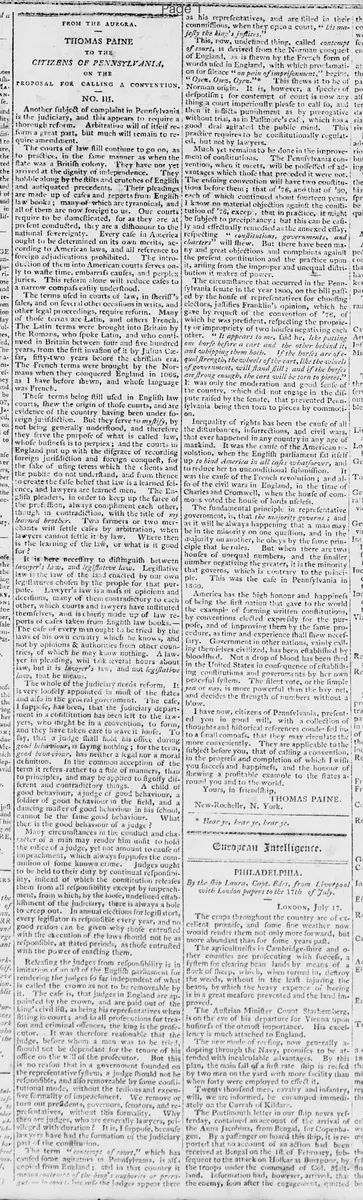
THOMAS PAINE
TO THE
CITIZENS OF PENNSYLVANIA,
ON THE
PROPOSAL FOR
CALLING
A CONVENTION.
NO. III.
Another subject of complaint in Pennsylvania is the judiciary, and this appears to require a thorough reform. Arbitration will of itself reform a great part, but much will remain to require amendment.
The courts of law still continue to go on, as to practice. in the same manner as when the state was a British colony. They have not yet arrived at the dignity of independence. They hobble along by the fits and crutches of English and antiquated precedents. Their pleadings are made up of cases and reports from English law books; many of which are tyrannical, and all of them are now foreign to us. Our courts require to be domesticated, for as they are at present conducted, they are a dishonour to the national sovereignty.
Every case in America ought to be determined on its own merits, according to American laws, and all reference to foreign adjudications prohibited.
The introduction of them into American courts serves only to waste time, embarrass causes, and perplex juries. This reform alone will reduce cases to a narrow compass easily understood.
The terms used in courts of law, in sheriff's sales, and on several other occasions in writs, and other legal proceedings, require reform. Many of those terms are Latin, and others French. The Latin terms were brought into Britain by the Romans, who spoke Latin, and who continued in Britain between four and five hundred years, from the first invasion of it by Julius Caesar, fifty-two years before the christian era. The French terms were brought by the Normans when they conquered England in 1066, as I have before shewn, and whose language was French.
These terms being still used in English law courts, shew the origin of those courts, and are evidence of the country having been under foreign jurisdiction. But they serve to mystify, by not being generally understood, and therefore they serve the purpose of what is called law, whose business is to perplex; and the courts in England put up with the disgrace of recording foreign jurisdiction and foreign conquest, for the sake of using terms which the clients and the public do not understand, and from thence to create the false belief that law is a learned science, and lawyers are learned men. The English pleaders, in order to keep up the farce of the profession, always compliment each other, though in contradiction, with the title of my learned brother. Two farmers or two merchants will settle cases by arbitration, when lawyers cannot settle it by law.
Where then is the learning of the law, or what is it good for?
It is here necessary to distinguish between lawyer's law, and legislative law. Legislative law is the law of the land enacted by our own legislatures chosen by the people for that purpose..
Lawyer's law is a mass of opinions and decisions, many of them contradictory to each other, which courts and lawyers have instituted themselves, and is chiefly made up of law reports of cases taken from English law books.-
The case of every man ought to be tried by the laws of his own country which he knows, and not by opinions & authorities from other countries, of which he may know nothing. A lawyer in pleading, will talk several hours about law, but it is lawyer's law, and not legislative law, that he means.
The whole of the judiciary needs reform. It is very loosely appointed in most of the states and also in the general government. The case, I suppose, has been, that the judiciary department in a constitution has been left to the lawyers, who might be in a convention, to form, and they have taken care to leave it loose. To say, that a judge shall hold his office during good behaviour, is saying nothing; for the term, good behaviour, has neither a legal nor a moral definition. In the common acceptation of the term it refers -rather to a stile of manners, than to principles, and may be applied to signify different and contradictory things. A child of good behaviour, a judge of good behaviour, a soldier of good behaviour in the field, and a dancing master of good behaviour in his school, cannot be the same good behaviour.
What then. is the good behaviour of a judge?
Many circumstances in the conduct and character of a man may render him unfit to hold the office of a judge, yet not amount to cause of impeachment, which always supposes the commission of some known crime. Judges ought to be held to their duty by continual responsibility, instead of which the constitution releases them from all responsibility except by impeachment, from which, by the loose, undefined establishment of the judiciary, there is always a hole to creep out. In annual elections for legislators, every legislator is responsible every year, and no good reason can be given why those entrusted with the execution of the laws should not be as responsible, at stated periods, as those entrusted with the power of enacting them.
Releasing the judges from responsibility is in imitation of an act of the English parliament for rendering the judges so far independent of what is called the crown as not to be removeable by it. The case is, that judges in England are appointed by the crown, and are paid out of the king's civil list, as being his representatives when sitting in court; and in all prosecutions for treason and criminal offences, the king is the prosecutor, It was therefore reasonable that the judge, before whom a man was to be tried, should not be dependant for the tenure of his office on the will of the prosecutor. But this is no reason that in a government founded on the representative system, a judge should not be responsible, and also removeable by some constitutional mode, without the tedious and expensive formality of impeachment. We remove or turn out presidents, governors, senators, and representatives, without this formality. Why then are judges, who are generally lawyers, privileged with duration? It is,I suppose, because lawyers have had the formation of the judiciary part of the constitution.
The term "contempt of court," which has caused some agitation in Pennsylvania. is also, copied from England; and in that country it means contempt of the king's authority or prerogatives in courts. because the judges appear there as his representatives, and are stiled in their commissions, when they open a court, "his majesty the king's justices."
This, now, undefined thing, called contempt of court, is derived from the Norman conquest of England, as is shewn by the French form of words used in England, with which proclamation for silence "on pain of imprisonment,"begins, "Oyez, Oyez, Oyez."
This shews it to be of Norman origin. It is, however, a species of despotism: for contempt of court is now any thing a court imperiously please to call so, and then it inflicts punishment as by prerogative without trial, as in Passmore's case.; which has a good deal agitated the public mind.
This practice requires to be constitutionally regulated, but not by lawyers.
Much yet remains to be done in the improvement of constitutions.
The Pennsylvania convention, when it meets, will be possessed of advantages which those that preceded it were not. The ensuing convention will have two constitutions before them; that of '76, and that of '90, each of which continued about fourteen years.
I know no material objection against the constitution of '76, except, that in practice, it might be subject to precipitancy: but this can be easily and effectually remedied as the annexed essay, respecting "constitutions, governments, and charters" will shew. But there have been many and great objections and complaints against the present constitution and the practice upon it, arising from the improper and unequal distribution it makes of power.
The circumstance that occurred in the Pennsylvania senate in the year 1800, on the bill passed by the house of representatives for chusing electors, justifies Franklin's opinion, which he gave by request of the convention of '76, of which he was president, respecting the propriety or impropriety of two houses negativing each other. "It appears to me, said he, like putting one horse before a cart and the other behind it, and whipping them both. If the horses are of equal strength, the wheels of the cart, like the wheels of government, will stand still; and if the horses are strong enough, the cart will be torn to pieces."
It was only the moderation and good sense of the country, which did not engage in the dispute raised by the senate, that prevented Pennsylvania being then torn to pieces by commotion.
Inequality of rights has been the cause of all the disturbances, insurrections, and civil wars, that ever happened in any country in any age of mankind. It was the cause of the American revolution, when the English parliament at itself up to bind America in all cases whatsoever, and to reduce her to unconditional submission. It was the cause of the French revolution; and also of the civil wars in England, in the time of Charles and Cromwell, when the house of commons voted the house of lords useless.
The fundamental principle in representative government, is, that the majority governs; and as it will be always happening that a man may be in the minority on one question, and in the majority on another, he obeys by the same principle that he rules. But when there are two houses of unequal numbers, and the smaller number negativing the greater, it is the minority that governs, which is contrary to the principle. This was the case in Pennsylvania in 1800.
America has the high honour and happiness of being the first nation that gave to the world the example of forming written constitutions, by conventions elected expressly for the purpose, and of improving them by the same procedure, as time and experience shall shew necessary. Government in other nations, vainly calling themselves civilized, has been established by bloodshed. Not a drop of blood has been shed in the United States in consequence of establishing constitutions and governments by her own peaceful system. The silent vote, or the simple yea or nay, is more powerful than the bayonet, and decides the strength of numbers without a blow.
I have now, citizens of Pennsylvania, presented you in good will, with a collection of thoughts and historical references condensed into a small compass, that they may circulate the more conveniently. They are applicable to the subject before you, that of calling a convention, in the progress and completion of which I wish you success and happiness, and the honour of shewing a profitable example to the states around you and to the world.
Yours, in friendship,
THOMAS PAINE.
New-Rochelle, N. York.
Hear ye, hear ye, hear ye.
What sub-type of article is it?
What themes does it cover?
What keywords are associated?
What entities or persons were involved?
Letter to Editor Details
Author
Thomas Paine
Recipient
Citizens Of Pennsylvania
Main Argument
thomas paine advocates for a constitutional convention in pennsylvania to reform the judiciary by eliminating english precedents and terms, ensuring trials under american laws, imposing greater judicial accountability through periodic responsibility rather than mere 'good behavior,' and correcting unequal power distribution in the bicameral legislature to uphold majority rule.
Notable Details