Thank you for visiting SNEWPapers!
Sign up free
Casper Daily Tribune
Casper, Natrona County, Wyoming
What is this article about?
US government awaits Norwegian request before aiding Amundsen-Ellsworth polar expedition rescue, amid criticism of Norway's news monopoly support and doubts on dirigible use.
Clipping
OCR Quality
Full Text
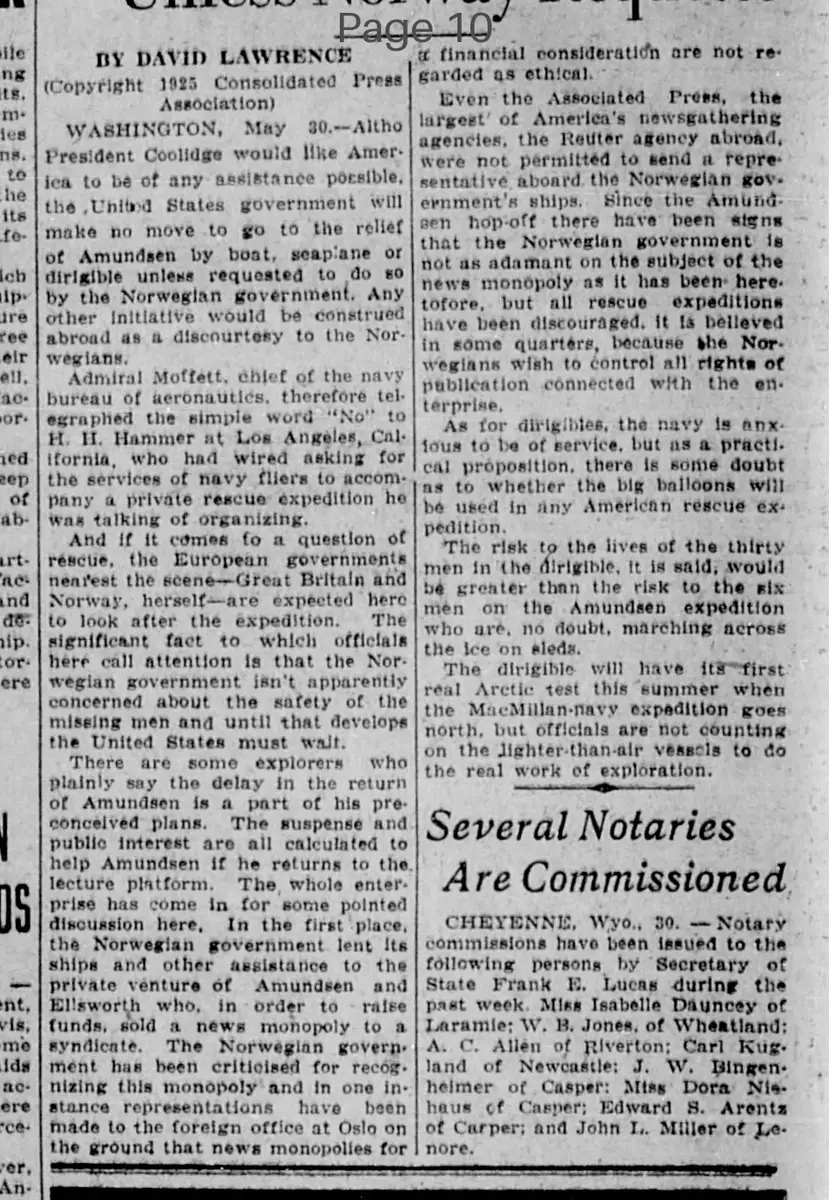
(Copyright 1925 Consolidated Press Association)
WASHINGTON, May 30.—Although President Coolidge would like America to be of any assistance possible, the United States government will make no move to go to the relief of Amundsen by boat, seaplane or dirigible unless requested to do so by the Norwegian government. Any other initiative would be construed abroad as a discourtesy to the Norwegians.
Admiral Moffett, chief of the navy bureau of aeronautics, therefore telegraphed the simple word "No" to H. H. Hammer at Los Angeles, California, who had wired asking for the services of navy fliers to accompany a private rescue expedition he was talking of organizing.
And if it comes to a question of rescue, the European governments nearest the scene—Great Britain and Norway, herself—are expected here to look after the expedition. The significant fact to which officials here call attention is that the Norwegian government isn't apparently concerned about the safety of the missing men and until that develops the United States must wait.
There are some explorers who plainly say the delay in the return of Amundsen is a part of his pre-conceived plans. The suspense and public interest are all calculated to help Amundsen if he returns to the lecture platform. The whole enterprise has come in for some pointed discussion here. In the first place, the Norwegian government lent its ships and other assistance to the private venture of Amundsen and Ellsworth who, in order to raise funds, sold a news monopoly to a syndicate. The Norwegian government has been criticised for recognizing this monopoly and in one instance representations have been made to the foreign office at Oslo on the ground that news monopolies for a financial consideration are not regarded as ethical.
Even the Associated Press, the largest of America's newsgathering agencies, the Reuter agency abroad, were not permitted to send a representative aboard the Norwegian government's ships. Since the Amundsen hop-off there have been signs that the Norwegian government is not as adamant on the subject of the news monopoly as it has been heretofore, but all rescue expeditions have been discouraged, it is believed in some quarters, because the Norwegians wish to control all rights of publication connected with the enterprise.
As for dirigibles, the navy is anxious to be of service, but as a practical proposition, there is some doubt as to whether the big balloons will be used in any American rescue expedition.
The risk to the lives of the thirty men in the dirigible, it is said, would be greater than the risk to the six men on the Amundsen expedition who are, no doubt, marching across the ice on sleds.
The dirigible will have its first real Arctic test this summer when the MacMillan-navy expedition goes north, but officials are not counting on the lighter-than-air vessels to do the real work of exploration.
What sub-type of article is it?
What keywords are associated?
What entities or persons were involved?
Where did it happen?
Foreign News Details
Primary Location
Norway
Event Date
May 30
Key Persons
Outcome
united states government will not initiate rescue without norwegian request; norwegian government not concerned and discouraging other rescues to control publication rights
Event Details
United States government under President Coolidge will not assist in rescuing Amundsen's expedition without request from Norwegian government to avoid discourtesy. Admiral Moffett denied request from H. H. Hammer for navy fliers. Norwegian government lent ships to Amundsen and Ellsworth's private venture which sold news monopoly, leading to criticism and exclusion of Associated Press and Reuter. Doubts on using dirigibles for rescue due to risks; upcoming MacMillan-navy expedition to test them in Arctic.