Thank you for visiting SNEWPapers!
Sign up free
The Charleston Daily News
Charleston, Charleston County, South Carolina
What is this article about?
At a large Democratic gathering in front of the Charleston Hotel, General John B. Gordon of Georgia delivers a speech praising Southern unity post-war, defending secession as not treason, criticizing Radical Republicans for violating the Constitution, and urging white and Black Southerners to unite against racial division and for Democratic victory.
Clipping
OCR Quality
Full Text
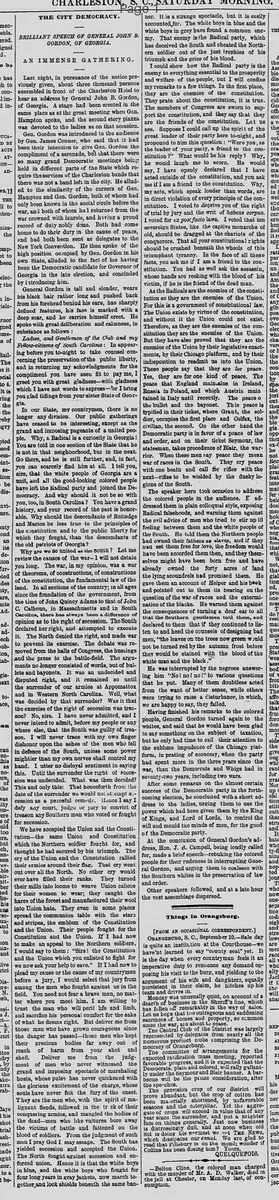
BRILLIANT SPEECH OF GENERAL JOHN B. GORDON, OF GEORGIA.
AN IMMENSE GATHERING.
Last night, in pursuance of the notice previously given, about three thousand persons assembled in front of the Charleston Hotel to hear an address by General John B. Gordon, of Georgia. A stage had been erected in the same place as at the great meeting when Gen. Hampton spoke, and the second story piazza was devoted to the ladies as on that occasion. Gen. Gordon was introduced to the audience by Gen. James Conner, who said that it had been their intention to give Gen. Gordon the compliment of a serenade, but that there were so many grand Democratic meetings being held in different parts of the State which require the services of the Charleston bands that there was not a band left in the city. He alluded to the similarity of the careers of Gen. Hampton and Gen. Gordon, both of whom had only been known in the social circle before the war, and both of whom had returned from the war crowned with laurels, and having a proud record of duty nobly done. Both had come home to do their duty in the cause of peace, and had both been sent as delegates to the New York Convention. He then spoke of the high position occupied by Gen. Gordon in his own State, alluded to the fact of his having been the Democratic candidate for Governor of Georgia in the late election, and concluded by introducing him.
General Gordon is tall and slender, wears his black hair rather long and pushed back from his forehead behind his ears, has sharply defined features, his face is marked with a deep scar, and he carries himself erect. He spoke with great deliberation and calmness, in substance as follows:
Ladies, and Gentlemen of the Club and my Fellow-citizens of South Carolina: In appearing before you to-night to take counsel concerning the preservation of the public liberty, and in returning my acknowledgments for the compliment you have seen fit to pay me, I greet you with great gladness—with gladness which I have not words to express—or I bring you glad tidings from your sister State of Georgia.
In our State, my countrymen, there is no longer any division. Our public gatherings have ceased to be interesting, except as the grand and imposing pageants of a united people. Why, a Radical is a curiosity in Georgia! You are told in one section of the State that he is not in that neighborhood, but in the next. Go there, and he is still further, and, in fact, you can scarcely find him at all. I tell you, sirs, that the white people of Georgia are a unit, and all the good-looking colored people have left the Radical party and joined the Democracy. And why should it not be so with you, too, in South Carolina? You have a grand history, and your record of the past is honorable. Why should the descendants of Rutledge and Marion be less true to the principles of the constitution and to the public liberty for which they fought, than the descendants of the old patriots of Georgia?
Why are we so united at the South? Let me review the causes of the war—I will not detain you long. The war, in my opinion, was a war of theorems, of constructions, of constructions of the constitution, the fundamental law of the land. In all sections of the country; in all ages since the foundation of the government, from the time of John Quincy Adams to that of John C. Calhoun, in Massachusetts and in South Carolina, there has always been a difference of opinion as to the right of secession. The South declared her right, and attempted to execute it. The North denied the right, and made war to prevent its exercise. The debate was removed from the halls of Congress, the hustings and the press to the battle-field. The arguments no longer consisted of words, but of bullets and bayonets. It was an undecided and disputed right, and it remained so until the surrender of our armies at Appomattox and in Western North Carolina. Well, what was decided by that surrender? Was it that the exercise of the right of secession was treason? No, sirs. I have never admitted, and I never intend to admit, before my people or anywhere else, that the South was guilty of treason. I will never trace with my own finger dishonor upon the ashes of the men who fell in defence of the South, unless some power mightier than my own nerves shall control my hand. I utter no disloyal sentiment in saying this. Until the surrender the right of secession was undecided. What was then decided? This and only this: That henceforth from the date of the surrender we would not attempt secession as a peaceful remedy. Hence I say I defy any court, judge or jury to convict of treason any Southern man who voted or fought for secession.
We have accepted the Union and the Constitution—the same Union and Constitution which the Northern soldier fought for, and thought he had secured by his triumph. The cry of the Union and the Constitution rallied their armies around their flag. That cry went out over all the North. No other cry would ever have filled their ranks. They turned their mills into looms to weave Union calicos for their women to wear; they caught the hares of the forest and manufactured their wool into Union hats. They even in some places spread the communion table with the stars and stripes, the emblem of the Constitution and the Union. Their people fought for the Constitution and the Union. If I had now to make an appeal to the Northern soldiers, I would say to them: "Sirs! the Constitution and the Union which you enlisted to fight for we now ask your help to save." If I had now to plead my cause or the cause of my countrymen before a jury, I would select that jury from among the men who fought against us in the field. You need not fear a brave man, no matter where you meet him. I am willing to trust the man who will peril life and limb, and sacrifice his personal comfort for the sake of what he deems right. But deliver me from those men who have grown courageous since the danger has passed—those men who kept their precious bodies far away out of reach of harm from your shot and shell. Deliver me from the judgment of men who never witnessed the grand and imposing spectacle of marshaling hosts, whose pulse has never quickened with the glorious excitement of the charge, whose souls have never felt the fury of the onset. They are the men who, with the spirit of malignant fiends, followed in the track of their conquering armies, and mangled the bodies of the dead—men who like vultures bore away the victims of battle and fattened on the blood of soldiers. From the judgment of such men I pray God I may escape. The South has yielded secession and accepted the Union. The North fought against secession and enforced union. Hence it is that the white boys in blue, and the white boys who fought for four long years in gray jackets, now march together and lock shields beneath the same banner. It is a strange spectacle, but it is easily accounted for. The white boys in blue and the white boys in grey have found a common enemy. That enemy is the Radical party, which has deceived the South and cheated the Northern soldier out of the just trophies of his triumph and the price of his blood.
I could show how the Radical party is the enemy to everything essential to the prosperity and welfare of the people, but I will confine my remarks to a few things. In the first place, they are the enemies of the constitution. They prate about the constitution, it is true. The members of Congress are sworn to support the constitution, and they say that they are the friends of the constitution. Let us see. Suppose I could call up the spirit of the great leader of their party here to-night, and propound to him this question: "Were you, as the leader of your party, a friend to the constitution?" What would be his reply? Why, he would laugh me to scorn. He would say, I have openly declared that I have acted outside of the constitution, and you ask me if I am a friend to the constitution. Why, my acts, which speak louder than words, are in direct violation of every principle of the constitution. I voted to deprive you of the right of trial by jury and the writ of habeas corpus. I voted for ex post facto laws. I voted that ten sovereign States, like the captive monarchs of old, should be dragged at the chariots of the conquerors. That all your constitutional rights should be crushed beneath the wheels of this triumphant tyranny. In the face of all these facts, you ask me if I am a friend to the constitution. You had as well ask the assassin, whose hands are reeking with the blood of his victim, if he is the friend of the dead man.
As the Radicals are the enemies of the constitution so they are the enemies of the Union. For this is a government of constitutional law. The Union exists by virtue of the constitution, and without it the Union could not exist. Therefore, as they are the enemies of the constitution they are the enemies of the Union. But they have also proved that they are the enemies of the Union by their legislative enactments, by their Chicago platform, and by their indisposition to readmit us into the Union.
These people say that they are for peace. Yes, they are for one kind of peace. The peace that England maintains in Ireland, Russia in Poland, and which Austria maintained in Italy until recently. The peace of the bullet and the bayonet. This peace is typified in their ticket, where Grant, the soldier, occupies the first place and Colfax, the civilian, the second. On the other hand the Democratic party is in favor of a peace of law and order, and on their ticket Seymour, the statesman, takes precedence of Blair, the warrior. When these men say peace they mean war of races in the South. They cry peace with one breath and call for rifles with the next—rifles to be wielded by the dusky legions of the South.
The speaker here took occasion to address the colored people in the audience. He addressed them in plain colloquial style, exposing Radical falsehoods, and warning them against the evil advice of men who tried to stir up ill feeling between them and the white people of the South. He told them the Northern people had owned their fathers as slaves, and if they had set them free for love, the freedom would have been accorded them then, and they themselves might have been born free and have already owned the forty acres of land the lying scoundrels had promised them. He gave them an account of Helper and his book and pointed out to them its bearing on the question of the war of races and the extermination of the blacks. He warned them against the consequences of turning a deaf ear to all that the Southern gentlemen told them, and declared to them that if they continued to listen to and heed the counsels of designing bad men, "the leaves on the trees now green would not be turned red by the autumn frost before they would be stained with the blood of the white man and the black."
He was interrupted by the negroes answering him "No! no! no!" to various questions that he put. Many of them doubtless acted from the want of better sense, while others were trying to raise a disturbance, in which, we are happy to say, they failed.
Having finished his remarks to the colored people, General Gordon turned again to the whites, and said that he would have been glad to say something on the subject of taxation, but he only had time to call their attention to the sublime impudence of the Chicago platform, in prating of economy, when the party had spent more in the three years since the war, than the Democrats and Whigs had in seventy-two years, including two wars.
After some remarks on the almost certain success of the Democratic party in the forthcoming election, he concluded with a short address to the ladies, urging them to use the power which had been given them by the King of Kings, and Lord of Lords, to control the will and mould the minds of men, for the good of the Democratic party.
At the conclusion of General Gordon's address, Hon. J. B. Campbell, being loudly called for, made a brief speech—rebuking the colored people for their rudeness in interrupting General Gordon, and urging them to coalesce with the Southern whites in the preservation of law and order.
Other speakers followed, and at a late hour the vast assemblage dispersed.
What sub-type of article is it?
What themes does it cover?
What keywords are associated?
What entities or persons were involved?
Where did it happen?
Story Details
Key Persons
Location
Charleston, South Carolina, In Front Of The Charleston Hotel
Event Date
Last Night
Story Details
General John B. Gordon speaks at a Democratic rally in Charleston, introduced by Gen. James Conner; he celebrates Georgia's unity, defends Southern secession as not treason post-surrender, criticizes Radical Republicans for constitutional violations and promoting racial war, addresses Black audience warning against Radical deception, predicts Democratic election success, followed by brief speech from Hon. J. B. Campbell.