Thank you for visiting SNEWPapers!
Sign up free
New York Tribune
New York, New York County, New York
What is this article about?
New York lawyer John Graham publicly denounces former client William M. Tweed in a Tribune interview, revealing secrets, criticizing his selfishness and insincerity, and estimating his wealth at $6-12 million despite convictions. Raises ethical questions in legal profession. Another report details Tweed's lawyer payments, with Graham receiving $16,000.
Clipping
OCR Quality
Full Text
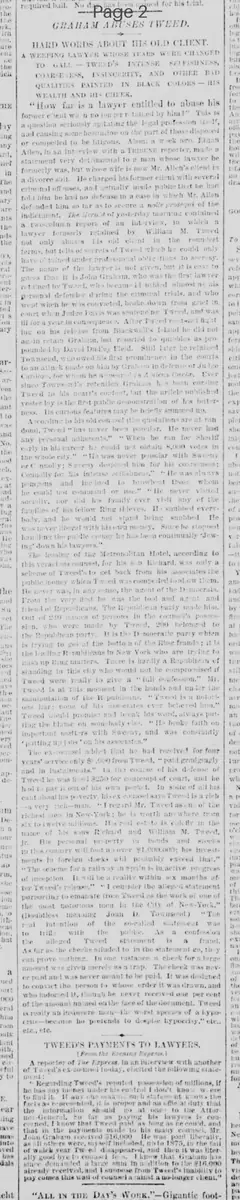
HARD WORDS ABOUT HIS OLD CLIENT.
A WEEPING LAWYER WHOSE TEARS WERE CHANGED TO GALL—TWEED'S INTENSE SELFISHNESS, COARSE MANNERS, INSINCERITY, AND OTHER BAD QUALITIES PAINTED IN BLACK COLORS—HIS WEALTH AND HIS CHEEK.
"How far is a lawyer entitled to abuse his former client when no longer retained by him?" This is a question seriously agitating the legal profession, and causing some hesitation on the part of those disposed or compelled to be litigants. About a week ago, Lyman Allen, in an interview with a Tribune reporter, made a statement very detrimental to a man whose lawyer he formerly was, but whose wife is now Mr. Allen's client in a divorce suit. He charged his former client with several criminal offenses, and actually made public the fact that he had told him he had no defense in a case in which Mr. Allen defended him so far as to secure a nolle prosequi of the indictment. The Tribune of yesterday morning contained a two-column report of an interview, in which a lawyer formerly retained by William M. Tweed not only abused his old client in the coarsest terms, but tells of secrets of Tweed which he could only have learned under professional obligation to secrecy. The name of the lawyer is not given, but it is easy to guess that it is John Graham, who was the trusted lawyer of Tweed, who became his principal defender during the criminal trials, and who went when he was convicted, broke down from grief in court when Judge Lawrence was sentencing Tweed, and was ill for a year in consequence. After Tweed's release from Blackwell's Island he did not again retain Graham, but resorted to quibbles as proposed by David Dudley Field. Still Hunter be retained Townsend, who owed his first prominence in the courts to an attack made on him by Graham in defense of John Cardoza, whom he had heard is aets Corid. Ever since Tweed's retention Graham is herh enr-ipg I wed to his heart's content, 'nt the article published yesterday is the first public denunciation of his bitter-ness. His various features may be briefly summed up. A column to his old counsel dts quotations ar at ran donn, Tweed "has never been popular. He never had any personal adherents," "When he ran for sheriff early in his career he could not obtain 5,000 votes in the whole city " "He was never popular with Sweeny or Connolly; Sweeny despised him for his coarseness; Connolly for his intense selfishness." "He was always imoolls and the tned to bowb st tho whom he coulad tot cohnand or use." He never Vated surinliy, ior dd hs family cverwilt mhy of the favlles of his fellow Ring athletes. IIsanbbed evere. bo ly, and he wot'd not stand being snnbbed He Was D vee ilhrol with Laewn m dey. Sm e he stoymed Lan Ing the pablle ryhey be has be n eoutmually 'Jew-in'sdoun his lawyers."
The leasing of the Metropolitan Hotel, according to this verad sts eouysal, for his a D Kiehand. was only a sebemne of I reed's to get back frotm his assoclates the Iablle anotey shlea Tw ed was compe led toal ow them. He LeyI sas, ih amy ehse, the agent of the D mhcrats. I'ron tie ivery ist ho eas the tood aud ag at and IJen 1 o Bepesidieans. The Kenabdeia varly teale htn. Out of 2in caurs of porsohs In th cotheel's pusors si n. who were made by Tyeed, 2oo telong d to the Bemalbe ip party. It is ths D moeratte pariy whien Is trving to gei at the batto n of the Rlog frand ; it l. the I a ing R tnbiteans In Now York who are Iryiog to nash np Hing taatters. Taore Is harlly a Repable n of sianding to this dy who would not be empro oised if Twed were reaily to give a "fall eafesjon." Mr. I wesd is at t is moment in the honds on l un iar fae manipulaiisn of lie R pubiieahs. "Twed Is a netot onts lar: Dome df hl ss clates et r beseved bln." Teeed sould pos miesasI 5 ca' bts word, alvays pnt. tog the Hlate on somn baly ds. "II heoke futh on iportont toatt rs with sweeny, and was constantly 'p itting u,jshs'oh his assoelates" The ex-ossel a bled that he had reedvel for fon? vears' a rvieeenly $ Oo frop Tweed. "palt grad gngly and in lus'alme als." Ia th's coise oI his d feuse of T wevd be was f e1 5o for coatempt of court. and he h ud i pav it out of his own peptt. In snte of ail has cast abodt hs p vecty hisex eomasel says Iwe I is a rleh -a very teh-man. "I rezarl Mr. Taced as n oftae Hichest en in New-York; he is wotth ap where from sis toiweive midloge. I s roal est te Is ch fly in the nathe of hs sans Rehad and Wollam M. Tweed, Jr. Iis Iersenal pr perty m bends and sioeks in th s conary will foot n oyer 91,con,oom; hue invest. ments In foreign -toeks aid picdably exeeed tha'." "The eaeme for a ratlw iy in spa'n is inaetive ps gress of meepiton. It vill te a reailtv within sex mopths of ter T wced's re'eass." · I com nder the alleged st atement parportins to emanate tron Twerd as the work oi ome of the mest notoroas mea io the Cty ot Noa-York." (Doubtless mea uag Joan D Tovadsend) "The r al int ntion of the so-caled seatenct was to tuill witb the patle. As a confess on the alleged Tweed stotement Is a fraud. As far as the cbecks niluded to in the statenent go, th y can prove sathrg. In one rastavce a check for a large amont wos given merely as n trap. Thecheek was nev- er pand an I was hever meant to he poid. It was designed to copvict ihe person to whose erder it was drawn,and who indor ed it, thongh he rever received one per cent of the atoant na ned outhe face of the doeament. Tweed is reaily an insincere tan-th w rst species of a lypo crite-becatlse ho pretends to despise Lypoerisy," etc., etc., etc.
TWEED'S PAYMENTS TO LAWYERS.
(From the Evening Express.)
A reporter of the Express, in an interview with another of Tweed's ex-classmate to-day, elicited the following statement:
Regarding Tweed's reputed possession of millions, I he has any money under his control don't know where to find it. If any one means his statement knows the farls as rypresetted, it is proper and an official duty that the information sh suld go at once to the Attorney-Gen eral. To far as paying his lawyers is concerned, I know that Tweed paid as long as he could, and that in the payments made to his many counsel Mr. John Graham received $16,000. He was paid liberally, as all others were, myself included, not 1875, in the fall of which year Tweed disappeared, and then it was finally good bye to counsel fees. I know that Graham has since demanded a large sum in addition to the $16,000 already received, and I suppose from Tweed's inability to pay comes this way of counsel against a no-longer client.
What sub-type of article is it?
What keywords are associated?
What entities or persons were involved?
Where did it happen?
Domestic News Details
Primary Location
New York
Key Persons
Outcome
tweed convicted and released from blackwell's island; estimated hidden wealth of $6-12 million; public denunciations by former lawyers including graham who received $16,000 in fees.
Event Details
John Graham, former lawyer for William M. Tweed, provides a Tribune interview abusing Tweed's character, selfishness, insincerity, and political manipulations, revealing confidential information about his unpopularity, Republican ties, and schemes. Raises ethical concerns over lawyers disclosing client secrets. A separate Evening Express interview from another ex-counsel discusses Tweed's lawyer payments and Graham's additional demands.