Thank you for visiting SNEWPapers!
Sign up free
Editorial
February 11, 1808
Alexandria Daily Advertiser
Alexandria, Virginia
What is this article about?
Editorial critiques US administration's handling of French and British maritime decrees, arguing French violations preceded British retaliations and questioning government's failure to confront France effectively amid blockades and seizures of American property.
Clipping
OCR Quality
92%
Excellent
Full Text
From the NORTH AMERICAN.
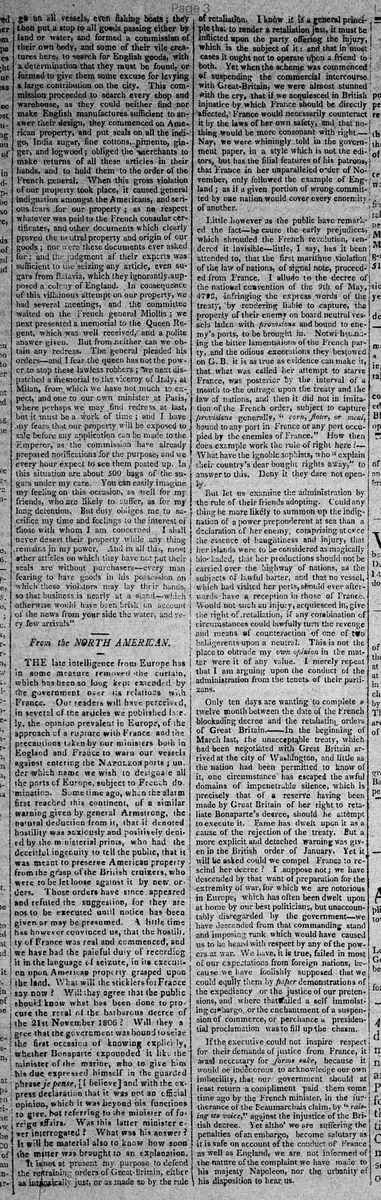
THE late intelligence from Europe has in some measure removed the curtain which has been so long kept extended by the government over its relations with France. Our readers will have perceived, in several of the articles we published lately., the opinion prevalent in Europe, of the approach of a rupture with France. and the precautions taken by our ministers both in England and France to warn our vessels against entering the NAPOLEON ports; under which name we wish to designate all the ports of Europe, subject to French domination. Some time ago, when the alarm first reached this continent, of a similar warning given by general Armstrong, the natural deduction from it, that it denoted hostility was anxiously and positively denied by the ministerial prints, who had the deceitful ingenuity to tell the public, that it was meant to preserve American property from the grasp of the British cruizers, who were to be let loose against it by new orders. Those orders have since appeared and refuted the suggestion, for they are not to be executed until notice has been given or may be presumed. A little time has however convinced us, that the hostility of France was real and commenced, and we have had the painful duty of recording it in the language of seizure, in its execution upon American property. grasped upon the land. What will the sticklers for France say now? Will they agree that the public should know what has been done to procure the recall of the barbarous decree of the 21st November 1806? Will they agree that the government was bound on the first occasion of knowing explicitly, whether Bonaparte expounded it like the minister of the marine, who to give him his due expressed himself in the guarded phrase je pense, I believe} and with the express declaration that it was not an official opinion, which it was beyond his functions to give, but referring to the minister of foreign affairs. - Was this latter minister ever interrogated? What was his answer? It will be material also to know how soon the matter was brought to an explanation. It is not at present my purpose to defend the restraining orders of Great-Britain, either as intrinsically just, or as made so by the rule of retaliation. I know it is a general principle that to render a retaliation just, it must be inflicted upon the party offering the injury, which is the subject of it: and that in most cases it ought not to operate upon a friend to both. Yet when the scheme was commenced of suspending the commercial intercourse with Great-Britain, we were almost stunned with the cry that if we acquiesced in British injustice by which France should be directly affected, France would necessarily counteract it by the laws of her own safety, and that nothing would be more consonant with right. Nay, we were whiningly told in the government paper, in a style which is not the editors, but has the filial features of his patrons, that France in her unparalleled order of November, only followed the example of England; as if a given portion of wrong committed by one nation would cover every enormity of another.
Little however as the public have remarked the act because, the early prejudices, which shrouded the French revolution, rendered it invisible-little, I say, has it been attended to, that the first maritime violation of the law of nations, of signal note, proceeded from France. I allude to the decree of the national convention of the 9th of May, 1793, infringing the express words of the treaty, by rendering liable to capture, the property of their enemy on board neutral vessels laden with provisions and bound to enemy's ports, to be brought in. Notwithstanding the bitter lamentations of the French party, and the odious execrations they bestowed on G. B. it is as true as evidence can make it, that what was called her attempt to starve France, was posterior by the interval of a month to the outrage upon the treaty and the law of nations, and then it did not in imitation of the French order, subject to capture provisions generally, "corn, flour, or meal. bound to any port in France or any port occupied by the enemies of France." How then does example work the rule of right here? What have the ignoble sophists, who "explain their country's dear bought rights away," to answer to this. Deny it they dare not openly.
But let us examine the administration by the rule of their friends adopting. Could any thing be more likely to summon up the indignation of a power predominant at sea than a declaration of her enemy, comprising at once the essence of haughtiness and injury, that her islands were to be considered as magically blockaded, that her productions should not be carried over the highway of nations, as the subjects of lawful barter, and that no vessel, which had visited her ports, should ever afterwards have a reception in those of France. Would not such an injury, acquiesced in, give the right of retaliation, if any combination of circumstances could lawfully turn the revenge and means of counteraction of one of the belligerents upon a neutral. This is not the place to obtrude my own opinion in the matter were it of any value. I merely repeat that I am arguing upon the conduct of the administration from the tenets of their partizans.
Only ten days are wanting to complete a twelve month between the date of the French blockading decree and the retaliating orders of Great Britain. In the beginning of March last, the unacceptable treaty, which had been negotiated with Great Britain arrived at the city of Washington, and little as the nation had been permitted to know of it, one circumstance has escaped the awful domains of impenetrable silence, which is precisely that of a reserve having been made by Great Britain of her right to retaliate Bonaparte's decree, should he attempt to execute it. Fame has dwelt upon it as a cause of the rejection of the treaty. But a more explicit and detached warning was given in the British order of January, Yet it will be asked could we compel France to rescind her decree? I suppose not; we have descended by that want of preparation for the extremity of war, for which we are notorious in Europe, which has often been dwelt upon at home by our best politicians, but unaccountably disregarded by the government--we have descended from that commanding stand and imposing rank which would have caused us to be heard with respect by any of the powers at war. We have, it is true, failed in most of our expectations from foreign nations, because we have foolishly supposed that we could equal them by further demonstrations of the expediency or the justice of our pretensions, and where that failed a self immolating embargo, or the enchantment of a suspension of commerce, or perchance a presidential proclamation was to fill up the chasm. If the executive could not inspire respect for their demands of justice from France, it was necessary for form's sake, because it would be indecorous to acknowledge our own imbecility, that our government should at least return a compliment paid them some time ago by the French minister, in the furtherance of the Beaumarchais claim, by "raising its voice," against the injustice of the British decree. Yet altho' we are suffering the penalties of an embargo, become salutary as it is safe on account of the conduct of France as well as England, we are not informed of the nature of the complaint we have made to his majesty. Napoleon, nor the urbanity of his disposition to hear us.
THE late intelligence from Europe has in some measure removed the curtain which has been so long kept extended by the government over its relations with France. Our readers will have perceived, in several of the articles we published lately., the opinion prevalent in Europe, of the approach of a rupture with France. and the precautions taken by our ministers both in England and France to warn our vessels against entering the NAPOLEON ports; under which name we wish to designate all the ports of Europe, subject to French domination. Some time ago, when the alarm first reached this continent, of a similar warning given by general Armstrong, the natural deduction from it, that it denoted hostility was anxiously and positively denied by the ministerial prints, who had the deceitful ingenuity to tell the public, that it was meant to preserve American property from the grasp of the British cruizers, who were to be let loose against it by new orders. Those orders have since appeared and refuted the suggestion, for they are not to be executed until notice has been given or may be presumed. A little time has however convinced us, that the hostility of France was real and commenced, and we have had the painful duty of recording it in the language of seizure, in its execution upon American property. grasped upon the land. What will the sticklers for France say now? Will they agree that the public should know what has been done to procure the recall of the barbarous decree of the 21st November 1806? Will they agree that the government was bound on the first occasion of knowing explicitly, whether Bonaparte expounded it like the minister of the marine, who to give him his due expressed himself in the guarded phrase je pense, I believe} and with the express declaration that it was not an official opinion, which it was beyond his functions to give, but referring to the minister of foreign affairs. - Was this latter minister ever interrogated? What was his answer? It will be material also to know how soon the matter was brought to an explanation. It is not at present my purpose to defend the restraining orders of Great-Britain, either as intrinsically just, or as made so by the rule of retaliation. I know it is a general principle that to render a retaliation just, it must be inflicted upon the party offering the injury, which is the subject of it: and that in most cases it ought not to operate upon a friend to both. Yet when the scheme was commenced of suspending the commercial intercourse with Great-Britain, we were almost stunned with the cry that if we acquiesced in British injustice by which France should be directly affected, France would necessarily counteract it by the laws of her own safety, and that nothing would be more consonant with right. Nay, we were whiningly told in the government paper, in a style which is not the editors, but has the filial features of his patrons, that France in her unparalleled order of November, only followed the example of England; as if a given portion of wrong committed by one nation would cover every enormity of another.
Little however as the public have remarked the act because, the early prejudices, which shrouded the French revolution, rendered it invisible-little, I say, has it been attended to, that the first maritime violation of the law of nations, of signal note, proceeded from France. I allude to the decree of the national convention of the 9th of May, 1793, infringing the express words of the treaty, by rendering liable to capture, the property of their enemy on board neutral vessels laden with provisions and bound to enemy's ports, to be brought in. Notwithstanding the bitter lamentations of the French party, and the odious execrations they bestowed on G. B. it is as true as evidence can make it, that what was called her attempt to starve France, was posterior by the interval of a month to the outrage upon the treaty and the law of nations, and then it did not in imitation of the French order, subject to capture provisions generally, "corn, flour, or meal. bound to any port in France or any port occupied by the enemies of France." How then does example work the rule of right here? What have the ignoble sophists, who "explain their country's dear bought rights away," to answer to this. Deny it they dare not openly.
But let us examine the administration by the rule of their friends adopting. Could any thing be more likely to summon up the indignation of a power predominant at sea than a declaration of her enemy, comprising at once the essence of haughtiness and injury, that her islands were to be considered as magically blockaded, that her productions should not be carried over the highway of nations, as the subjects of lawful barter, and that no vessel, which had visited her ports, should ever afterwards have a reception in those of France. Would not such an injury, acquiesced in, give the right of retaliation, if any combination of circumstances could lawfully turn the revenge and means of counteraction of one of the belligerents upon a neutral. This is not the place to obtrude my own opinion in the matter were it of any value. I merely repeat that I am arguing upon the conduct of the administration from the tenets of their partizans.
Only ten days are wanting to complete a twelve month between the date of the French blockading decree and the retaliating orders of Great Britain. In the beginning of March last, the unacceptable treaty, which had been negotiated with Great Britain arrived at the city of Washington, and little as the nation had been permitted to know of it, one circumstance has escaped the awful domains of impenetrable silence, which is precisely that of a reserve having been made by Great Britain of her right to retaliate Bonaparte's decree, should he attempt to execute it. Fame has dwelt upon it as a cause of the rejection of the treaty. But a more explicit and detached warning was given in the British order of January, Yet it will be asked could we compel France to rescind her decree? I suppose not; we have descended by that want of preparation for the extremity of war, for which we are notorious in Europe, which has often been dwelt upon at home by our best politicians, but unaccountably disregarded by the government--we have descended from that commanding stand and imposing rank which would have caused us to be heard with respect by any of the powers at war. We have, it is true, failed in most of our expectations from foreign nations, because we have foolishly supposed that we could equal them by further demonstrations of the expediency or the justice of our pretensions, and where that failed a self immolating embargo, or the enchantment of a suspension of commerce, or perchance a presidential proclamation was to fill up the chasm. If the executive could not inspire respect for their demands of justice from France, it was necessary for form's sake, because it would be indecorous to acknowledge our own imbecility, that our government should at least return a compliment paid them some time ago by the French minister, in the furtherance of the Beaumarchais claim, by "raising its voice," against the injustice of the British decree. Yet altho' we are suffering the penalties of an embargo, become salutary as it is safe on account of the conduct of France as well as England, we are not informed of the nature of the complaint we have made to his majesty. Napoleon, nor the urbanity of his disposition to hear us.
What sub-type of article is it?
Foreign Affairs
War Or Peace
Trade Or Commerce
What keywords are associated?
French Decrees
British Orders
Neutral Rights
Us Foreign Policy
Blockades
Embargo
Napoleon
Retaliation
What entities or persons were involved?
France
Bonaparte
Great Britain
Us Government
General Armstrong
Minister Of The Marine
Minister Of Foreign Affairs
Editorial Details
Primary Topic
Critique Of Us Policy On French And British Maritime Decrees And Blockades
Stance / Tone
Critical Of Us Administration And Pro French Bias, Defending British Retaliation
Key Figures
France
Bonaparte
Great Britain
Us Government
General Armstrong
Minister Of The Marine
Minister Of Foreign Affairs
Key Arguments
French Hostility Towards Us Is Real And Involves Seizures Of American Property.
Us Government Failed To Adequately Confront France Over The Decree Of 21st November 1806.
French Decree Of 9th May 1793 Was The First Major Violation Of Neutral Rights, Preceding British Actions.
British Orders Were Retaliation Against French Blockades, Not Unprovoked Aggression.
Us Administration's Embargo And Complaints Lack Effectiveness Due To Weak Foreign Policy.
Public Should Demand Transparency On Government's Communications With France.