Thank you for visiting SNEWPapers!
Sign up free
Literary
July 14, 1809
Virginia Argus
Richmond, Virginia
What is this article about?
Joel Barlow's July 4th oration in Washington City commemorates American independence after 33 years, honors past heroes, reflects on the nation's unique democratic government, and urges public improvements and instruction to preserve the union and fulfill its destiny for human happiness.
Clipping
OCR Quality
95%
Excellent
Full Text
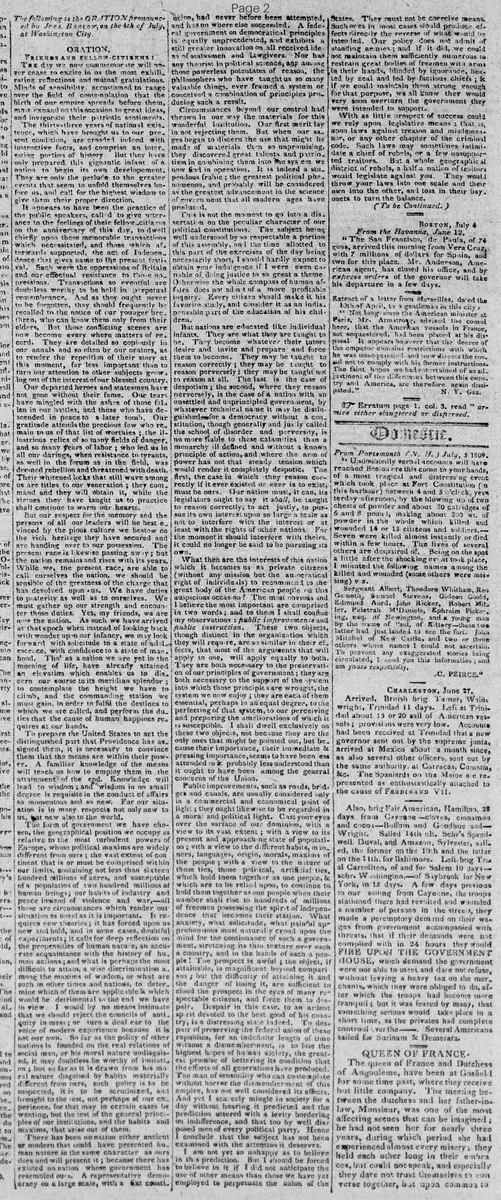
The following is the ORATION pronounced by Joel L. Barlow, on the 4th of July, at Washington City.
ORATION.
FRIENDS AND FELLOW-CITIZENS:
This day we now commemorate will never cease to excite in us the most exhilarating reflections and mutual gratulations. Minds of sensibility, accustomed to range over the field of contemplation that the birth of our empire spreads before them, must expand on this occasion to great ideas, and invigorate their patriotic sentiments. The thirty-three years of national existence, which have brought us to our present condition, are crowded indeed with instructive facts, and comprise an interesting portion of history. But they have only prepared this gigantic infant of a nation to begin its own development. They are only the prelude to the greater events that seem to unfold themselves before us, and call for the highest wisdom to give them their proper direction.
It appears to have been the practice of the public speakers, called to give utterance to the feelings of their fellow-citizens on the anniversary of this day, to dwell chiefly upon those memorable transactions which necessitated, and those which afterwards supported, the act of Independence that gives name to the present festival. Such were the oppressions of Britain and our effectual resistance to those oppressions. Transactions so eventful are doubtless worthy to be held in perpetual remembrance. And as they ought never to be forgotten, they should frequently be recalled to the notice of our younger brethren, who can know them only from their elders. But those conflicting scenes are now become every where matters of record. They are detailed so copiously in our annals and so often by our orators, as to render the repetition of their story at this moment, far less important than to turn our attention to other subjects growing out of the interest of our blessed country.
Our departed heroes and statesmen have not gone without their fame. Our tears have mingled with the ashes of those fallen in our battles, and those who have descended in peace to a later tomb. Our gratitude attends the precious few who remain to us of that list of worthies; the illustrious relics of so many fields of danger, and so many years of labor; who led us in all our darings, when resistance to tyrants, as well in the forum as in the field, was deemed rebellion and threatened with death. Their whitened locks that still wave among us are titles to our veneration; they command and they will obtain it, while the virtues they have taught us to practice shall continue to warm our hearts.
But our respect for the memory and the persons of all our leaders will be best evinced by the pious culture we bestow on the rich heritage they have secured and are handing over to our possession. The present race is likewise passing away; but the nation remains and rises with its years. While we, the present race, are able to call ourselves the nation, we should be sensible of the greatness of the charge that has devolved upon us. We have duties to posterity as well as to ourselves. We must gather up our strength and encounter those duties. Yes, my friends, we are now the nation. As such we have arrived at that epoch when instead of looking back with wonder upon our infancy, we may look forward with solicitude to a state of adolescence, with confidence to a state of manhood. Tho' as a nation we are yet in the morning of life, have already attained an elevation which enables us to discern our course to its meridian splendor; to contemplate the height we have to climb, and the commanding station we must gain, in order to fulfill the destinies to which we are called, and perform the duties that the cause of human happiness requires at our hands.
To prepare the United States to act the distinguished part that Providence has assigned them, it is necessary to convince them that the means are within their power. A familiar knowledge of the means will teach us how to employ them in the attainment of the end. Knowledge will lead to wisdom: and wisdom in no small degree is requisite in the conduct of affairs so momentous and so new. For our situation is in many respects not only new to us, but new also to the world.
The form of government we have chosen, the geographical position we occupy as relative to the most turbulent powers of Europe, whose political maxims are widely different from ours; the vast extent of continent that is or must be comprised within our limits, containing not less than sixteen hundred millions of acres, and susceptible of a population of two hundred millions of human beings: our habits of industry and peace instead of violence and war,—all these are circumstances which render our situation as novel as it is important. It requires new theories; it has forced upon us new and bold, and in some cases, doubtful experiments; it calls for deep reflection on the propensities of human nature, an accurate acquaintance with the history of human actions; and what is perhaps the most difficult to attain, a wise discrimination among the maxims of wisdom, or what are such in other times and nations, to determine which of them are applicable & which would be detrimental to the end we have in view, I would by no means insinuate that we should reject the councils of antiquity in mass; or turn a deaf ear to the voice of modern experience because it is not our own. So far as the policy of other nations is founded on the real relations of social man, or his moral nature undisguised, it may doubtless be worthy of imitation'; but so far as it is drawn from his moral nature disguised by habits materially different from ours, such policy is to be suspected, it is to be scrutinized, and brought to the test, not perhaps of our experience, for that may in certain cases be wanting, but the test of the general principles of our institutions, and the habits and maxims, that arise out of them,
There has been no nation either ancient or modern that could have presented human nature in the same character as ours does and will present it: because there has existed no nation whose government has resembled ours. A representative democracy on a large scale, with a fixt constitution, had never before been attempted. and in no where else succeeded. A federal government on democratical principles is equally unprecedented, and exhibits a still greater innovation on all received ideas of statesmen and lawmakers. Nor has any theorist in political science, nor among those powerless potentates of reason, the philosophers who have taught us so many valuable things, ever framed a system or conceived a combination of principles producing such a result.
Circumstances beyond our control had thrown in our way the materials for this wonderful institution. Our first merit lay in not rejecting them. But when our sages began to discern the use that might be made of materials then so unpromising they discovered great talents and patriotism in combining them into the system we now find in operation. It is indeed a stupendous fabric; the greatest political phenomenon, and probably will be considered as the greatest advancement in the science of government that all modern ages have produced.
This is not the moment to go into a dissertation on the peculiar character of our political constitutions. The subject being well understood by so respectable a portion of this assembly, and the time allotted to this part of the exercises of the day being necessarily short, I should hardly expect to obtain your indulgence if I were even capable of doing justice to so great a theme. Otherwise the whole compass of human affairs does not admit of a more profitable inquiry. Every citizen should make it his favorite study, and consider it as an indispensable part of the education of his children.
But nations are educated like individual infants. They are what they are taught to be. They become whatever their tutors desire and invite and prepare and force them to become. They may be taught to reason correctly; they may be taught to reason perversely: they may be taught not to reason at all. The last is the case of despotism; the second, where they reason perversely, is the case of a nation with an unsettled and unprincipled government, by whatever technical name it may be distinguished for a democracy without a constitution, though generally and justly called the school of disorder and perversity, is no more liable to these calamities than a monarchy ill defined and without a known principle of action, and where the arm of power has not that steady tension which would render it completely despotic. The first, the case in which they reason correctly if it ever existed or ever is to exist, must be ours. Our nation must, it can, its legislators ought to say it shall, be taught to reason correctly; to act justly, to pursue its own interest upon so large a scale as not to interfere with the interest or at least with the rights of other nations. For the moment it should interfere with theirs. it could no longer be said to be pursuing its own.
What then are the interests of this nation which it becomes us as private citizens (without any mission but the aristocratical right of individuals) to recommend to the great body of the American people on this auspicious occasion? The most obvious and I believe the most important are comprised in two words: and to them I shall confine my observations: public improvements and public instruction. These two objects, though distinct in the organization which they will require, are so similar in their effects, that most of the arguments that will apply to one, will apply equally to both. They are both necessary to the preservation of our principles of government; they are both necessary to the support of the system into which those principles are wrought, the system we now enjoy; they are each of them essential, perhaps in an equal degree, to the perfecting of that system, to our perceiving and preparing the ameliorations of which it is susceptible. I shall dwell exclusively on these two objects, not because they are the only ones that might be pointed out, but because their importance, their immediate & pressing importance, seems to have been less attended to & probably less understood than it ought to have been among the general concerns of the Union.
Public improvements, such as roads, bridges and canals, are usually considered only in a commercial and economical point of light; they ought likewise to be regarded in a moral and political light. Cast your eyes over the surface of our dominion, with a view to its vast extent; with a view to its present and approaching state of population: with a view to the different habits, manners, languages, origin, morals, maxims of the people; with a view to the nature of those ties, those political, artificial ties, which hold them together as one people, & which are to be relied upon, to continue to hold them together as one people when their number shall rise to hundreds of millions of freemen possessing the spirit of independence that becomes their station. What anxiety, what solicitude, what painful apprehensions must naturally crowd upon the mind for the continuance of such a government, stretching its thin texture over such a country, and in the hands of such a people! The prospect is awful; the object, if attainable, is magnificent beyond comparison; but the difficulty of attaining it and the danger of losing it, are sufficient to cloud the prospect in the eyes of many respectable citizens, and force them to despair. Despair in this case, to an ardent spirit devoted to the best good of his country, is a distressing state indeed. To despair of preserving the federal union of these republics, for an indefinite length of time without a dismemberment, is to lose the highest hopes of human society, the greatest promise of bettering its condition that the efforts of all generations have produced. The man of sensibility who can contemplate without horror the dismemberment of this empire, has not well considered its effects. And yet I scarcely mingle in society for a day without hearing it predicted and the prediction uttered with a levity bordering on indifference, and that too by well disposed men of every political party. Hence I conclude that the subject has not been examined with the attention it deserves.
I am not yet so unhappy as to believe in this prediction. But I should be forced to believe in it if I did not anticipate the use of other means than those we have yet employed to perpetuate the union of the States. They must not be coercive means. Such forces in most cases would produce effects directly the reverse of what would be intended. Our policy does not admit of standing armies; and if it did, we could not maintain them sufficiently numerous to restrain great bodies of freemen with arms in their hands, blinded by ignorance, heated by zeal and led by factious chiefs; & if we could maintain them strong enough for that purpose, we all know they would very soon overturn the government they were intended to support.
With as little prospect of success could we rely upon legislative means: that is, upon laws against treason and misdemeanor, or any other chapter of the criminal code. Such laws may sometimes intimidate a chief of rebels, or a few unsupported traitors. But a whole geographical district of rebels, a half a nation of traitors would legislate against you. They would throw your laws into one scale and their own into the other, and toss in their bayonets to turn the balance.
(To be Continued.)
ORATION.
FRIENDS AND FELLOW-CITIZENS:
This day we now commemorate will never cease to excite in us the most exhilarating reflections and mutual gratulations. Minds of sensibility, accustomed to range over the field of contemplation that the birth of our empire spreads before them, must expand on this occasion to great ideas, and invigorate their patriotic sentiments. The thirty-three years of national existence, which have brought us to our present condition, are crowded indeed with instructive facts, and comprise an interesting portion of history. But they have only prepared this gigantic infant of a nation to begin its own development. They are only the prelude to the greater events that seem to unfold themselves before us, and call for the highest wisdom to give them their proper direction.
It appears to have been the practice of the public speakers, called to give utterance to the feelings of their fellow-citizens on the anniversary of this day, to dwell chiefly upon those memorable transactions which necessitated, and those which afterwards supported, the act of Independence that gives name to the present festival. Such were the oppressions of Britain and our effectual resistance to those oppressions. Transactions so eventful are doubtless worthy to be held in perpetual remembrance. And as they ought never to be forgotten, they should frequently be recalled to the notice of our younger brethren, who can know them only from their elders. But those conflicting scenes are now become every where matters of record. They are detailed so copiously in our annals and so often by our orators, as to render the repetition of their story at this moment, far less important than to turn our attention to other subjects growing out of the interest of our blessed country.
Our departed heroes and statesmen have not gone without their fame. Our tears have mingled with the ashes of those fallen in our battles, and those who have descended in peace to a later tomb. Our gratitude attends the precious few who remain to us of that list of worthies; the illustrious relics of so many fields of danger, and so many years of labor; who led us in all our darings, when resistance to tyrants, as well in the forum as in the field, was deemed rebellion and threatened with death. Their whitened locks that still wave among us are titles to our veneration; they command and they will obtain it, while the virtues they have taught us to practice shall continue to warm our hearts.
But our respect for the memory and the persons of all our leaders will be best evinced by the pious culture we bestow on the rich heritage they have secured and are handing over to our possession. The present race is likewise passing away; but the nation remains and rises with its years. While we, the present race, are able to call ourselves the nation, we should be sensible of the greatness of the charge that has devolved upon us. We have duties to posterity as well as to ourselves. We must gather up our strength and encounter those duties. Yes, my friends, we are now the nation. As such we have arrived at that epoch when instead of looking back with wonder upon our infancy, we may look forward with solicitude to a state of adolescence, with confidence to a state of manhood. Tho' as a nation we are yet in the morning of life, have already attained an elevation which enables us to discern our course to its meridian splendor; to contemplate the height we have to climb, and the commanding station we must gain, in order to fulfill the destinies to which we are called, and perform the duties that the cause of human happiness requires at our hands.
To prepare the United States to act the distinguished part that Providence has assigned them, it is necessary to convince them that the means are within their power. A familiar knowledge of the means will teach us how to employ them in the attainment of the end. Knowledge will lead to wisdom: and wisdom in no small degree is requisite in the conduct of affairs so momentous and so new. For our situation is in many respects not only new to us, but new also to the world.
The form of government we have chosen, the geographical position we occupy as relative to the most turbulent powers of Europe, whose political maxims are widely different from ours; the vast extent of continent that is or must be comprised within our limits, containing not less than sixteen hundred millions of acres, and susceptible of a population of two hundred millions of human beings: our habits of industry and peace instead of violence and war,—all these are circumstances which render our situation as novel as it is important. It requires new theories; it has forced upon us new and bold, and in some cases, doubtful experiments; it calls for deep reflection on the propensities of human nature, an accurate acquaintance with the history of human actions; and what is perhaps the most difficult to attain, a wise discrimination among the maxims of wisdom, or what are such in other times and nations, to determine which of them are applicable & which would be detrimental to the end we have in view, I would by no means insinuate that we should reject the councils of antiquity in mass; or turn a deaf ear to the voice of modern experience because it is not our own. So far as the policy of other nations is founded on the real relations of social man, or his moral nature undisguised, it may doubtless be worthy of imitation'; but so far as it is drawn from his moral nature disguised by habits materially different from ours, such policy is to be suspected, it is to be scrutinized, and brought to the test, not perhaps of our experience, for that may in certain cases be wanting, but the test of the general principles of our institutions, and the habits and maxims, that arise out of them,
There has been no nation either ancient or modern that could have presented human nature in the same character as ours does and will present it: because there has existed no nation whose government has resembled ours. A representative democracy on a large scale, with a fixt constitution, had never before been attempted. and in no where else succeeded. A federal government on democratical principles is equally unprecedented, and exhibits a still greater innovation on all received ideas of statesmen and lawmakers. Nor has any theorist in political science, nor among those powerless potentates of reason, the philosophers who have taught us so many valuable things, ever framed a system or conceived a combination of principles producing such a result.
Circumstances beyond our control had thrown in our way the materials for this wonderful institution. Our first merit lay in not rejecting them. But when our sages began to discern the use that might be made of materials then so unpromising they discovered great talents and patriotism in combining them into the system we now find in operation. It is indeed a stupendous fabric; the greatest political phenomenon, and probably will be considered as the greatest advancement in the science of government that all modern ages have produced.
This is not the moment to go into a dissertation on the peculiar character of our political constitutions. The subject being well understood by so respectable a portion of this assembly, and the time allotted to this part of the exercises of the day being necessarily short, I should hardly expect to obtain your indulgence if I were even capable of doing justice to so great a theme. Otherwise the whole compass of human affairs does not admit of a more profitable inquiry. Every citizen should make it his favorite study, and consider it as an indispensable part of the education of his children.
But nations are educated like individual infants. They are what they are taught to be. They become whatever their tutors desire and invite and prepare and force them to become. They may be taught to reason correctly; they may be taught to reason perversely: they may be taught not to reason at all. The last is the case of despotism; the second, where they reason perversely, is the case of a nation with an unsettled and unprincipled government, by whatever technical name it may be distinguished for a democracy without a constitution, though generally and justly called the school of disorder and perversity, is no more liable to these calamities than a monarchy ill defined and without a known principle of action, and where the arm of power has not that steady tension which would render it completely despotic. The first, the case in which they reason correctly if it ever existed or ever is to exist, must be ours. Our nation must, it can, its legislators ought to say it shall, be taught to reason correctly; to act justly, to pursue its own interest upon so large a scale as not to interfere with the interest or at least with the rights of other nations. For the moment it should interfere with theirs. it could no longer be said to be pursuing its own.
What then are the interests of this nation which it becomes us as private citizens (without any mission but the aristocratical right of individuals) to recommend to the great body of the American people on this auspicious occasion? The most obvious and I believe the most important are comprised in two words: and to them I shall confine my observations: public improvements and public instruction. These two objects, though distinct in the organization which they will require, are so similar in their effects, that most of the arguments that will apply to one, will apply equally to both. They are both necessary to the preservation of our principles of government; they are both necessary to the support of the system into which those principles are wrought, the system we now enjoy; they are each of them essential, perhaps in an equal degree, to the perfecting of that system, to our perceiving and preparing the ameliorations of which it is susceptible. I shall dwell exclusively on these two objects, not because they are the only ones that might be pointed out, but because their importance, their immediate & pressing importance, seems to have been less attended to & probably less understood than it ought to have been among the general concerns of the Union.
Public improvements, such as roads, bridges and canals, are usually considered only in a commercial and economical point of light; they ought likewise to be regarded in a moral and political light. Cast your eyes over the surface of our dominion, with a view to its vast extent; with a view to its present and approaching state of population: with a view to the different habits, manners, languages, origin, morals, maxims of the people; with a view to the nature of those ties, those political, artificial ties, which hold them together as one people, & which are to be relied upon, to continue to hold them together as one people when their number shall rise to hundreds of millions of freemen possessing the spirit of independence that becomes their station. What anxiety, what solicitude, what painful apprehensions must naturally crowd upon the mind for the continuance of such a government, stretching its thin texture over such a country, and in the hands of such a people! The prospect is awful; the object, if attainable, is magnificent beyond comparison; but the difficulty of attaining it and the danger of losing it, are sufficient to cloud the prospect in the eyes of many respectable citizens, and force them to despair. Despair in this case, to an ardent spirit devoted to the best good of his country, is a distressing state indeed. To despair of preserving the federal union of these republics, for an indefinite length of time without a dismemberment, is to lose the highest hopes of human society, the greatest promise of bettering its condition that the efforts of all generations have produced. The man of sensibility who can contemplate without horror the dismemberment of this empire, has not well considered its effects. And yet I scarcely mingle in society for a day without hearing it predicted and the prediction uttered with a levity bordering on indifference, and that too by well disposed men of every political party. Hence I conclude that the subject has not been examined with the attention it deserves.
I am not yet so unhappy as to believe in this prediction. But I should be forced to believe in it if I did not anticipate the use of other means than those we have yet employed to perpetuate the union of the States. They must not be coercive means. Such forces in most cases would produce effects directly the reverse of what would be intended. Our policy does not admit of standing armies; and if it did, we could not maintain them sufficiently numerous to restrain great bodies of freemen with arms in their hands, blinded by ignorance, heated by zeal and led by factious chiefs; & if we could maintain them strong enough for that purpose, we all know they would very soon overturn the government they were intended to support.
With as little prospect of success could we rely upon legislative means: that is, upon laws against treason and misdemeanor, or any other chapter of the criminal code. Such laws may sometimes intimidate a chief of rebels, or a few unsupported traitors. But a whole geographical district of rebels, a half a nation of traitors would legislate against you. They would throw your laws into one scale and their own into the other, and toss in their bayonets to turn the balance.
(To be Continued.)
What sub-type of article is it?
Essay
What themes does it cover?
Political
Liberty Freedom
Patriotism
What keywords are associated?
Independence Day
American Union
Public Improvements
Public Instruction
Federal Government
Democracy
National Destiny
What entities or persons were involved?
Joel L. Barlow
Literary Details
Title
Oration
Author
Joel L. Barlow
Subject
On The 4th Of July, At Washington City
Form / Style
Patriotic Oration In Prose
Key Lines
Friends And Fellow Citizens:
Yes, My Friends, We Are Now The Nation.
Public Improvements And Public Instruction.
It Is Indeed A Stupendous Fabric; The Greatest Political Phenomenon, And Probably Will Be Considered As The Greatest Advancement In The Science Of Government That All Modern Ages Have Produced.
To Despair Of Preserving The Federal Union Of These Republics, For An Indefinite Length Of Time Without A Dismemberment, Is To Lose The Highest Hopes Of Human Society