Thank you for visiting SNEWPapers!
Sign up free
Portland Gazette, And Maine Advertiser
Portland, Cumberland County, Maine
What is this article about?
In a January 24, 1814, letter from Oak Heights to Mr. Shirley, 'The Son of a Soldier' quotes James Madison's Federalist essays, John Locke's writings, and the Declaration of Independence to argue that citizens retain the right to resist federal encroachments on state liberties, particularly in response to embargoes and trade cutoffs.
Clipping
OCR Quality
Full Text
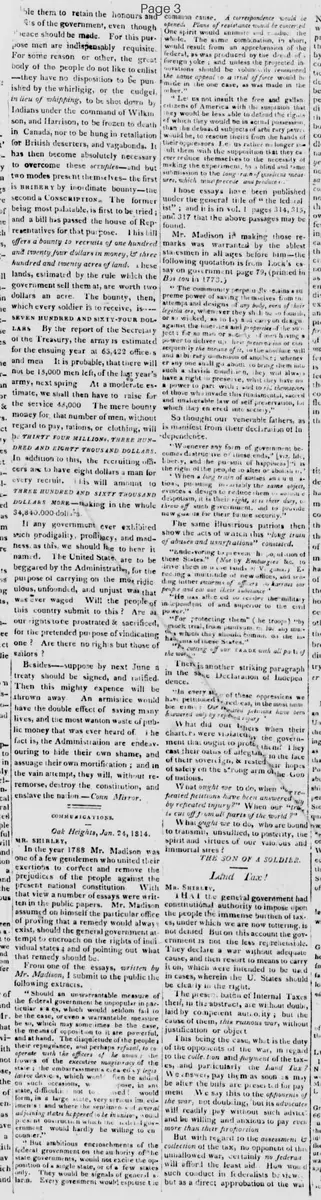
Oak Heights, Jan. 24, 1814.
MR. SHIRLEY,
In the year 1788 Mr. Madison was one of a few gentlemen who united their exertions to correct and remove the prejudices of the people against the present national constitution. With that view a number of essays were written in the public papers. Mr. Madison assumed on himself the particular office of proving that a remedy would always exist, should the general government attempt to encroach on the rights of individual states; and of pointing out what that remedy should be.
From one of the essays, written by Mr. Madison, I submit to the public the following extracts.
"Should an unwarrantable measure of the federal government be unpopular in particular states, which would seldom fail to be the case, or even a warrantable measure be so, which may sometimes be the case, the means of opposition to it are powerful, and at hand. The disquietude of the people; their repugnance, and perhaps refusal, to co-operate with the officers of the union; the frowns of the executive magistracy of the state; the embarrassment of legislative devices, which would often be added on such occasions, would oppose, in any state, difficulties not to be overcome; and where the sentiments of several adjoining states happened to be in unison, could present obstructions which the federal government would hardly be willing to encounter."
"But ambitious encroachments of the federal government on the authority of the state governments, would not excite the opposition of a single state, or of a few states only. They would be signals of general alarm. Every government would espouse the common cause. A correspondence would be opened. Plans of resistance would be concerted. One spirit would animate and actuate the whole. The same combination, in short, would result from an apprehension of the federal, as was produced by the dread of a foreign yoke: and unless the projected innovations should be voluntarily renounced, the same appeal to a trial of force would be made in the one case, as was made in the other."
"Let us not insult the free and gallant citizens of America with the suspicion that they would be less able to defend the rights of which they would be in actual possession, than the debased subjects of arbitrary power would be, to rescue theirs from the hands of their oppressors. Let us rather no longer insult them with the supposition that they can ever reduce themselves to the necessity of making the experiment, by a blind and tame submission to the long train of insidious measures, which must precede and produce it."
These essays have been published under the general title of "the Federalist": and it is in vol. 1 pages 314, 315, and 317 that the above passages may be found.
Mr. Madison in making those remarks was warranted by the ablest statesmen in all ages before him—the following quotation is from Locke's essay on government page 79, (printed in Boston in 1773.)
"The community perpetually retains a supreme power of saving themselves from the attempts and designs of any body, even of their legislators, whenever they shall be so foolish, or so wicked, as to lay and carry on designs against the liberties and properties of the subject: for no man or society of men having a power to deliver up their preservation or consequently the means of it, to the absolute will and arbitrary dominion of another; whenever any one shall go about to bring them into such a slavish condition, they will always have a right to preserve, what they have not a power to part with; and to rid themselves of those who invade this fundamental, sacred and unalterable law of self preservation, for which they entered into society."
So thought our venerable fathers, as is manifest from their declaration of Independence.
"Whenever any form of government becomes destructive of these ends," (viz. life, liberty, and the pursuit of happiness) "it is the right of the people to alter or to abolish it."
"When a long train of abuses and usurpations, pursuing invariably the same object, evinces a design to reduce them under absolute despotism, it is their right, as it is their duty, to throw off such government, and to provide new guards for their future security."
The same illustrious patriots then show the acts of which this "long train of abuses and usurpations" consisted.
"Endeavouring to prevent the population of these States."—(Not by Embargoes &c. to drive them into one land V. qua.) Erecting a multitude of new offices, and sending hither swarms of officers to harass our people and eat out their substance.
"He has affected to render the military independent of and superior to the civil power."
"For protecting them (the troops) by a mock trial, from punishment for any murders which they should commit on the inhabitants of these States."
"In cutting off our trade with all parts of the world.."
There is another striking paragraph in the same Declaration of Independence.
"In every stage of these oppressions we have petitioned for redress, in the most humble terms: Our repeated petitions have been answered only by repeated injury."
What did our Whigs when their charters were violated by the government that ought to protect them? They cast their oaths of allegiance in the face of their sovereign, & rested their hopes of safety on the strong arm of the God of nations.
What ought we to do, when "our repeated petitions have been answered only by repeated injury?" When our "trade is cut off from all parts of the world?"
What ought we to do, who are bound to transmit, unsullied, to posterity, the spirit and virtues of our valorous and immortal sires?
THE SON OF A SOLDIER.
What sub-type of article is it?
What themes does it cover?
What keywords are associated?
What entities or persons were involved?
Letter to Editor Details
Author
The Son Of A Soldier.
Recipient
Mr. Shirley,
Main Argument
citing madison's federalist essays, locke's writings on government, and the declaration of independence, the letter argues that the people retain the supreme power to resist and overthrow a federal government that encroaches on state rights and liberties through measures like embargoes and trade restrictions, as such actions echo the abuses that led to american independence.
Notable Details