Thank you for visiting SNEWPapers!
Sign up free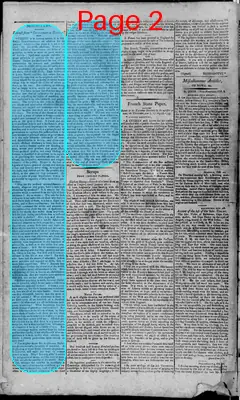
Literary
November 11, 1799
Jenks's Portland Gazette
Portland, Cumberland County, Maine
What is this article about?
Extract from 'Discourses on Davila' discusses human nature's benevolence, desire for reputation as a social motivator, self-preservation, and how government regulates these passions for order. Explores why beauty, birth, and wealth attract esteem despite their superficiality.
Clipping
OCR Quality
98%
Excellent
Full Text
MISCELLANY.
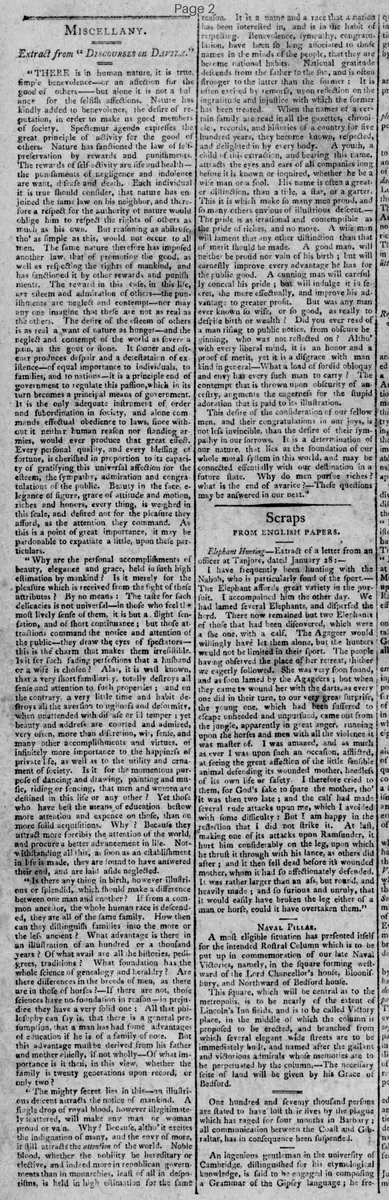
Extract from "Discourses on Davila."
"THERE is in human nature, it is true, simple benevolence—or an affection for the good of others—but alone it is not a balance or the selfish affections. Nature has kindly added to benevolence, the desire of reputation, in order to make us good members of society. Spectemur agendo expresses the great principle of activity for the good of others. Nature has sanctioned the law of self-preservation by rewards and punishments. The rewards of self activity are life and health—the punishments of negligence and indolence are want, disease and death. Each individual it is true should consider, that nature has enjoined the same law on his neighbor, and therefore a respect for the authority of nature would oblige him to respect the rights of others as much as his own. But reasoning as abstruse, though as simple as this, would not occur to all men. The same nature therefore has imposed another law, that of promoting the good, as well as respecting the rights of mankind, and has sanctioned it by other rewards and punishments. The reward in this case, in this life, are esteem and admiration of others—the punishments are neglect and contempt—nor may any one imagine that these are not as real as the others. The desire of the esteem of others is as real a want of nature as hunger—and the neglect and contempt of the world as severe a pain, as the gout or stone. It sooner and oftener produces despair and a detestation of existence. Of equal importance to individuals, to families, and to nations—it is a principle end of government to regulate this passion, which in its turn becomes a principal means of government. It is the only adequate instrument of order and subordination in society, and alone commands effectual obedience to laws, since without it neither human reason nor understanding armies, would ever produce that great effect. Every personal quality, and every blessing of fortune, is cherished in proportion to its capacity of gratifying this universal affection for the esteem, the sympathy, admiration and congratulations of the public. Beauty in the face, elegance of figure, grace of attitude and motion, riches and honors, every thing, is weighed in this scale, and desired not for the pleasure they afford, as the attention they command. As this is a point of great importance, it may be pardonable to expatiate a little, upon these particulars.
"Why are the personal accomplishments of beauty, elegance and grace, held in such high estimation by mankind? Is it merely for the pleasure which is received from the sight of these attributes? By no means: The taste for such delicacies is not universal—in those who feel the most lively sense of them, it is but a slight sensation, and of short continuance: but those attractions command the notice and attention of the public—they draw the eyes of spectators—this is the charm that makes them irresistible. Is it for such fading perfections that a husband or a wife is chosen? Alas, it is well known, that a very short familiarity, totally destroys all sense and attention to such properties; and on the contrary, a very little time and habit destroys all the aversion to ugliness and deformity, when unattended with disease or ill temper: yet beauty and address are courted and admired, very often, more than discretion, wit, sense, and many other accomplishments and virtues, of infinitely more importance to the happiness of private life, as well as to the utility and ornament of society. Is it for the momentous purpose of dancing and drawing, painting and music, riding or fencing, that men and women are destined in this life or any other? Yet those who have best the means of education bestow more attention and expense on those, than on more solid acquisitions. Why? Because they attract more forcibly the attention of the world, and procure a better advancement in life. Notwithstanding all this, as soon as an establishment in life is made, they are found to have answered their end, and are laid aside neglected.
"Is there any thing in birth, however illustrious or splendid, which should make a difference between one man and another? If from a common ancestor, the whole human race is descended, they are all of the same family. How then can they distinguish families into the more or the less ancient? What advantage is there in an illustration of an hundred or a thousand years? Of what avail are all the histories, pedigrees, traditions? What foundation has the whole science of genealogy and heraldry? Are there differences in the breeds of men, as there are in those of horses? If there are not, those sciences have no foundation in reason—in prejudice they have a very solid one: All that philosophy can say is, that there is a general presumption, that a man has had some advantages of education if he is of a family of note. But this advantage must be derived from his father and mother chiefly, if not wholly—Of what importance is it then, in this view, whether the family is twenty generations upon record, or only two?
"The mighty secret lies in this—an illustrious descent attracts the notice of mankind. A single drop of royal blood, however illegitimately scattered, will make any man or woman proud or vain. Why? Because, although it excites the indignation of many, and the envy of more, it still attracts the attention of the world. Noble Blood, whether the nobility be hereditary or elective, and indeed more in republican governments than in monarchies, least of all in despotisms, is held in high estimation for the same reason. It is a name and a race that a nation has been interested in, and is in the habit of respecting. Benevolence, sympathy, congratulation, have been so long associated to those names in the minds of the people, that they are become national habits. National gratitude descends from the father to the son, and is often stronger to the latter than the former: It is often excited by remorse, upon reflection on the ingratitude and injustice with which the former has been treated. When the names of a certain family are read in all the gazettes, chronicles, records, and histories of a country for five hundred years, they become known, respected, and delighted in by every body. A youth, a child of this extraction, and bearing this name, attracts the eyes and ears of all companies long before it is known or inquired, whether he be a wise man or a fool. His name is often a greater distinction, than a title, a star, or a garter. This it is which make so many men proud, and so many others envious of illustrious descent.—The pride is as irrational and contemptible as the pride of riches, and no more. A wise man will lament that any other distinction than that of merit should be made. A good man, will neither be proud nor vain of his birth; but will earnestly improve every advantage he has for the public good. A cunning man will carefully conceal his pride; but will indulge it in secret, the more effectually, and improve his advantage to greater profit. But was any man ever known so wise, or so good, as really to despise birth or wealth? Did you ever read of a man rising to public notice, from obscure beginning, who was not reflected on? Although with every liberal mind, it is an honor and a proof of merit, yet it is a disgrace with mankind in general—What a load of sordid obloquy and envy has every such man to carry? The contempt that is thrown upon obscurity of ancestry, augments the eagerness for the stupid adoration that is paid to its illustration. This desire of the consideration of our fellow men, and their congratulations in our joys, is not less invincible, than the desire of their sympathy in our sorrows. It is a determination of our nature, that lies at the foundation of our whole moral system in this world, and may be connected essentially with our destination in a future state. Why do men pursue riches? What is the end of avarice?—These questions may be answered in our next."
Extract from "Discourses on Davila."
"THERE is in human nature, it is true, simple benevolence—or an affection for the good of others—but alone it is not a balance or the selfish affections. Nature has kindly added to benevolence, the desire of reputation, in order to make us good members of society. Spectemur agendo expresses the great principle of activity for the good of others. Nature has sanctioned the law of self-preservation by rewards and punishments. The rewards of self activity are life and health—the punishments of negligence and indolence are want, disease and death. Each individual it is true should consider, that nature has enjoined the same law on his neighbor, and therefore a respect for the authority of nature would oblige him to respect the rights of others as much as his own. But reasoning as abstruse, though as simple as this, would not occur to all men. The same nature therefore has imposed another law, that of promoting the good, as well as respecting the rights of mankind, and has sanctioned it by other rewards and punishments. The reward in this case, in this life, are esteem and admiration of others—the punishments are neglect and contempt—nor may any one imagine that these are not as real as the others. The desire of the esteem of others is as real a want of nature as hunger—and the neglect and contempt of the world as severe a pain, as the gout or stone. It sooner and oftener produces despair and a detestation of existence. Of equal importance to individuals, to families, and to nations—it is a principle end of government to regulate this passion, which in its turn becomes a principal means of government. It is the only adequate instrument of order and subordination in society, and alone commands effectual obedience to laws, since without it neither human reason nor understanding armies, would ever produce that great effect. Every personal quality, and every blessing of fortune, is cherished in proportion to its capacity of gratifying this universal affection for the esteem, the sympathy, admiration and congratulations of the public. Beauty in the face, elegance of figure, grace of attitude and motion, riches and honors, every thing, is weighed in this scale, and desired not for the pleasure they afford, as the attention they command. As this is a point of great importance, it may be pardonable to expatiate a little, upon these particulars.
"Why are the personal accomplishments of beauty, elegance and grace, held in such high estimation by mankind? Is it merely for the pleasure which is received from the sight of these attributes? By no means: The taste for such delicacies is not universal—in those who feel the most lively sense of them, it is but a slight sensation, and of short continuance: but those attractions command the notice and attention of the public—they draw the eyes of spectators—this is the charm that makes them irresistible. Is it for such fading perfections that a husband or a wife is chosen? Alas, it is well known, that a very short familiarity, totally destroys all sense and attention to such properties; and on the contrary, a very little time and habit destroys all the aversion to ugliness and deformity, when unattended with disease or ill temper: yet beauty and address are courted and admired, very often, more than discretion, wit, sense, and many other accomplishments and virtues, of infinitely more importance to the happiness of private life, as well as to the utility and ornament of society. Is it for the momentous purpose of dancing and drawing, painting and music, riding or fencing, that men and women are destined in this life or any other? Yet those who have best the means of education bestow more attention and expense on those, than on more solid acquisitions. Why? Because they attract more forcibly the attention of the world, and procure a better advancement in life. Notwithstanding all this, as soon as an establishment in life is made, they are found to have answered their end, and are laid aside neglected.
"Is there any thing in birth, however illustrious or splendid, which should make a difference between one man and another? If from a common ancestor, the whole human race is descended, they are all of the same family. How then can they distinguish families into the more or the less ancient? What advantage is there in an illustration of an hundred or a thousand years? Of what avail are all the histories, pedigrees, traditions? What foundation has the whole science of genealogy and heraldry? Are there differences in the breeds of men, as there are in those of horses? If there are not, those sciences have no foundation in reason—in prejudice they have a very solid one: All that philosophy can say is, that there is a general presumption, that a man has had some advantages of education if he is of a family of note. But this advantage must be derived from his father and mother chiefly, if not wholly—Of what importance is it then, in this view, whether the family is twenty generations upon record, or only two?
"The mighty secret lies in this—an illustrious descent attracts the notice of mankind. A single drop of royal blood, however illegitimately scattered, will make any man or woman proud or vain. Why? Because, although it excites the indignation of many, and the envy of more, it still attracts the attention of the world. Noble Blood, whether the nobility be hereditary or elective, and indeed more in republican governments than in monarchies, least of all in despotisms, is held in high estimation for the same reason. It is a name and a race that a nation has been interested in, and is in the habit of respecting. Benevolence, sympathy, congratulation, have been so long associated to those names in the minds of the people, that they are become national habits. National gratitude descends from the father to the son, and is often stronger to the latter than the former: It is often excited by remorse, upon reflection on the ingratitude and injustice with which the former has been treated. When the names of a certain family are read in all the gazettes, chronicles, records, and histories of a country for five hundred years, they become known, respected, and delighted in by every body. A youth, a child of this extraction, and bearing this name, attracts the eyes and ears of all companies long before it is known or inquired, whether he be a wise man or a fool. His name is often a greater distinction, than a title, a star, or a garter. This it is which make so many men proud, and so many others envious of illustrious descent.—The pride is as irrational and contemptible as the pride of riches, and no more. A wise man will lament that any other distinction than that of merit should be made. A good man, will neither be proud nor vain of his birth; but will earnestly improve every advantage he has for the public good. A cunning man will carefully conceal his pride; but will indulge it in secret, the more effectually, and improve his advantage to greater profit. But was any man ever known so wise, or so good, as really to despise birth or wealth? Did you ever read of a man rising to public notice, from obscure beginning, who was not reflected on? Although with every liberal mind, it is an honor and a proof of merit, yet it is a disgrace with mankind in general—What a load of sordid obloquy and envy has every such man to carry? The contempt that is thrown upon obscurity of ancestry, augments the eagerness for the stupid adoration that is paid to its illustration. This desire of the consideration of our fellow men, and their congratulations in our joys, is not less invincible, than the desire of their sympathy in our sorrows. It is a determination of our nature, that lies at the foundation of our whole moral system in this world, and may be connected essentially with our destination in a future state. Why do men pursue riches? What is the end of avarice?—These questions may be answered in our next."
What sub-type of article is it?
Essay
What themes does it cover?
Moral Virtue
Political
Social Manners
What keywords are associated?
Benevolence
Reputation
Self Preservation
Social Order
Noble Birth
Public Esteem
Government Regulation
Human Nature
Literary Details
Title
Extract From "Discourses On Davila."
Subject
On Human Nature, Reputation, And Social Distinctions
Key Lines
The Desire Of The Esteem Of Others Is As Real A Want Of Nature As Hunger—And The Neglect And Contempt Of The World As Severe A Pain, As The Gout Or Stone.
It Is The Only Adequate Instrument Of Order And Subordination In Society, And Alone Commands Effectual Obedience To Laws.
The Mighty Secret Lies In This—An Illustrious Descent Attracts The Notice Of Mankind.
A Wise Man Will Lament That Any Other Distinction Than That Of Merit Should Be Made.
This Desire Of The Consideration Of Our Fellow Men, And Their Congratulations In Our Joys, Is Not Less Invincible, Than The Desire Of Their Sympathy In Our Sorrows.