Thank you for visiting SNEWPapers!
Sign up free
Story
September 12, 1883
Connecticut Western News
North Canaan, Salisbury, Canaan, Litchfield County, Connecticut
What is this article about?
In 1841, American diver Samuel Scott died in London after a stunt where he accidentally hanged himself from a rope on scaffolding over Waterloo Bridge before intending to dive 40 feet into the Thames. Despite rescue efforts, he could not be saved at Charing Cross Hospital.
Clipping
OCR Quality
98%
Excellent
Full Text
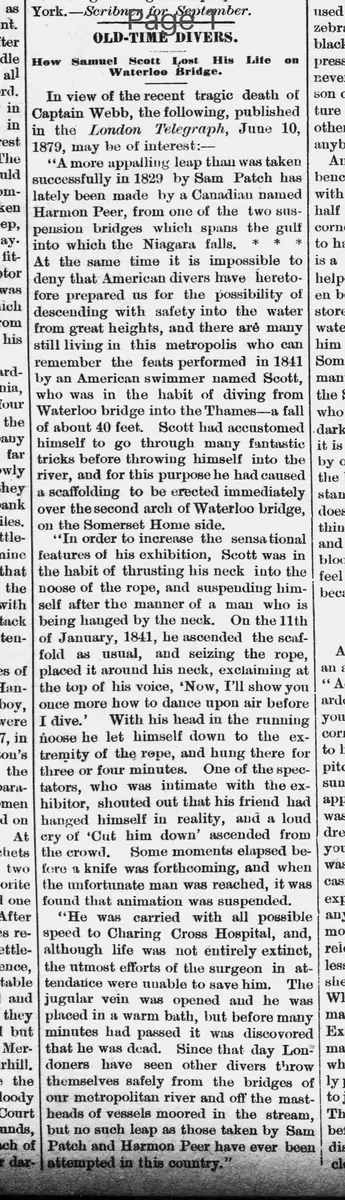
OLD-TIME DIVERS.
How Samuel Scott Lost His Life on Waterloo Bridge.
In view of the recent tragic death of Captain Webb, the following, published in the London Telegraph, June 10, 1879, may be of interest:-
"A more appalling leap than was taken successfully in 1829 by Sam Patch has lately been made by a Canadian named Harmon Peer, from one of the two suspension bridges which spans the gulf into which the Niagara falls. At the same time it is impossible to deny that American divers have heretofore prepared us for the possibility of descending with safety into the water from great heights, and there are many still living in this metropolis who can remember the feats performed in 1841 by an American swimmer named Scott, who was in the habit of diving from Waterloo bridge into the Thames—a fall of about 40 feet. Scott had accustomed himself to go through many fantastic tricks before throwing himself into the river, and for this purpose he had caused a scaffolding to be erected immediately over the second arch of Waterloo bridge, on the Somerset House side.
"'In order to increase the sensational features of his exhibition, Scott was in the habit of thrusting his neck into the noose of the rope, and suspending himself after the manner of a man who is being hanged by the neck. On the 11th of January, 1841, he ascended the scaffold as usual, and seizing the rope, placed it around his neck, exclaiming at the top of his voice, 'Now, I'll show you once more how to dance upon air before I dive.' With his head in the running noose he let himself down to the extremity of the rope, and hung there for three or four minutes. One of the spectators, who was intimate with the exhibitor, shouted out that his friend had hanged himself in reality, and a loud cry of 'Cut him down' ascended from the crowd. Some moments elapsed before a knife was forthcoming, and when the unfortunate man was reached, it was found that animation was suspended.
"He was carried with all possible speed to Charing Cross Hospital, and, although life was not entirely extinct the utmost efforts of the surgeon in attendance were unable to save him. The jugular vein was opened and he was placed in a warm bath, but before many minutes had passed it was discovered that he was dead. Since that day Londoners have seen other divers throw themselves safely from the bridges of our metropolitan river and off the mastheads of vessels moored in the stream, but no such leap as those taken by Sam Patch and Harmon Peer have ever been attempted in this country."
How Samuel Scott Lost His Life on Waterloo Bridge.
In view of the recent tragic death of Captain Webb, the following, published in the London Telegraph, June 10, 1879, may be of interest:-
"A more appalling leap than was taken successfully in 1829 by Sam Patch has lately been made by a Canadian named Harmon Peer, from one of the two suspension bridges which spans the gulf into which the Niagara falls. At the same time it is impossible to deny that American divers have heretofore prepared us for the possibility of descending with safety into the water from great heights, and there are many still living in this metropolis who can remember the feats performed in 1841 by an American swimmer named Scott, who was in the habit of diving from Waterloo bridge into the Thames—a fall of about 40 feet. Scott had accustomed himself to go through many fantastic tricks before throwing himself into the river, and for this purpose he had caused a scaffolding to be erected immediately over the second arch of Waterloo bridge, on the Somerset House side.
"'In order to increase the sensational features of his exhibition, Scott was in the habit of thrusting his neck into the noose of the rope, and suspending himself after the manner of a man who is being hanged by the neck. On the 11th of January, 1841, he ascended the scaffold as usual, and seizing the rope, placed it around his neck, exclaiming at the top of his voice, 'Now, I'll show you once more how to dance upon air before I dive.' With his head in the running noose he let himself down to the extremity of the rope, and hung there for three or four minutes. One of the spectators, who was intimate with the exhibitor, shouted out that his friend had hanged himself in reality, and a loud cry of 'Cut him down' ascended from the crowd. Some moments elapsed before a knife was forthcoming, and when the unfortunate man was reached, it was found that animation was suspended.
"He was carried with all possible speed to Charing Cross Hospital, and, although life was not entirely extinct the utmost efforts of the surgeon in attendance were unable to save him. The jugular vein was opened and he was placed in a warm bath, but before many minutes had passed it was discovered that he was dead. Since that day Londoners have seen other divers throw themselves safely from the bridges of our metropolitan river and off the mastheads of vessels moored in the stream, but no such leap as those taken by Sam Patch and Harmon Peer have ever been attempted in this country."
What sub-type of article is it?
Extraordinary Event
Tragedy
Biography
What themes does it cover?
Misfortune
Tragedy
What keywords are associated?
Diving Accident
Waterloo Bridge
Samuel Scott
Hanging Stunt
Thames Dive
Fatal Performance
What entities or persons were involved?
Samuel Scott
Sam Patch
Harmon Peer
Where did it happen?
Waterloo Bridge, London, Thames River
Story Details
Key Persons
Samuel Scott
Sam Patch
Harmon Peer
Location
Waterloo Bridge, London, Thames River
Event Date
11th Of January, 1841
Story Details
American diver Samuel Scott performed daring dives from Waterloo Bridge into the Thames, including hanging stunts. On January 11, 1841, he accidentally hanged himself during a performance and died despite medical efforts at Charing Cross Hospital.