Thank you for visiting SNEWPapers!
Sign up free
Atlanta Daily World
Atlanta, Fulton County, Georgia
What is this article about?
The National Urban League, founded in 1910, has aided 18 million African Americans, especially urban migrants from the South, by securing jobs, fighting discrimination, educating on rights, and fostering interracial cooperation for economic and social advancement over 50 years.
Clipping
OCR Quality
Full Text
How this nationwide social and economic agency helps you lead a richer life in today's America.
by LESTER B. GRANGER
About 18 million Negroes live in the United States—six out of ten in the South, and the other four in the North and West. The proportion is changing every day as Negroes continue to leave the South for areas where they can expect full protection of the law and full benefit of public education. As they move, the proportion of Negro urban residence rises—for almost all northern and western Negroes live in cities. As a racial group we are now an integral part of America's urban civilization.
Here is a social revolution of which the Urban League has been part from its very beginning. In the early years of this century, Negroes leaving the South by tens of thousands marched deep into blind alleys in such cities as New York and Philadelphia, as well as Nashville. Men were herded into low-paid laboring jobs; women were given the shoddiest housework and paid practically nothing for it; houses of prostitution recruited many of the inexperienced and untrained. Fresh from the farm, lost children in big-city life, these in-migrant Negroes were slowly rotting away.
It was George E. Haynes, a brilliant young Negro social scientist and the first member of his race to graduate from the New York School of Social Work, who saw the need of a long-range, broadly-based social engineering program to help Negroes take advantage of opportunities in the city and encourage their white neighbors to make those opportunities available on the basis of merit, rather than race.
So he sat down with the widow of William H. Baldwin (William Baldwin was President of the Long Island Railroad Company and a truly advanced social thinker): and out of their discussions was formed in April, 1910—the Committee on Urban Conditions Among Negroes—today's National Urban League. Here was the beginning of the interracial cooperation that has been the trademark of the Urban League ever since, for the first Board was composed almost equally of distinguished white and colored citizens. And everything that has been done by the Urban League since 1910 has been on the basis of an interracial membership, interracial boards and interracial committees in each of the 63 local Urban Leagues spread throughout the country.
In those 63 cities are to be found over half of the urban Negro population of the country, and, naturally, it is there that clearest public understanding is to be found of the Urban League's work. The fact is, however, that every one of the 10-million Negroes of urban residence in this country—every man, woman and child among them—is affected by the work that the League has done over the past 50 years.
The man who gets a job in some big industrial plant, even in a city without an Urban League, is benefiting from the League's work in industrial relations—a special activity organized in 1925. When he joins a union, whose officers may not even have heard of the League, he is cashing in on Urban League relations (both friendly and unfriendly) with organized labor that started back in 1917 when Eugene Kinckle Jones was executive secretary. When he buys a house and gets a mortgage from a bank, when he registers at a public employment office which would have refused him twenty years ago, is referred to a job on the basis of his qualifications instead of his race—when the Negro does any of these things essential to his economic and social welfare, he is drawing a little interest on the investment of effort made in his behalf for fifty years by the Urban League.
Even in the short period since World War II, tens of thousands of Negroes, because of Urban League activities, have gone into jobs never before held by members of their race. Think of the telephone operators and taxi-cab drivers, policemen and firemen, stenographers and draftsmen, civil service employees, engineers, scientists, and technicians, and workers in dozens of other fields who were the first or among the first of their race employed in their jobs—because the Urban League was in there working for them.
As far back as World War I, the League introduced hundreds of industrial employers to the unused pool of Negro unskilled and semi-skilled labor. When these workers were dropped after the war was over, Urban Leagues in two-dozen cities accepted responsibility for stubbornly finding other jobs for the displaced and for pushing the state employment offices to do their share toward re-employment of jobless Negroes.
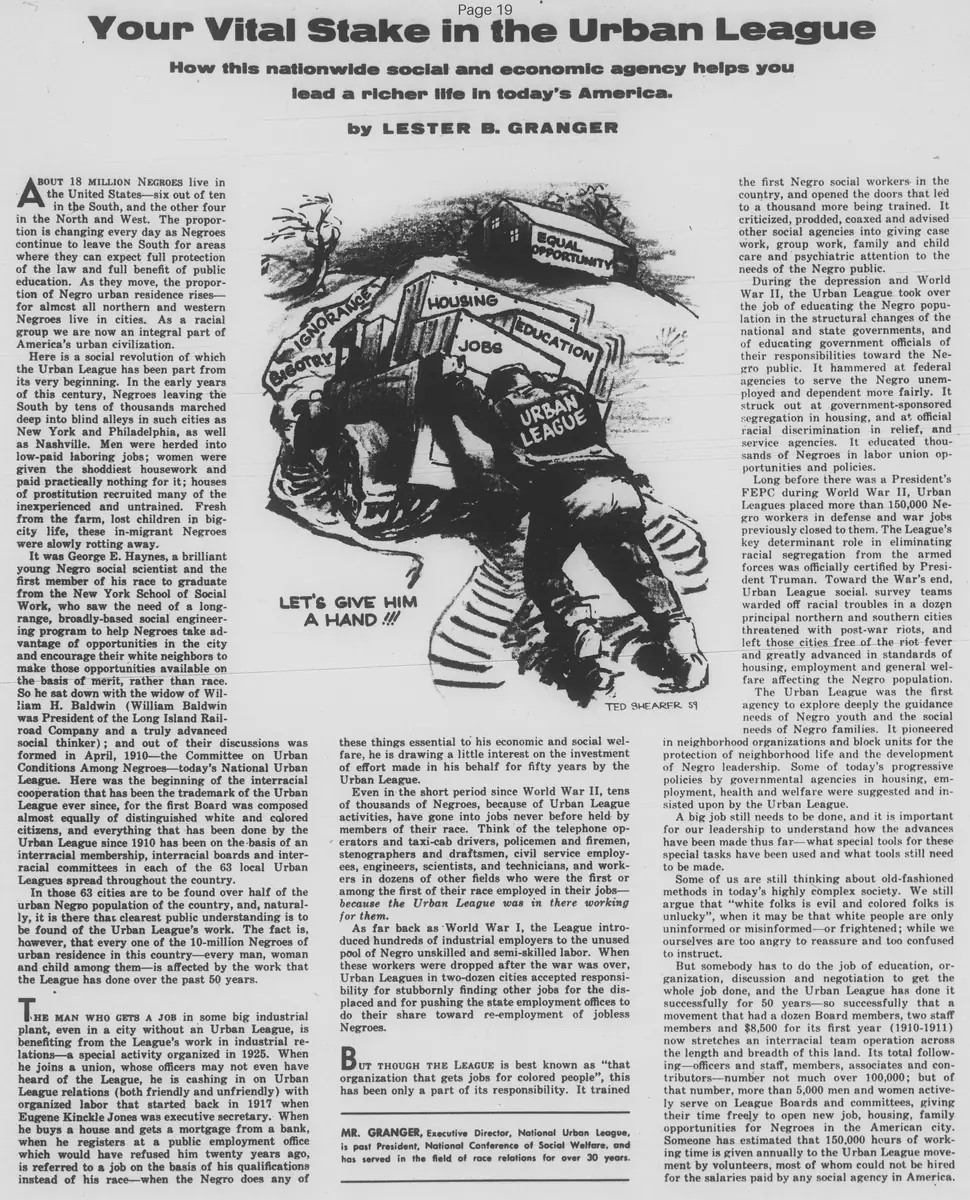
But though the League is best known as "that organization that gets jobs for colored people", this has been only a part of its responsibility. It trained the first Negro social workers in the country, and opened the doors that led to a thousand more being trained. It criticized, prodded, coaxed and advised other social agencies into giving case work, group work, family and child care and psychiatric attention to the needs of the Negro public.
During the depression and World War II, the Urban League took over the job of educating the Negro population in the structural changes of the national and state governments, and of educating government officials of their responsibilities toward the Negro public. It hammered at federal agencies to serve the Negro unemployed and dependent more fairly. It struck out at government-sponsored segregation in housing, and at official racial discrimination in relief, and service agencies. It educated thousands of Negroes in labor union opportunities and policies.
Long before there was a President's FEPC during World War II, Urban Leagues placed more than 150,000 Negro workers in defense and war jobs previously closed to them. The League's key determinant role in eliminating racial segregation from the armed forces was officially certified by President Truman. Toward the War's end, Urban League social survey teams warded off racial troubles in a dozen principal northern and southern cities threatened with post-war riots, and left those cities free of the riot fever and greatly advanced in standards of housing, employment and general welfare affecting the Negro population.
The Urban League was the first agency to explore deeply the guidance needs of Negro youth and the social needs of Negro families. It pioneered in neighborhood organizations and block units for the protection of neighborhood life and the development of Negro leadership. Some of today's progressive policies by governmental agencies in housing, employment, health and welfare were suggested and insisted upon by the Urban League.
A big job still needs to be done, and it is important for our leadership to understand how the advances have been made thus far—what special tools for these special tasks have been used and what tools still need to be made.
Some of us are still thinking about old-fashioned methods in today's highly complex society. We still argue that "white folks is evil and colored folks is unlucky", when it may be that white people are only uninformed or misinformed—or frightened; while we ourselves are too angry to reassure and too confused to instruct.
But somebody has to do the job of education, organization, discussion and negotiation to get the whole job done, and the Urban League has done it successfully for 50 years—so successfully that a movement that had a dozen Board members, two staff members and $8,500 for its first year (1910-1911) now stretches an interracial team operation across the length and breadth of this land. Its total following—officers and staff, members, associates and contributors—number not much over 100,000; but of that number, more than 5,000 men and women actively serve on League Boards and committees, giving their time freely to open new job, housing, family opportunities for Negroes in the American city.
Someone has estimated that 150,000 hours of working time is given annually to the Urban League movement by volunteers, most of whom could not be hired for the salaries paid by any social agency in America.
MR. GRANGER, Executive Director, National Urban League, is past President, National Conference of Social Welfare, and has served in the field of race relations for over 30 years.
What sub-type of article is it?
What themes does it cover?
What keywords are associated?
What entities or persons were involved?
Where did it happen?
Story Details
Key Persons
Location
Urban Cities In The United States (E.G., New York, Philadelphia)
Event Date
April 1910 To Present (50 Years As Of Article)
Story Details
The National Urban League, founded in April 1910 by George E. Haynes and others as the Committee on Urban Conditions Among Negroes, has worked for 50 years to aid African American migrants in urban areas through interracial cooperation, job placement, education, fighting discrimination in employment, housing, and government services, and promoting social welfare.