Thank you for visiting SNEWPapers!
Sign up free
Editorial
April 2, 1936
Atlanta Daily World
Atlanta, Fulton County, Georgia
What is this article about?
The editorial lauds the U.S. Supreme Court's unanimous decisions in Scottsboro (1932, 1935) and Mississippi cases protecting Negro defendants from unfair trials, lack of counsel, jury exclusion, and tortured confessions. It condemns Southern racial prejudice and warns that curbing the Court's power would reduce Negroes to serfdom, endangering all minorities.
Clipping
OCR Quality
98%
Excellent
Full Text
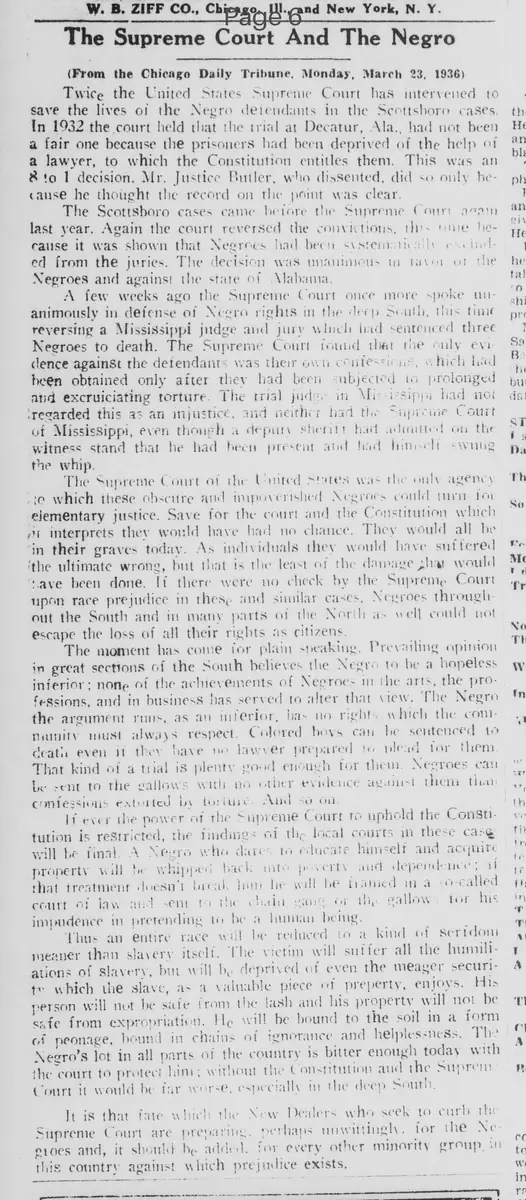
The Supreme Court And The Negro
(From the Chicago Daily Tribune, Monday, March 23, 1936)
Twice the United States Supreme Court has intervened to save the lives of the Negro defendants in the Scottsboro cases. In 1932 the court held that the trial at Decatur, Ala., had not been a fair one because the prisoners had been deprived of the help of a lawyer, to which the Constitution entitles them. This was an 8 to 1 decision. Mr. Justice Butler, who dissented, did so only because he thought the record on the point was clear.
The Scottsboro cases came before the Supreme Court again last year. Again the court reversed the convictions, this time because it was shown that Negroes had been systematically excluded from the juries. The decision was unanimous in favor of the Negroes and against the state of Alabama.
A few weeks ago the Supreme Court once more spoke unanimously in defense of Negro rights in the deep South, this time reversing a Mississippi judge and jury which had sentenced three Negroes to death. The Supreme Court held that the only evidence against the defendants was their own confessions, which had been obtained only after they had been subjected to prolonged and excruciating torture. The trial judge in Mississippi had not regarded this as an injustice, and neither had the supreme Court of Mississippi, even though a deputy sheriff had testified on the witness stand that he had been present and had hung the whip. The supreme Court of the United States was the only agency in which these obscure and impoverished Negroes could turn for elementary justice. Save for the court and the Constitution which it interprets they would have had no chance. They would all be in their graves today. As individuals they would have suffered the ultimate wrong, but that is the least of the damage that would have been done. If there were no check by the Supreme Court upon race prejudice in these and similar cases, Negroes throughout the South and in many parts of the North as well could not escape the loss of all their rights as citizens.
The moment has come for plain speaking. Prevailing opinion in great sections of the South believes the Negro to be a hopeless inferior; none of the achievements of Negroes in the arts, the professions, and in business has served to alter that view. The Negro, the argument runs, as an inferior, has no right which the community must always respect. Colored boys can be sentenced to death even if they have no lawyer prepared to plead for them. That kind of a trial is plenty good enough for them. Negroes can be sent to the gallows with no other evidence against them than confessions extorted by torture. And so on.
If ever the power of the Supreme Court to uphold the Constitution is restricted, the findings of the local courts in these cases will be final. A Negro who dares to educate himself and acquire property will be whipped back into poverty and dependence; if that treatment doesn't break him he will be framed in a so-called court of law and sent to the chain gang or the gallows for his impudence in pretending to be a human being.
Thus an entire race will be reduced to a kind of serfdom meaner than slavery itself. The victim will suffer all the humiliations of slavery, but will be deprived of even the meager security which the slave, as a valuable piece of property, enjoys. His person will not be safe from the lash and his property will not be safe from expropriation. He will be bound to the soil in a form of peonage, bound in chains of ignorance and helplessness. The Negro's lot in all parts of the country is bitter enough today with the court to protect him; without the Constitution and the Supreme Court it would be far worse, especially in the deep South.
It is that fate which the New Dealers who seek to curb the Supreme Court are preparing, perhaps unwittingly, for the Negroes and, it should be added, for every other minority group in this country against which prejudice exists.
(From the Chicago Daily Tribune, Monday, March 23, 1936)
Twice the United States Supreme Court has intervened to save the lives of the Negro defendants in the Scottsboro cases. In 1932 the court held that the trial at Decatur, Ala., had not been a fair one because the prisoners had been deprived of the help of a lawyer, to which the Constitution entitles them. This was an 8 to 1 decision. Mr. Justice Butler, who dissented, did so only because he thought the record on the point was clear.
The Scottsboro cases came before the Supreme Court again last year. Again the court reversed the convictions, this time because it was shown that Negroes had been systematically excluded from the juries. The decision was unanimous in favor of the Negroes and against the state of Alabama.
A few weeks ago the Supreme Court once more spoke unanimously in defense of Negro rights in the deep South, this time reversing a Mississippi judge and jury which had sentenced three Negroes to death. The Supreme Court held that the only evidence against the defendants was their own confessions, which had been obtained only after they had been subjected to prolonged and excruciating torture. The trial judge in Mississippi had not regarded this as an injustice, and neither had the supreme Court of Mississippi, even though a deputy sheriff had testified on the witness stand that he had been present and had hung the whip. The supreme Court of the United States was the only agency in which these obscure and impoverished Negroes could turn for elementary justice. Save for the court and the Constitution which it interprets they would have had no chance. They would all be in their graves today. As individuals they would have suffered the ultimate wrong, but that is the least of the damage that would have been done. If there were no check by the Supreme Court upon race prejudice in these and similar cases, Negroes throughout the South and in many parts of the North as well could not escape the loss of all their rights as citizens.
The moment has come for plain speaking. Prevailing opinion in great sections of the South believes the Negro to be a hopeless inferior; none of the achievements of Negroes in the arts, the professions, and in business has served to alter that view. The Negro, the argument runs, as an inferior, has no right which the community must always respect. Colored boys can be sentenced to death even if they have no lawyer prepared to plead for them. That kind of a trial is plenty good enough for them. Negroes can be sent to the gallows with no other evidence against them than confessions extorted by torture. And so on.
If ever the power of the Supreme Court to uphold the Constitution is restricted, the findings of the local courts in these cases will be final. A Negro who dares to educate himself and acquire property will be whipped back into poverty and dependence; if that treatment doesn't break him he will be framed in a so-called court of law and sent to the chain gang or the gallows for his impudence in pretending to be a human being.
Thus an entire race will be reduced to a kind of serfdom meaner than slavery itself. The victim will suffer all the humiliations of slavery, but will be deprived of even the meager security which the slave, as a valuable piece of property, enjoys. His person will not be safe from the lash and his property will not be safe from expropriation. He will be bound to the soil in a form of peonage, bound in chains of ignorance and helplessness. The Negro's lot in all parts of the country is bitter enough today with the court to protect him; without the Constitution and the Supreme Court it would be far worse, especially in the deep South.
It is that fate which the New Dealers who seek to curb the Supreme Court are preparing, perhaps unwittingly, for the Negroes and, it should be added, for every other minority group in this country against which prejudice exists.
What sub-type of article is it?
Constitutional
Slavery Abolition
Crime Or Punishment
What keywords are associated?
Supreme Court
Negro Rights
Scottsboro Cases
Racial Prejudice
Constitutional Protection
Southern Trials
Tortured Confessions
What entities or persons were involved?
Supreme Court
Negro Defendants
Scottsboro Cases
State Of Alabama
Mississippi Courts
New Dealers
Editorial Details
Primary Topic
Supreme Court Protection Of Negro Rights Against Southern Prejudice
Stance / Tone
Strong Defense Of Supreme Court Role In Upholding Constitutional Rights For Negroes
Key Figures
Supreme Court
Negro Defendants
Scottsboro Cases
State Of Alabama
Mississippi Courts
New Dealers
Key Arguments
Supreme Court Reversed Scottsboro Convictions Due To Lack Of Counsel In 1932
Supreme Court Reversed Scottsboro Convictions Due To Exclusion Of Negroes From Juries In 1935
Supreme Court Reversed Mississippi Death Sentences Based On Tortured Confessions
Southern Prejudice Views Negroes As Inferiors Unworthy Of Fair Trials
Restricting Supreme Court Power Would Allow Local Courts To Deny Negro Rights
Without Constitutional Protections, Negroes Face Serfdom Worse Than Slavery
New Dealers' Efforts To Curb Supreme Court Threaten Minorities