Thank you for visiting SNEWPapers!
Sign up free
The North Carolina Standard
Raleigh, Wake County, North Carolina
What is this article about?
Speech by Mr. Bynum at the Democratic Republican Festival in Yanceyville, NC, on September 28, denouncing the Whig party and banking monopolies as waging war on productive classes like planters and farmers, defending Democratic policies under Van Buren, and urging vigilance against non-productive interests.
Merged-components note: Continuation of the 'SPEECH OF MR. BYNUM' across pages 1 and 4; original label on page 1 is editorial, page 4 is story, but overall fits editorial as political opinion/speech.
Clippings
1 of 2
OCR Quality
Full Text
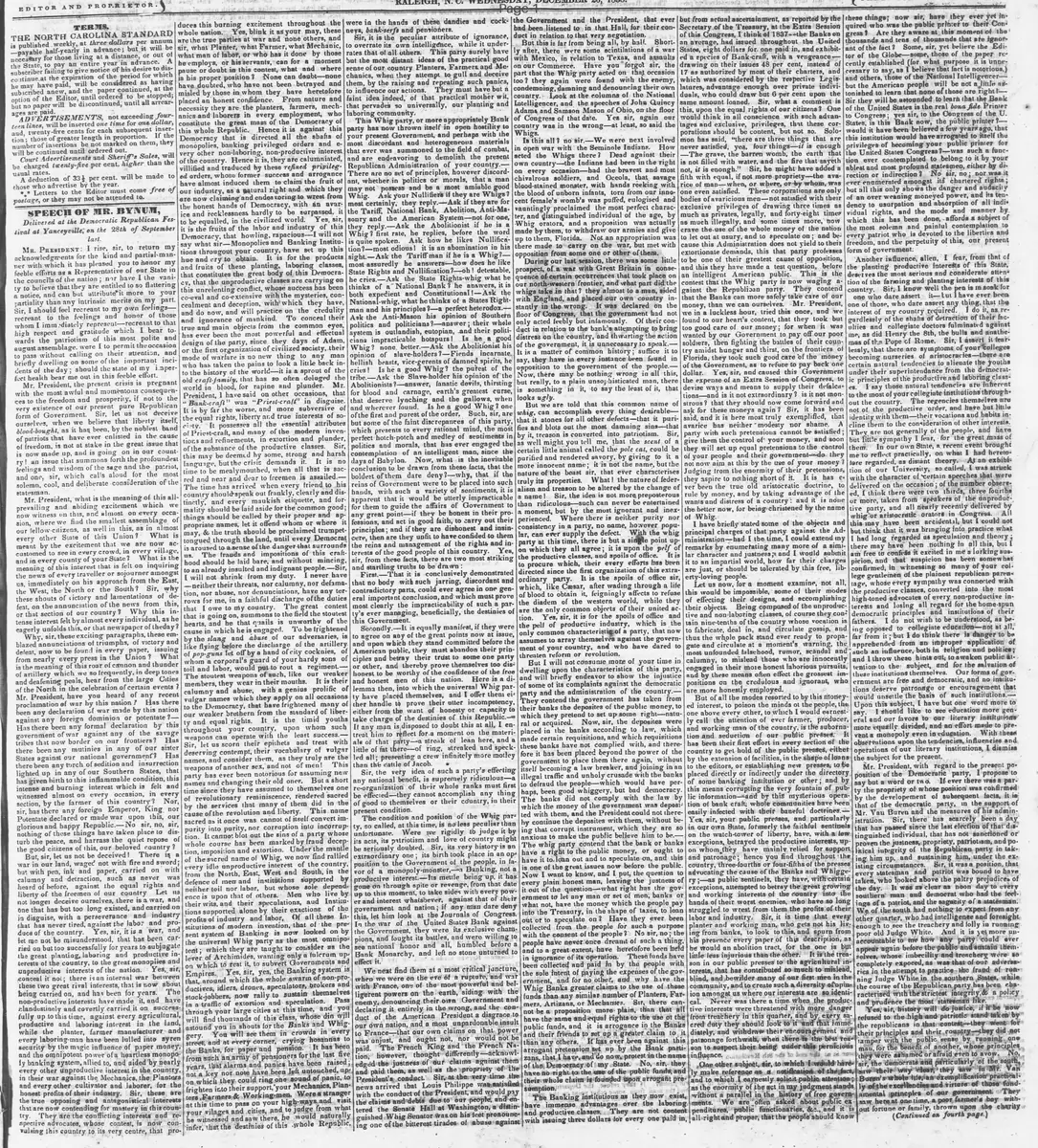
Delivered at the Democratic Republican Festival at Yanceyville, on the 28th of September last.
MR. PRESIDENT: I rise, sir, to return my acknowledgments for the kind and partial manner with which it has pleased you to honor my feeble efforts as a Representative of our State in the councils of the nation; nor have I the vanity to believe that they are entitled to so flattering a notice, and can but attribute it more to your partiality than any intrinsic merits on my part.
Sir, I should feel recreant to my own feelings—recreant to the feelings and honor of those whom I immediately represent—recreant to that high respect and gratitude which I bear towards the patriotism of this most polite and august assemblage—were I to permit the occasion to pass without calling on their attention, and briefly dwelling on some of the important incidents of the day; should the state of my imperfect health bear me out in this feeble effort.
Mr. President, the present crisis is pregnant with the most awful and momentous consequences to the freedom and prosperity, if not to the very existence of our present pure Republican form of Government. Sir, let us not deceive ourselves, when we believe that liberty itself, blood-bought as it has been, by the noblest band of patriots that have ever enlisted in the cause of freedom, is not at stake in the great issue that is now made up, and is going on in our country! an issue that summons forth the profoundest feelings and wisdom of the sage and the patriot, and one, sir, which calls aloud for the most solemn, cool, and deliberate consideration of the statesman.
Mr. President, what is the meaning of this all-prevailing and abiding excitement which we now witness on this, and almost on every occasion, where we find the smallest assemblage of our fellow-citizens, as well in this, as in almost every other State of this Union? What is meant by the excitement that we are now accustomed to see in every crowd, in every village, and in every county of your State? What is the meaning of this interest that is felt on inquiring the news of every traveller or sojourner amongst us, immediately on his approach from the East, the West, the North or the South? Sir, why these shouts of victory and lamentations of defeat, on the annunciation of the news from this, or that section of our country? Why this intense interest felt by almost every individual, as he eagerly unfolds this, or that newspaper of the day? Why, sir, these exciting paragraphs, these emblazoned annunciations of triumphs, of victory and defeat, now to be found in every paper, issuing from nearly every press in the Union? What is the meaning of this roar of cannon and thunder of artillery which we so frequently, in deep tones and deafening peals, hear from the large cities of the North in the celebration of certain events?
Mr. President, have you heard of any recent proclamation of war by this nation? Has there been any declaration of war made by this nation against any foreign dominion or potentate?—Has there been any formal declaration by this government of war against any of the savage tribes that now border on our frontiers? Has there been any mutinies in any of our sister States against our national government? Has there been any torch of sedition and insurrection lighted up in any of our Southern States, that has given birth to this inflammable condition, this intense and burning interest which is felt and witnessed almost on every occasion, in every section, by the farmer of this country? Nor, sir, has there any foreign Emperor, King, nor Potentate declared or made war upon this, our glorious and happy Republic. No sir, no, sir, nothing of these things have taken place to disturb the peace, and harass the quiet repose of the good citizens of this, our beloved country?
But, sir, let us not be deceived! There is a war in our land, waged not with fire and sword but with pen, ink and paper, carried on with calumny and detraction, such as never was heard of before, against the equal rights and liberty of the freemen of our country. Let us not longer deceive ourselves, there is a war, and one that has but too long existed, and carried on in disguise, with a perseverance and industry that has never tired, against the labor and produce of the country. Yes, sir, it is a war, and let me not be misunderstood, that has been carried on but too successfully for years to subjugate the great planting, laboring and productive interests of the country, to the great monopolies and unproductive interests of the nation. Yes, sir, conceal it not; there is an internal war between these two great rival interests, that is now about being carried on, and has been for years. "The non-productive interests have made it, and have clandestinely and covertly carried it on successfully up to this time, against every agricultural, productive and laboring interest in the land, while the planter, farmer manufacturer and every laboring-man have been lulled into syren security by the magic influence of paper money, and the omnipotent power of a heartless monopoly banking system, allied to, and aided by nearly every other unproductive interest in the country."
In their war against the Mechanics, the Planters and every other cultivator and laborer, for the honest profits of their industry. Sir, these are the true opposing and antagonistical interests that are now contending for mastery in this country. They are the conflicting interests and respective advocates, whose contest, is now convulsing this country to its very centre, that produces the excitement, the war, the commotion, the interest, the triumph and defeat, that we now witness on every occasion, where we find the smallest assemblage of our fellow-citizens, as well in this, as in almost every other State of this Union? What is meant by the excitement that we are now accustomed to see in every crowd, in every village, and in every county of your State? What is the meaning of this interest that is felt on inquiring the news of every traveller or sojourner amongst us, immediately on his approach from the East, the West, the North or the South? Sir, why these shouts of victory and lamentations of defeat, on the annunciation of the news from this, or that section of our country? Why this intense interest felt by almost every individual, as he eagerly unfolds this, or that newspaper of the day? Why, sir, these exciting paragraphs, these emblazoned annunciations of triumphs, of victory and defeat, now to be found in every paper, issuing from nearly every press in the Union? What is the meaning of this roar of cannon and thunder of artillery which we so frequently, in deep tones and deafening peals, hear from the large "Cities of the North in the celebration of certain events?
re the true parties at war and none others, and sir, what Planter, what Farmer, what Mechanic, what man of labor, or who has it done by those he employs, or his servants, can for a moment pause or doubt in this contest, what and where is his proper position? None can doubt-none have doubted, who have not been betrayed and misled by those in whom they have heretofore placed an honest confidence. From nature and necessity they are the planters, farmers, mechanics and laborers in every employment, who constitute the great mass of the Democracy of this whole Republic. Hence it is against this Democracy that is directed all the shafts of monopolies, banking privileged orders and every other non-laboring, non-productive interest of the country. Hence it is, they are calumniated, vilified and traduced by these refined privileged orders, whose former success and arrogance have almost induced them to claim the fruit of our industry, as a natural right and which they are now claiming and endeavoring to wrest from the honest hands of Democracy, with an avarice and recklessness hardly to be surpassed, it is to be equalled, in the civilized world. Yes, sir, it is the fruits of the labor and industry of this Democracy, that howling, rapacious—I will not say what sir—Monopolies and Banking Institutions throughout your country, have set up this hue and cry to obtain. It is for the products and fruits of these planting, laboring classes, that constitutes the great body of this Democracy, that the unproductive classes are carrying on this unrelenting conflict, whose success has been co-eval and co-extensive with the mysteries, concealment and deception, with which they have, and do now, and will practice on the credulity and ignorance of mankind. To conceal their true and main objects from the common eyes, has ever been the most powerful and effectual design of the party, since the days of Adam, or the first organization of civilized society, their mode of warfare is no new thing to any man who has taken the pains to look a little back into the history of the world it is a sprout of the old craft-family, that has so often deluged the world in blood, for rapine and plunder. Mr. President, I have said on other occasions, that "Bank-craft" was "Priest-craft" in disguise. It is by far the worse, and more subversive of the equal rights, liberty and true interests of society. It possesses all the essential attributes of Priest-craft, and many of the modern inventions and refinements, in extortion and plunder, of the substance of the productive classes. Sir, this may be deemed by some, strong and harsh language, but the crisis demands it. It is no time to be mealy-mouthed, when all that is sacred and near and dear to freemen is assailed. The time has arrived when every friend to his country should speak out frankly, clearly and distinctly, and every maudish etiquette, and formality should be laid aside for the common good; things should be called by their proper and appropriate names, let it offend whom or where it may, & the truth should be proclaimed trumpet-tongued through the land, until every Democrat is aroused to a sense of the danger that surrounds us.
The frauds and impositions of this craft-hood should be laid bare, and without mincing, to an already insulted and indignant people.—Sir, I will not shrink from my duty. I never have—neither their threats, nor calumny, nor defamation, nor abuse, nor denunciations, have any terrors for me, in a faithful discharge of the duties that I owe to my country. The great contest that is going on, summons to the field the stoutest hearts, and he that quails is unworthy of the cause in which he is engaged. To be frightened by the slang and abuse of our adversaries, is like flying before the discharge of the artillery of pop-guns let off by a band of city cocknies, of whom a corporal's guard of your hardy sons of toil and labor, would put to rout a regiment.—The stoutest weapons of such, like our weaker members, they wear in their mouths. It is their calumny and abuse, with a genius prolific of vulgar names which they apply on all occasions to the Democracy, that have frightened many of our weaker brethren from the standard of liberty and equal rights. It is the timid youths throughout your country, upon whom such weapons can operate with the least success.—Sir, let us scorn their epithets and treat with deserving contempt, their vocabulary of vulgar names, and consider them, as they truly are the weapons of another sex, and not of men! This party has ever been notorious for assuming new names and changing their old ones. But a short time since they have assumed to themselves one of revolutionary reminiscence, rendered sacred by the services that many of them did in the cause of the revolution and liberty. This name sacred as it once was cannot of itself convert impurity into purity, nor corruption into incorruption. It cannot blot out the sins of a party whose whole course has been marked by fraud deception, imposition and extortion. Under the mantle of the sacred name of Whig, we now find rallied every idle unproductive interest of the country, from the North, East, West and South, in the defence of men and institutions supported by neither toil nor labor, but whose sole dependence is upon that of others. Men who live by their wits, and their speculations, and Institutions supported alone by their exactions of the profits of industry and labor. Of all these Institutions of modern invention, that of the present system of Banking is now looked on by the universal Whig party as the most omnipotent; which they are taught to consider as the lever of Archimedes, wanting only a fulcrum upon which to rest it, to subvert Governments and Empires. Yes, sir, yes, the Banking system is that, around which the whole swarm of non-productive, idlers, drones, speculators, brokers and stock-jobbers, now rally to sustain themselves in a traffic of extortion and speculation. Pass through your large cities at this time, and you will find thousands of this class, whose din will astound you in shouts for the Banks and Whiggery. You will see them in crowds in every street, and at every corner, crying hosannas to the Banks, or paper and pension. It has been from such an army of pensioners for the last five years, that alarms and panics have been raised: not a key nor note have been left untouched, upon which they could ring one sound of panic, to frighten it to their support, your Mechanics, Planters, Farmers & Working-men. Were a stranger at this time to pass on your high-ways and visit your villages and cities, and to judge from what he witnessed and saw there, he would naturally infer, that the destinies of this whole Republic,
were in the hands of these dandies and cockneys; bank-serfs and pensioners.
Sir, it is the peculiar attribute of ignorance, to overrate its own intelligence, while it underrates that of all others. This party surely have but the most distant ideas of the practical good sense of our country Planters, Farmers and Mechanics, when they attempt to gull and deceive them, by the raising and repeating such panics, to influence our actions. They must have but a faint idea indeed, of that practical mother wit, that pervades so universally, our planting and laboring community.
This Whig party, or more appropriately Bank party has now thrown itself in open hostility to your present Government, and perhaps with the most discordant and heterogeneous materials that ever was summoned to the field of combat, and are endeavoring to demolish the present Republican Administration of your country.—There are no set of principles, however discordant, whether in politics or morals, that a man may not possess—and be a most amiable good Whig. Ask your Nullifiers if they are Whigs? most certainly, they reply.—Ask if they are for the Tariff, National Bank, Abolition, Anti-Masonry and the American System—not for one, they reply.—Ask the Abolitionist if he is a Whig? first rate, he replies, before the word is quite spoken. Ask how he likes Nullification?—most odious! it is an abomination in his sight.—Ask the Tariff man if he is a Whig?—most assuredly he answers—how does he like State Rights and Nullification?—oh! detestable, he cries.—Ask the State Rights-whig what he thinks of a "National Bank? he answers, it is both expedient and Constitutional!—Ask the National-whig, what he thinks of a States Rights-man and his principles?—a perfect heterodox. Ask the Anti-Mason his opinion of Southern politics and politicians?—answer; their whole system is outlandish, eutopian, -and their politicians impracticable hotspurs! Is he a good Whig? none better.—Ask the Abolitionist his opinion of slave-holders? Fiends incarnate. hellish beasts, vice-gerents of damned spirits, he cries! Is he a good Whig? the purest of the tribe.—Ask the Slave-holder his opinion of the Abolitionists? answer, fanatic devils, thirsting for blood and carnage, earth's greatest curse, that deserve lynching and the gallows, when and wherever found. Is he a good Whig? one of the first and purest of the order. Such, sir, are but some of the faint discrepancies of this party. which presents to every rational mind, the most perfect hotch-potch and medley of sentiments in politics and morals, that has ever engaged the contemplation of an intelligent man, since the days of Babylon. Now, what is the inevitable conclusion to be drawn from these facts, that the boldest of them dare deny?—why, that if the reins of Government were to be placed into such hands, with such a variety of sentiments, it is apparent that it would be utterly impracticable for them to guide the affairs of Government to any great point if they be honest in their professions, and act in good faith, to carry out their principles; and if they are dishonest and insincere, then are they unfit to have confided to them the reins and management of the rights and interests of the good people of this country.
Yes, sir, from these facts, there are two most striking and startling truths to be drawn:
First.—That it is conclusively demonstrated that no body with such jarring, discordant and contradictory parts, could ever agree in one general important conclusion, and which must prove most clearly the impracticability of such a party's ever managing, beneficially, the destinies of this Government.
Secondly.—It is equally manifest, if they were to agree on any of the great points now at issue, and upon which they stand committed before the American public, they must abandon their principles and betray their trust to some one party or other, and thereby prove themselves too dishonest to be worthy of the confidence of the free and honest men of this nation.
Here is a dilemma then, into which the universal Whig party have placed themselves, and I offer them either handle to prove their utter incompetency, either from the want of honesty or capacity to take charge of the destinies of this Republic.—It any man is disposed to doubt this at all, I entreat him to reflect for a moment on the materials of that party—a streak of lean here, and a little of fat there—of ring, streaked and speckled all; presenting a crew infinitely more motley than the cattle of Jacob.
Sir, the very idea of such a party's effecting any national benefit, is supremely ridiculous—a re-organization of their whole ranks must first be effected—they cannot accomplish any thing of good to themselves or their country, in their present condition.
The condition and position of the Whig party, so called, at this time, is no less peculiar than unfortunate.
Were we rigidly to judge it by its acts, its patriotism and love of country might be seriously doubted. Sir, its very history is an extraordinary one; its birth took place in an opposition to the Government of the people, in favor of a monopoly-monster,—a Banking, not a productive interest. In being up, it has gone on through spite or revenge, from that date up to this moment, to take sides with every power and interest whatsoever, against that of their government and nation; if any man dare deny this, let him look at the Journals of Congress.
In the war of the United States Bank against the Government, they were its exclusive champions, and fought its battles, and were willing to see national honor and all, humbled before a Bank Monarchy, and let no stone unturned to effect it.
We next find them at a most critical juncture, when we were on the eve of a rupture, and war with France, one of the most powerful and belligerent powers on the earth, siding with the enemy, denouncing their own Government and declaring it entirely in the wrong, and the conduct of the American President a disgrace to our own nation, and a most unpardonable insult to France—that our own claims on that power was unjust, and ought not, nor would not be paid. The French King and the French Nation, however, thought differently—acknowledged the justness of our claims against them and paid them, as well as the propriety of the President's conduct. Sir, at the very time the news arrived that Louis Philippe was satisfied with the claims and debts due to our people, and entered the Senate Hall at Washington, a distinguished Whig Senator was on his feet pronouncing one of the bitterest tirades of abuse against the Government and the President, that ever had been listened to in that Hall, for their conduct in relation to that very negotiation.
But this is far from being all, by half. Shortly after, there were some scintillations of a war with Mexico, in relation to Texas, and assaults on our Commerce. Have you forgot sir, the part that the Whig party acted on that occasion too? they again were found with the enemy. condemning, damning and denouncing their own country.—Look at the columns of the National Intelligencer, and the speeches of John Quincy Adams and Samson Mason of Ohio, on the floor of Congress of that date. Yes sir, again our country was in the wrong—at least, so said the Whigs.
Is this all? no sir.—We were next involved in open war with the Seminole Indians. How acted the Whigs there? Dead against their own country—the Indians had been in the right on every occasion—had the bravest and most chivalrous soldiers, and Osceola, that savage blood-stained monster, with hands reeking with the blood of unborn infants, torn from our innocent female's wombs was puffed, eulogised and vauntingly proclaimed the most perfect character, and distinguished individual of the age, by Whig orators, and a proposition was actually made by them, to withdraw our armies and give up to them, Florida. Not an appropriation was there made to carry on the war, but met with opposition from some one or other of them.
During our last session, there was some little prospect, of a war with Great Britain in consequence of certain occurrences that took place on our north-western frontier, and what part did the whigs take in that? they almost to a man, sided with England, and placed our own country instantly in the wrong. It was declared on the floor of Congress, that the government had not only acted feebly but infamously. Of their conduct in relation to the bank's attempting to bring distress on the country, and thwarting the action of the government, it is unnecessary to speak.—It is a matter of common history; suffice it to say, they have in every instance been found in opposition to the government of the people.—Now, there may be nothing wrong in all this, but really, to a plain unsophisticated man, there is something in it, to say the least of it, that looks ugly.
But we are told that this common name of whig, can accomplish every thing desirable—that it atones for all other defects—that it purifies and blots out the most damning sins—that by it, treason is converted into patriotism. Sir, as well might you tell me, that the scent of a certain little animal called the pole cat, could be purified and rendered savory, by giving to it a more innocent name; it is not the name, but the nature of the beast sir, that ever characterises truly its properties. What! the nature of federalism and treason to be altered by the change of a name! Sir, the idea is not more preposterous than ridiculous—such can never be entertained a moment, but by the most ignorant and inexperienced. Where there is neither purity nor consistency in a party, no name, however popular, can ever supply the defect. With the whig party at this time, there is but a single point upon which they all agree; it is upon the pelf of the productive classes, and spoils of office. It is to procure which, their every efforts has been directed since the first organization of this extraordinary party. It is the spoils of office sir, which, like Cæsar, after wading through a life of blood to obtain it, feigningly affects to refuse the diadem of the western world, while they are the only common objects of their united action.
Yes, sir, it is for the spoils of office and the pelf of productive industry, which is the only common characteristic of a party, that now assumes to array themselves against the government of your country, and who have dared to threaten reform or revolution.
But I will not consume more of your time in dwelling upon the characteristics of this party, and will briefly endeavor to show the injustice of some of its complaints against the democratic party and the administration of the country.—They contend the government has taken from their banks the deposites of the public money, to which they pretend to set up some right—natural or acquired. Now, sir, the deposites were placed in the banks according to law, which made certain requisitions, and which requisitions these banks have not complied with, and therefore it has been placed beyond the power of the government to place them there again, without itself becoming a law breaker, and joining in an illegal traffic and unholy crusade with the banks to defraud the people which would have perhaps, been good whiggery. but bad democracy.
The banks did not comply with the law by which the money of the government was deposited with them, and the President could not thereby continue the deposites with them, without being that corrupt instrument, which they are so anxious to make the public believe him to be.—The whig party contend that the bank or banks have a right to the public money, or ought to have it to loan out and to speculate on, and this is one of the great issues now before the public.
Now I want to know, and I put, the question to every plain honest man, leaving the justness of it out of the question—what right has the government to let any man or set of men, banks or what not, have the money which the people pay into the Treasury, in the shape of taxes, to loan out or to speculate on? Have they ever been collected from the people for such a purpose with the consent of the people? No sir, no; the people have never once dreamt of such a thing. and to a great extent, have heretofore been held in ignorance of its operation. These funds have been collected and paid in by the people with the sole intent of paying the expenses of the government, and for no other, and why have the Whig Banks greater claims to the use of these funds than any similar number of Planters, Farmers, Artizans, or Mechanics. Sir, there cannot be a proposition more plain, than that all have the same and equal rights to the use of the public funds, and it is arrogance in the Banks and their friends to set up a greater claim to it than any others. It has ever been against this arrogant pretension set up by the Bank partizans, that I have, and do now, protest in the name of the Democracy of my State. No, sir, they have no right to the use of the public funds, and their whole claim is founded upon arrogant presumption.
The Banking institutions as they now exist, have immense advantages over the laboring and productive classes. They are not content with issuing three dollars for every one paid in, but from actual ascertainment, as reported by the Secretary of the Treasury, at the Extra Session of this Congress. I think of 1837—the Banks on an average, had issued throughout the United States, eight dollars for one paid in, and exhibited a species of Bank-craft, with a vengeance—drawing on their issues 48 per cent, instead of 17 as authorized by most of their charters, and which was considered by the respective Legislatures, advantage enough over private individuals, who could draw but 6 per cent upon the same amount loaned. Sir, what a comment is this, upon the equal rights of our citizens? One would think in all conscience with such advantages and exclusive, privileges, that these corporations should be content, but not so. Solomon has said, "there are three things that are never satisfied, yea, four things it is enough —The grave, the barren womb, the earth that is not filled with water, and the fire that sayeth not, it is enough." Sir, he might have added a fifth with equal, if not more propriety—the avarice of man—when, or where, or by whom, was one ever satisfied. These corporations are only bodies of avaricious men—not satisfied with their exclusive privileges of drawing three times as much as privates, legally, and forty-eight times as much illegally, and some times more, they crave the use of the whole money of the nation to let out at usury, and to speculate on; and because this Administration does not yield to their extortionate demands, this that party professes to be one of their greatest cause of opposition, and this they have made a test question, before an intelligent American public. This is the contest that the Whig party is now waging against the Republican party. They contend that the Banks can more safely take care of our money, than we can ourselves. Mr. President, we in a luckless hour, tried this once, and we found to our heart's content, that they took but too good care of our money; for when it was wanted by our Government to pay off our poor soldiers, then fighting the battles of their country amidst hunger and thirst, on the frontiers of Florida, they took such good care of the money of the Government, as to refuse to pay back one dollar. Yes, sir, and caused this Government the expense of an Extra Session of Congress, to devise ways and means to supply their defalcations—and is it not extraordinary? is it not monstrous? that they should now come forward and ask for these moneys again? Sir, it has been said, and it is here most truly exemplified, that avarice has neither modesty nor shame. A party with such pretensions cannot be satisfied; give them the control of your money, and soon they will set up equal pretensions to the control of your people and their government—do they not now aim at this by the use of your money? Judging from the enormity of their pretensions; they aspire to nothing short of it. It has ever been the true old aristocratic doctrine, to rule by money, and by taking advantage of the wants and distress of a country: and it is none the better now, for being christened by the name of Whig.
I have briefly stated some of the objects and principal charges of that party against the Administration—had I the time, I could extend my remarks by enumerating many more of a similar character and justness; and I would submit it to an impartial world, how far their charges are just, or should be tolerated by this free, liberty-loving people.
Let us now, for a moment examine, not all, this would be impossible, some of their modes of effecting their designs, and accomplishing their objects. Being composed of the unproductive and non-laboring classes, of course they contain nine-tenths of the country whose vocation is to fabricate, deal in, and circulate gossip, and thus the whole pack stand ever ready to propagate and circulate at a moment's warning, the most unfounded falsehood, rumor, scandal and calumny, to mislead those who are innocently engaged in their more honest laborious pursuits, and by these means often effect the grossest impositions on the credulous and ignorant, who are more honestly employed.
But of all the modes resorted to by this moneyed interest, to poison the minds of the people, the one above every other, to which I would earnestly call the attention of every farmer, producer, and working man of the country, is the subornation and seduction of our public presses. It has been their first effort in every section of the country to get hold of the public presses, either by the extension of facilities, in the shape of loans to the editors, or establishing new presses; to be placed directly or indirectly under the directory of some banking institution or other; and by this means corrupting the very fountain of public information—and by this mysterious operation of bank craft; whole communities have been easily infected with their baneful doctrines.
Yes, sir, your public presses, and particularly in our own State, formerly the faithful sentinels on the watch-tower of liberty, have, with a few exceptions, betrayed the productive interests, upon whom they have mainly, relied for support and patronage; hence you find throughout the country, three-fourths or four-fifths of the presses advocating the cause of the Banks and Whiggery; as public sentinels, they have, with certain exceptions, attempted to betray the great growing and working interests of the country into the hands of their worst enemies, who have so long struggled to wrest from them the profits of their labor and industry, Sir, it is time that every planter and working man, who gets not his living from banks, to look to this, and spurn from his presence every paper of this description, as he would an abolition tract, for the one is but little less injurious than the other. It is the treason in our public presses to the agricultural interests, that has contributed so much to mislead, blind, and bewilder many of our first men in the community, and to create such a diversity of opinion amongst us where our interests are so identical.
Never was there a time when the productive interests were threatened with more danger from treachery in this quarter, and by every sacred duty they should look to it and that immediately, and withdraw their encouragement and patronage forthwith, when there is the best reason to suspect their being under this pernicious influence.
One other subject, sir, to which I would harely make reference as a notification of the fact, and to which I earnestly solicit public attention; as the enormity of the act in my judgment stands without a parallel in the history of free governments. We are often asked about public expenditures, public functionaries, &c., and it is all right and proper, that the people should know these things; now sir, have they ever yet inquired who was the public printer to their Congress? Are they aware at this moment of the thousands and tens of thousands that are ignorant of the fact? Some, sir, yet believe the Editor of the Globe—some, those of the paper recently established (for what purpose it is unnecessary to say, as I believe that fact is notorious.) and others, those of the National Intelligencer but the American people will be not a little astonished to learn that none of those are right!—Sir they will be astounded to learn that the Bank of the United States is the real bona fide Printer to Congress: yes sir, to the Congress of the U. States, is this Bank now, the public printer?—would it have been believed a few years ago, that this institution would have arrogated to itself the privileges of becoming your public printer for the United States Congress?—was such a function ever contemplated to belong to it by your ablest and most profound statesmen, either by direction or indirection? No—sir, no; nor was it ever enumerated amongst its chartered rights; but all this only shows the danger and audacity of an over weaning moneyed power, and its tendency to usurpation and absorption of all individual rights, and the mode and manner by which this has been done, -affords a subject of the most solemn and painful contemplation to every patriot who is devoted to the liberties and freedom, and the perpetuity of this, our present form of government:
Another influence, alien I fear, from that of the planting productive interests of this State, deserves the most serious and considerate attention of the farming and planting interests of this county. Sir; I know well the pen is in soak for one who dare assert it—but I have ever been one of those, who dare assert any thing, that the interest of my country required. I do it, as regardlessly of the shafts of detraction of their faculties and collegiate doctors fulminated against me, as did Henry the 8th, the bulls and anathemas of the Pope of Rome. Sir, I assert it fearlessly. that there are symptoms of your colleges becoming nurseries of aristocracies—there are certain natural tendencies to alienate the youths under their superintendance from the democratic principles of the productive and laboring classes. I say those natural tendencies are inherent to the most of your collegiate institutions throughout the country. The regencies themselves are not of the productive order, and have but little identity with them—their vocations and habits incline them to the consideration of other interests. They are not generally of the people, and have but little sympathy I fear, for the great mass of them. In our own State, a recent event brought me to reflect practically, on what I had heretofore regarded, as distant theory. At an exhibition of our University, so called, I was struck with the character of Certain speeches that were delivered on the occasion; of the number observed, I think there were two thirds, three fourths or more, taken from speakers of the unproductive party, and all nearly recently delivered by whig or aristocratic orators in Congress. This may have been accidental; but I could not but think that it was bringing into practice what I had long regarded as speculation and theory: there may have been nothing in all this, but I am free to confess it excited in me a lurking suspicion, and that suspicion has been somewhat confirmed, it witnessing so many of your college gentlemen of the plainest republican parentage, whose every sympathy was connected with the productive classes, converted into the most high-toned advocates of every non-productive interest and losing all regard for the home-spun democratic principles and institutions of their fathers. I do not wish to be understood, as being opposed to collegiate education—not at all. far from it; but I do think there is danger to be apprehended from an improper application: of such an influence, both in religion and politics and I throw these hints out; to awaken public attention to the subject, and for the salvation of these institutions themselves. Our forms of government are free and democratic, and no institutions deserve patronage or encouragement that would unsettle the basis of such institutions.—Upon this subject, I have but one word more to say. I should like to see education more general and our favors to our literary institutions more equally divided, and an effort made to prevent a monopoly even in education. With these observations upon the tendencies, influences and operations of our literary institutions, I dismiss the subject for the present.
Mr. President, with regard to the present position of the Democratic party, I propose to say but a word or two. If ever there was a party the propriety of whose position was confirmed by the development of subsequent facts, it is that of the democratic party, in the support of Mr. Van Buren and the measures of his administration. Sir, there has scarcely been a day that has passed since the last election of that distinguished individual, that has not sanctioned or proven the justness, propriety, patriotism, and political integrity of the Republican party in taking him up, and sustaining him, under the existing circumstances. Sir, it was a position, that every statesman and patriot was bound to have taken, who looked above the paltry prejudices of the day. It was as clear as noon day to every southern man and democrat who had the feelings of a patriot, and the sagacity of a statesman. We of the south had nothing to expect from any other quarter, who had intelligence and foresight enough to see the treachery and folly in running poor old Judge White. And it is yet more unaccountable to me how any party could over appear again before the public and sustain themselves, whose imbecility and treachery were so completely exposed, as was that of our adversaries in the attempt to practice the fraud of running Judge White in the southern States, while the course of the Republican party has been characterized with the strictest integrity.& a policy the most statesman like.
Yes, sir, history will do justice, if it be now refused to the high and patriotic stand taken by the republicans in that contest—they went for their principles and their country they did not tamper with the public sense by running one man, for the benefit of another, whose principles they were ashamed or afraid even to avow. No, sir, the democrats and particularly of the south. saw their way clear, they saw in Mr. Van Buren's whole life, an exemplification practically of the excellencies and virtues of those fundamental principles of our government. They saw here at one time, a poor farmer boy without fortune or family, thrown upon the charity
(Continued on fourth page.)
SPEECH OF MR. BYNUM.
(Concluded from first page.)
of the world, struggling through want and adversity. They have seen that same boy, by the dint of his own industry and perseverance, not by accident, but by degrees, well merited, regularly elevate himself by public favor to the first office in the world, presenting at the same time, one of the most sublime, moral, and political lessons, to our youth, that was ever exhibited to intellectual man. Yes, sir, displaying to the world, not only in theory, but in practice, the sublime virtues and blessings of a free Democratic Republican form of government: and holding out an example, that should fire and set in a blaze, that ardent patriotism of every youthful bosom, who has not sprung from the "would be" lordlings of the land. It has been the elevation of such a one, and on such circumstances, whose example has proven worse than arsenic or ratsbane to the bitter enemies of our free institutions. It is this example that has inflamed their indignation, and poisoned all their hopes; in his elevation the genius and virtue of true Republicanism and Democracy have been triumphantly displayed. I will not descend into further particulars on the occasion; the details are known to most, if not to all of you.
Mr. President and fellow-citizens, two years hence, and the correctness of those principles and of the position taken by our party will be again before you. Our enemies have or will no doubt change their horses, but not their riders in the next presidential contest. They will bring doubtless next in the field, a Clay Bank courser, and he will again be rode by that celebrated jockey, Nicholas, who is already booted and spurred for the race, with the promise of occasional respite, by his recent allies, (the Pets of the different States.) and what he lacks in speed they promise to make up in cash. Yes, sir, their promises of money—the policy of the party is founded on great promises and little performance. It is Harry of the West, that they have named to be let off on this national course, backed by every unproductive interest and class, that can be found in our country. Now sir, his color to us of the south has ever been considered bad. his principles infinitely worse, we cannot take him without abandoning every principle and interest, that we have held sacred and dear to us, since the days of the revolution. Sir. he stands committed and bound by every sacred pledge against us and all we hold dear. Mr. Clay if elected, must be elected by the united influence of every interest- that is now considered at war with ours, which he is pledged to sustain. The Tariff men, Bank men, Internal Improvement men, Anti-mason men, Abolition men and all, are enlisted under his banner. Let one give way or be withdrawn, and his election is questionable; then sir, he is equally dependent on each of those influences for support, and if elected must be equally bound in honor to sustain and conciliate them; they have him, then, one and all, in their power, and if he adheres to his interest, he is bound to accommodate them! Yes, the abolitionists, the midnight plotters of our destruction and assassination, if Henry Clay is an honest man. have him bound hand and foot to them. and without their support he cannot be elected, nor sustained when elected; and if he is dishonest to them, we should be aware how we trust one so false. How with Mr. Van Buren? we have his open and avowed pledges to sustain our Institutions, as guaranteed by the Constitution, which as an honest and honorable man, he is bound to adhere to. If the dishonest scoundrel, as he is represented to be, by our whig enemies, then we have him by his interest. Mr. Van Buren knows full well. that he never could have been elected except by our votes, nor when elected, that he could not have sustained himself without the support of the Democratic members from the south—then sir, again, give our enemies either horn of the proposition, & we are infinitely more safe in trusting him on this occasion on the contrary, it does seem most clear to my mind, that nothing can justify our sustaining Mr. Clay under these circumstances without being guilty of treason to the south, treason to the great Democratic Republican party of the Union—treason to every planting, productive & laboring interest in the country. Sir, as a southern planting man—as a slave holder—a democrat and a friend to the constitution and union of the States, I raise my feeble voice against it, and warn my countrymen against this modern Philip, and his moneyed influences. Now, sir, the people of this country like those of Greece, can never take Henry Clay, until they are corrupted and rotten to the core, by the influence of the, not money, but promises of your Banks.
Mr. President, before I conclude—a word or two upon some of the events, that have lately transpired within our own State.
The recent elections in the State of N. Carolina have not terminated as favorably as every patriot of the State could have wished, although our enemies have not a majority upon any given subject: yet, sir, I am free to confess that the Republicans have not. No sir, the State has not gone for the Republican party, not that the State is not republican—no, sir, she is strictly so -but she has been hood-winked and betrayed.
I say the productive interests of this State have been betrayed by its Representatives and its own public presses. I am aware of the responsibility I assume in asserting it, but I do it boldly, in defiance of consequences. Look around you sir, and see how many of the presses of this State are engaged on the side of the Banks_and non-productives. In the west at this time there are five public presses in favor of your whigs and banks and non-productives, to two in favor of the productive democratic interests of the State: or in other words, the democracy and the planting farming classes. In the eastern part of your State, there are ten in favor of the Bank whigs and but four in favor of the productive interest and the Republican party. Such a disparity was scarcely ever before known in this old Republican State, on any similar occasion; and, sir, does it require any "ghosts from the dead to tell," how it has been effected ? -facts that speak a language louder than thunder, and should never cease to roar, until every planter, Republican Democrat in the land is aroused to a sense of the perils and dangers that await them. Yet, sir, with these odds and disadvantages against us, we have maintained our ground, and our enemies though not defeated by us, can boast of no victory—we have made a draw fight with them they can effect nothing, but expose the incoherence of their own materials. Strong and abiding must be that cause, that could sustain itself against near three fourths of the public presses of the State in a community like ours, where they have heretofore been looked up to, as the faithful sentinels of public liberty. Every Republican throughout the country instead of desponding, should have the greatest cause to rejoice. It is a notorious fact, that should not be forgotten, that wherever the opposite party, with all their odds against us have been met, with any thing like equal talents and resolution, they have been routed. horse foot and dragoons Look, sir, at Orange, at the wonders performed by our farming candidates, against the first talents of the unproductive banking party, of which they could boast. Look at Wake, where they still boasted in having all the talents in their redoubtable editor;—see there what was accomplished in the teeth, too, of two presses to one, by your unsophisticated planters. Look, sir, at Halifax, once the most renowned sister in the family of Republican counties—here was Greek to Greek, and for the first time that the party had been equally met since it hoisted the whig banner, with a press in the very heart of the county, that has carried on a war for the last six or eight years against its very "bread and butter,"
—the very farming and planting interests that feed it—dealing out without stint to the right. and left, its federal whig slang, to the prejudice of the interest of every planting, farming man in society, as far as it has its influence, and for the exclusive benefit of the idle, unproductive classes of the country. The omnipotence of truth, however, when boldly put forth, was irresistible, and that Republican people immediately began to see in what manner they had been betrayed, and at once resolved to shake off the spell. Old Northampton, too, sir, our neighbor county, has come to the rescue, that for several years has labored under the incubus of non-productive whiggery—she rallied under the auspices of a youth, a little more than beardless, whose nerve had hardly gristled into manhood, but with a firmness and resolution, that became the occasion, armed with the weapon of truth alone, he effectually exposed the delusive and treacherous doctrines by which she had been imposed on since the reign of whiggery, and like that majestic beast of the forest, she resolved at once, this blighting, withering frost to shake from her mane. Sir, she did it, and magnanimously scorned longer to submit to the foul and loathsome impositions that whiggery had forged to enchained her to the destinies of an idle non-productive interest, so much at war with her own.
Having broken off their own chains, I would say to those counties, go on—go on, illustrious sisterhood; break down, now through thy bright examples, the chains of others. Sir, the result in those counties afford a volume of contemplation to the patriot's bosom; in it, they may read the omnipotence of truth, and the folly of endeavoring to press a people to go against their own home-born interest, for the benefit of idlers, strangers and foreigners.
Mr. President, nineteen out of twenty of the population of North Carolina, are connected with, and identified with the productive, agricultural interests of the country, and the idea that we should become the supporters of a monopolizing, banking, speculating, stock-jobbing, trading, unproductive interest, would be to suppose us to be, in truth, what a certain bladder-blowing, water-headed South Carolina Senator once stigmatized our whole State with being, truly the "Rip Van Winkle of the age;" a Senator, sir, it is true, whose arrogance and audacity in applying this epithet, are only equalled by the weakness of his head, from which, if shaken a month, there would drop not a practical idea. Yes, sir, were we to permit ourselves by trick or manœuvre, to become the supporters of such influences, well would we be deserving the application of the epithets of this calumniator, who is now one of the bright specimens of the leaders of the whig party in the south, whose efforts are to subjugate the whole agricultural interest, to that of the league of the non-productives. Sir, in the field under such a leader, what true bred lofty spirited N. Carolinian would be found fighting to subjugate the most sacred interest of the State? Who would bring shame in his State by fighting under the lead of one that attempted to dishonor us? none, sir, none who would scorn to be a menial.
But, another influence there is, that is, and has been exerted most actively and perniciously against the planter, farming and productive interest—here again, I am aware of the responsibility that I assume, and the shafts of envy and detraction, to which I subject myself, by making the assertion, and calling the attention of the great productive interest to the fact; but I make it for my country's, not for my own good, in whose cause it were base to flatter or mince the truth—sir, it is the mercantile interest. Let any man look around, with some honorable exceptions, and say, if the whole influence of that class has not been exerted in favor of the banking or non-productive interests throughout the country?
It insinuates itself into every farming community, and infects whole societies, and most particularly in your little cities and villages, and especially, if there is located within them, a bank to back them. If any man dare deny the fact, let him look at the complexion of every little town, village, and city in your State, in which this class of men have the greatest influence, and say if they are not almost without an exception, bank whigs in their politics. Now, it must be admitted, that those villages, towns, and cities, are supported almost entirely by the produce and the farming productive classes, and it is as plain as noon day, that it is to the interest of those villagers, townsmen, and citymen to get this produce at as low rate as possible; and, sir, is it not equally clear, that it is to their interest to sell to the farmers their merchandise, at as high rates as possible? The two propositions are conclusive and irresistible—the banker here too, has an interest similar to that of the merchants, in selling his promises or notes to the producer for usury, for the greatest percentage that he can exact from him: and of course, as far as their barter extends is interested in getting his produce at as low rate as possible—hence the merchants are all interested in sustaining the banks, that afford or loans them facilities to purchase goods to speculate thus on the producer, and the merchants being, too, borrowers of the banks to the greatest amounts, the bankers become thereby more interested in the success of the trade of the merchant—these two interests, thus united, seldom, if ever, fail to carry every little village and town in the country against the productive interests. Now, sir, is there one single sign in the whole political zodiac more clear to the intelligent practical mind than as go your towns, cities, and villages, in adhering to their interest, so should not go the country, which composes the whole producing classes, in strict adherence to their interests? Then as go your unproductive classes in your boroughs, towns, and villages, that should be an unerring beacon to every laboring, planting, producing man, from which to steer a contrary route, if he would consult his own nearest interest.
But there is another mode by which our merchants are often alienated from the interest of the laboring, planting, and producing classes among whom they live, (I leave out all foreigners who come and settle amongst us, with feelings and principles and interest, all hostile and destructive to our own, whose opposition is to be expected.) Sir, it is effected by the intercourse between our own merchants & those of the large cities—our merchants are in the habit, as we all well know, of paying a visit annually, and often semi-annually, to those cities in the way of trade, —when there, the associations, connections, and almost entire dealing, are with the unproductive classes; consequently every influence and impression that is made on their minds, are made by this class, and often they ally themselves to, and become identified with them; and hence almost invariably enlisted in their favor, at the sacrifice of the dearest interests of those amongst whom they live, and out of whom they make their support. Sir, this is a thing of every day practice, whose effects are most sensible and destructively felt, by our farmers, planters, and productive classes, throughout the country. In those cities, they, particularly our young merchants, suffer themselves to be played upon, or in common parlance, "used up." No sooner do many of them enter those commercial cities, than they are taken hold of by your keen artful merchants there, introduced to their comrades, all elegantly dressed and exceedingly genteel, and no doubt often to the great delight of our country friend, by which, of course, he is laid under some obligations of civility—a walk is proposed up "Broadway" or down "Chesnut" or some other street. I think I have heard some such a dialogue as this, as they pass their public presses, perhaps, the National Gazette, New York Commercial, or that more beautiful specimen of purity, the Courier & Enquirer, edited by that son of Mars and beautiful pink of chivalry. City merchant, sir, suppose stop in and read the news, -certainly, sir, says the countryman. Here's a first rate paper, says the city man, no loco-foco I assure you, you can find something here worth reading. Sir, are you a subscriber to any of our city papers? I am not sir, says the countryman. Possible? cries the city man—sir, let me have one of those papers directed to your address, the expense is a mere trifle, I'll attend to this. Our countryman, little loath to be outdone in civility, replies, I have no objection sir. Sir, replies the editor, or one of the press tribe, we should be glad to have the honor of your influence in your section in increasing our list of subscribers, will you do us the favor to take a prospectus? Certainly, sir! The prospectus is taken, and frequently returned with a long list of country subscribers, which, like so many unproductive seed sown in the soil of the producer, whose growth and influence is most infecting and blighting to all around it. By this we may most easily account for the almost universal opposition of our merchants to the farming and planting productive interest of the country, and the division and discord that is produced wherever their influence is most felt. And, sir, they have another most sordid and mercenary practice that many of them use with most potent effect. It is that Shylock-like leger influence, by which they grind into the support of their measures, the distressed, the poor & oppressed—practices, that are of daily occurrence, that are as ruinous & destructive of the best interest of the farming, planting, and laboring classes, as they are tyrannical and common. Productive men, laboring men, farmers and mechanics, should these things be?—the remedy is in your hands, are you too blind, or too timid and cowardly to apply it ? do not your wives, your firesides, and your infant children demand it? Producers and farmers, this soil is yours, the products of this land earned by your industry and your sweat, is emphatically yours, and no earthly power has any right, constitutional, legal, moral, or natural, to wrest it from you. Those hordes of non-productive idlers, who sing and fiddle, in superfine clothes, while we are at the handle of the hoe, the plough or the axe, have no earthly right to the products of our labor, legal or equitable. natural or artificial: then. let us at once resolve no longer to be cheated, swindled and robbed of our profits— They shall not have mine! Sooner, I will die in the last ditch upon my own premises, or be found fighting arm in arm, shoulder to shoulder with some patriot band, with them perish, with musket in hand, or drive back those marauders, who have attempted legally to plunder us of the fruits of our industry. In such a contest, where is he, that is so base, that lives amongst us, as to be a neutral ? But, sir, this war is not carried on with powder and ball; it would be less dangerous, were it so. No sir, no sir—it is a war upon the minds of men, for the benefit of their industry, to enslave them by deception and delusion, and conquering their prejudices— it is a war of craft, in which Bank-craft is the most prominent of all craft, and made their general-in-chief.
Mr. President, the crisis is pregnant with events most ominous and appalling, the deep and abiding effects of which, the sagacity of our wisest statesmen is incompetent to foresee, and awakens the solicitude of the most profound and intrepid patriots. Let those unproductive interests go on conquering and to conquer! Let this Federal Whig party prove triumphant and rear upon the ruins of your Constitution and the prostration of every productive interest a Mammoth National Bank, all flushed with victory over the falling rights of this people; who can say to what extravagance and excess, they will not go to secure and render perpetual this ill-gotten power? Sir, burning with revenge, and having proved too strong for the people, what experiment of prostitution and oppression, would it leave untried. The anticipation is a frightful one, and is enough to appal the stoutest heart ! But let us not despair!— A victory got over the equal rights, liberty and the great interests of the country cannot be lasting. The freemen of this country will arouse, shake off this spell, and be themselves again—and let us never, oh ! never, lose sight of that little maxim, that, in itself contains a volume of comment, that should be written in golden letters in every farmer's dwelling, and emblazoned in capitals on the house-tops of every public building of every County in your State and Nation, that "THE PRICE OF LIBERTY IS ETERNAL VIGILANCE."
Sir, like the produce of our industry, we should never cease to watch and guard it, with an Argus eye, knowing that the hungry unproductives are ever lying in watch, who, like the wolf crouched to spring on his prey, wants only the turn of the head, to snatch it, and fly to his jungle. But, sir, I have said more than I had intended, on rising to address you. I am aware of the offence I have given to those, to whom the truth is offensive, and the torrents of abuse I have provoked ; but am consoled in having spoken for the cause and my country, and from no personal gratification. I will conclude, sir, by presenting you the following sentiment:
The Republicans of Caswell county— Ever illustrious in the cause of Republicanism; they have struck the first blow in defence of the productive interests of the State; will not their Republican brethren of the other counties follow up so glorious an example, in quick succession?
What sub-type of article is it?
What keywords are associated?
What entities or persons were involved?
Editorial Details
Primary Topic
Defense Of Democratic Party And Productive Interests Against Whig Banking Monopolies
Stance / Tone
Strongly Pro Democratic And Anti Whig, Exhortatory Against Banks And Non Productive Classes
Key Figures
Key Arguments