Thank you for visiting SNEWPapers!
Sign up free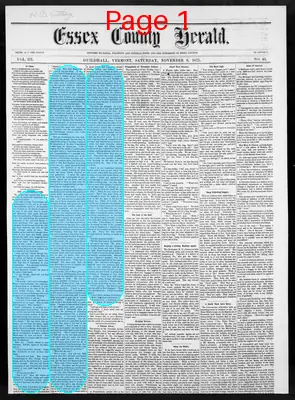
Story
November 6, 1875
Essex County Herald
Island Pond, Guildhall, Essex County, Vermont
What is this article about?
George Vanderburgh tells friend Jack Raymond how he forsook high-society courtship with Judith Delmar for mill worker Margaret 'Pearlie' Smith in New Hampshire, rescued her from a factory fire, and married her despite class differences.
Clipping
OCR Quality
98%
Excellent
Full Text
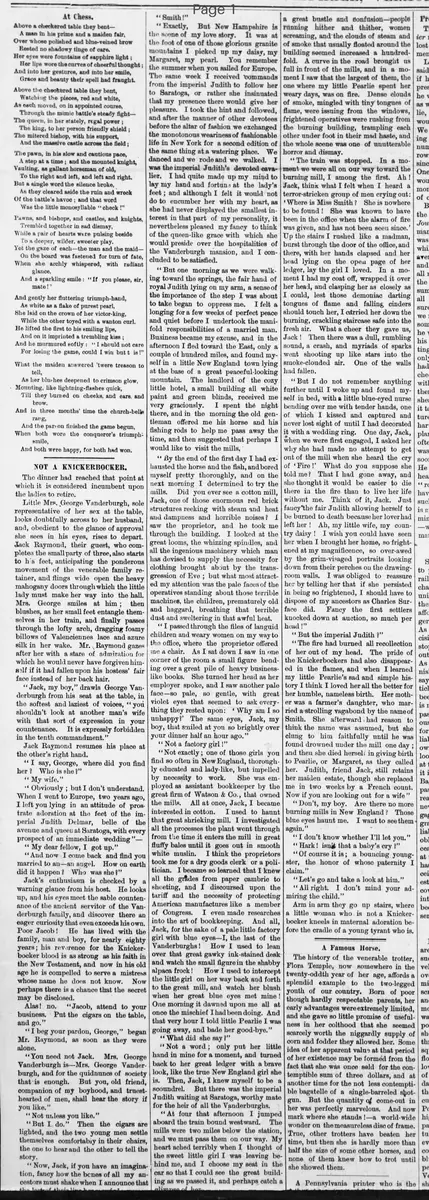
NOT A KNICKERBOCKER.
The dinner had reached that point at which it is considered incumbent upon the ladies to retire. Little Mrs. George Vanderburgh, sole representative of her sex at the table, looks doubtfully across to her husband, and, obedient to the glance of approval she sees in his eyes, rises to depart. Jack Raymond, their guest, who completes the small party of three, also starts to his feet, anticipating the ponderous movement of the venerable family retainer, and flings wide open the heavy mahogany doors through which the little lady must make her way into the hall. Mrs. George smiles at him; then blushes, as her small feet entangle themselves in her train, and finally passes through the lofty arch, dragging foamy billows of Valenciennes lace and azure silk in her wake. Mr. Raymond gazes after her with a stare of admiration for which he would never have forgiven himself if it had fallen upon his hostess' fair face instead of her back hair.
"Jack, my boy," drawls George Vanderburgh from his seat at the table, in the softest and laziest of voices, "you shouldn't look at another man's wife with that sort of expression in your countenance. It is expressly forbidden in the tenth commandment."
Jack Raymond resumes his place at the other's right hand.
"I say, George, where did you find her? Who is she?"
"My wife."
Obviously; but I don't understand. When I went to Europe, two years ago, I left you lying in an attitude of prostrate adoration at the feet of the imperial Judith Delmar, belle of the avenue and queen at Saratoga, with every prospect of an immediate wedding.
"My dear fellow, I got up."
"And now I come back and find you married to an—an angel. How on earth did it happen? Who was she?"
Jack's enthusiasm is checked by a warning glance from his host. He looks up, and his eyes meet the sable countenance of the ancient servitor of the Vanderburgh family, and discover there an eager curiosity that even exceeds his own. Poor Jacob! He has lived with the family, man and boy, for nearly eighty years; his reverence for the Knickerbocker blood is as strong as his faith in the New Testament, and now in his old age he is compelled to serve a mistress whose name he does not know. Now perhaps there is a chance that the secret may be disclosed.
Alas! no. "Jacob, attend to your business. Put the cigars on the table, and go."
"I beg your pardon, George," began Mr. Raymond, as soon as they were alone.
"You need not Jack. Mrs. George Vanderburgh is—Mrs. George Vanderburgh, and for the quidnuncs of society that is enough. But you, old friend, companion of my boyhood, and truest hearted of men, shall hear the story if you like."
"Not unless you like."
"But I do." Then the cigars are lighted, and the two young men settle themselves comfortably in their chairs, the one to hear and the other to tell the story.
"Now, Jack, if you have an imagination, fancy how the bones of all my ancestors must shake when I announce that I am going to marry a—"
"Smith!"
"Exactly. But New Hampshire is the scene of my love story. It was at the foot of one of those glorious granite mountains I picked up my daisy, my Margaret, my pearl. You remember the summer when you sailed for Europe. The same week I received commands from the imperial Judith to follow her to Saratoga, or rather she insinuated that my presence there would give her pleasure. I took the hint and followed, and after the manner of other devotees before the altar of fashion we exchanged the monotonous weariness of fashionable life in New York for a second edition of the same thing at a watering place. We danced and we rode and we walked. I was the imperial Judith's devoted cavalier. I had quite made up my mind to lay my hand and fortune at the lady's feet: and although I felt it would not do to encumber her with my heart, as she had never displayed the smallest interest in that part of my personality, it nevertheless pleased my fancy to think of the queen-like grace with which she would preside over the hospitalities of the Vanderburgh mansion, and I concluded to be satisfied.
"But one morning as we were walking toward the springs, the fair hand of royal Judith lying on my arm, a sense of the importance of the step I was about to take began to oppress me. I felt a longing for a few weeks of perfect peace and quiet before I undertook the manifold responsibilities of a married man. Business became my excuse, and in the afternoon I fled toward the East, only a couple of hundred miles, and found myself in a little New England town lying at the base of a great peaceful-looking mountain. The landlord of the cozy little hotel, a small building all white paint and green blinds, received me very graciously. I spent the night there, and in the morning the old gentleman offered me his horse and his fishing rods to help me pass away the time, and then suggested that perhaps I would like to visit the mills.
"By the end of the first day I had exhausted the horse and the fish, and bored myself pretty thoroughly, and on the next morning I determined to try the mills. Did you ever see a cotton mill, Jack, one of those enormous red brick structures reeking with steam and heat and dampness and horrible noises? I saw the proprietor, and he took me through the building. I looked at the great looms, the whizzing spindles, and all the ingenious machinery which man has devised to supply the necessity for clothing brought about by the transgression of Eve; but what most attracted my attention was the pale faces of the operatives standing about those terrible machines, the children, prematurely old and haggard, breathing that terrible dust and sweltering in that awful heat.
"I passed through the files of languid children and weary women on my way to the office, where the proprietor offered me a chair. As I sat down I saw in one corner of the room a small figure bending over a great pile of heavy business-like books. She turned her head as her employer spoke, and I saw another pale face—so pale, so gentle, with great violet eyes that seemed to ask everything they rested upon: 'Why am I so unhappy?' The same eyes, Jack, my boy, that smiled at you so brightly over your dinner half an hour ago.
"Not a factory girl!"
"Not exactly; one of those girls you find so often in New England, thoroughly educated and lady-like, but impelled by necessity to work. She was employed as assistant bookkeeper by the great firm of Watson & Co., that owned the mills. All at once, Jack, I became interested in cotton. I used to haunt that great shrieking mill. I investigated all the processes the plant went through from the time it enters the mill in great fluffy bales until it goes out in smooth white muslin. I think the proprietors took me for a dry goods clerk or a politician. I became so learned that I knew all the grades from paper cambric to sheeting, and I discoursed upon the tariff and the necessity of protecting American manufactures like a member of Congress. I even made researches into the art of bookkeeping. And all, Jack, for the sake of a pale little factory girl with blue eyes—I, the last of the Vanderburghs! How I used to lean over that great gawky ink-stained desk and watch the small figure in the shabby alpaca frock! How I used to intercept the little girl on her way back and forth to the great mill, and watch her blush when her great blue eyes met mine!
One morning it dawned upon me all at once the mischief I had been doing. And that very hour I told little Pearlie I was going away, and bade her good-bye."
"What did she say?"
"Not a word; only put her little hand in mine for a moment, and turned back to her great ledger with a brave look, like the true New England girl she is. Then, Jack, I knew myself to be a scoundrel. But there was the imperial Judith waiting at Saratoga, worthy mate for the heir of all the Vanderburghs.
"At four that afternoon I jumped aboard the train bound westward. The mills were two miles below the station, and we must pass them on our way. My heart ached terribly when I thought of the sweet little girl I was leaving behind me, and I chose my seat in the car so that I could see the great building as we passed it, and perhaps catch a glimpse of her sweet face at one of the windows.
As the train neared the mills there was a great bustle and confusion—people running hither and thither, women screaming, and the clouds of steam and of smoke that usually floated around the building seemed increased a hundred-fold. A curve in the road brought us full in front of the mills, and in a moment I saw that the largest of them, the one where my little Pearlie spent her weary days, was on fire. Dense clouds of smoke, mingled with tiny tongues of flame, were issuing from the windows, frightened operatives were rushing from the burning building, trampling each other under foot in their mad haste, and the whole scene was one of unutterable horror and dismay.
"The train was stopped. In a moment we were all on our way toward the burning mill. I among the first. Ah, Jack, think what I felt when I heard a terror-stricken group of men crying out: 'Where is Miss Smith? She is nowhere to be found! She was known to have been in the office when the alarm of fire was given, and has not been seen since.'
Up the stairs I rushed like a madman, burst through the door of the office, and there, with her hands clasped and her head lying on the open page of her ledger, lay the girl I loved. In a moment I had my coat off, wrapped it over her head, and clasping her as closely as I could, lest those demoniac darting tongues of flame and falling cinders should touch her, I carried her down the burning, crackling staircase safe into the fresh air. What a cheer they gave us, Jack! Then there was a dull, rumbling sound, a crash, and myriads of sparks went shooting up like stars into the smoke-clouded air. One of the walls had fallen.
"But I do not remember anything further until I woke up and found myself in bed, with a little blue-eyed nurse bending over me with tender hands, one of which I kissed and captured and never lost sight of until I had decorated it with a wedding ring. One day, Jack, when we were first engaged, I asked her why she had made no attempt to get out of the mill when she heard the cry of 'Fire!' What do you suppose she told me? That I had gone away, and she thought it would be easier to die there in the fire than to live her life without me. Think of it, Jack. Just fancy the fair Judith allowing herself to be burned to death because her lover had left her! Ah, my little wife, my country daisy! I wish you could have seen her when I brought her home, so frightened at my magnificence, so over-awed by the grim-visaged portraits looking down from their perches on the drawing room walls. I was obliged to reassure her by telling her that if she persisted in being so frightened, I should have to dispose of my ancestors as Charles Surface did. Fancy the first settlers knocked down at auction, so much per head!"
"But the imperial Judith?"
"The fire had burned all recollection of her out of my head. The pride of the Knickerbockers had also disappeared in the flames, and when I learned my little Pearlie's sad and simple history I think I loved her all the better for her humble, nameless birth. Her mother was a farmer's daughter, who married a strolling vagabond by the name of Smith. She afterward had reason to think the name was assumed, but she clung to him faithfully until he was found drowned under the mill one day; and then she died herself in giving birth to Pearlie, or Margaret, as they called her. Judith, friend Jack, still retains her maiden estate, though she replaced me in two weeks by a French count. Now if you are looking out for a wife—"
"Don't, my boy. Are there no more burning mills in New England? Those blue eyes haunt me. I want to see them again."
"I don't know whether I'll let you."
"Hark! isn't that a baby's cry?"
"Of course it is; a bouncing youngster, the honor of whose paternity I claim."
"Let's go and take a look at him."
"All right. I don't mind your admiring the child."
Arm in arm they go up stairs, where a little woman who is not a Knickerbocker kneels in maternal adoration before the cradle of a young tyrant who is.
The dinner had reached that point at which it is considered incumbent upon the ladies to retire. Little Mrs. George Vanderburgh, sole representative of her sex at the table, looks doubtfully across to her husband, and, obedient to the glance of approval she sees in his eyes, rises to depart. Jack Raymond, their guest, who completes the small party of three, also starts to his feet, anticipating the ponderous movement of the venerable family retainer, and flings wide open the heavy mahogany doors through which the little lady must make her way into the hall. Mrs. George smiles at him; then blushes, as her small feet entangle themselves in her train, and finally passes through the lofty arch, dragging foamy billows of Valenciennes lace and azure silk in her wake. Mr. Raymond gazes after her with a stare of admiration for which he would never have forgiven himself if it had fallen upon his hostess' fair face instead of her back hair.
"Jack, my boy," drawls George Vanderburgh from his seat at the table, in the softest and laziest of voices, "you shouldn't look at another man's wife with that sort of expression in your countenance. It is expressly forbidden in the tenth commandment."
Jack Raymond resumes his place at the other's right hand.
"I say, George, where did you find her? Who is she?"
"My wife."
Obviously; but I don't understand. When I went to Europe, two years ago, I left you lying in an attitude of prostrate adoration at the feet of the imperial Judith Delmar, belle of the avenue and queen at Saratoga, with every prospect of an immediate wedding.
"My dear fellow, I got up."
"And now I come back and find you married to an—an angel. How on earth did it happen? Who was she?"
Jack's enthusiasm is checked by a warning glance from his host. He looks up, and his eyes meet the sable countenance of the ancient servitor of the Vanderburgh family, and discover there an eager curiosity that even exceeds his own. Poor Jacob! He has lived with the family, man and boy, for nearly eighty years; his reverence for the Knickerbocker blood is as strong as his faith in the New Testament, and now in his old age he is compelled to serve a mistress whose name he does not know. Now perhaps there is a chance that the secret may be disclosed.
Alas! no. "Jacob, attend to your business. Put the cigars on the table, and go."
"I beg your pardon, George," began Mr. Raymond, as soon as they were alone.
"You need not Jack. Mrs. George Vanderburgh is—Mrs. George Vanderburgh, and for the quidnuncs of society that is enough. But you, old friend, companion of my boyhood, and truest hearted of men, shall hear the story if you like."
"Not unless you like."
"But I do." Then the cigars are lighted, and the two young men settle themselves comfortably in their chairs, the one to hear and the other to tell the story.
"Now, Jack, if you have an imagination, fancy how the bones of all my ancestors must shake when I announce that I am going to marry a—"
"Smith!"
"Exactly. But New Hampshire is the scene of my love story. It was at the foot of one of those glorious granite mountains I picked up my daisy, my Margaret, my pearl. You remember the summer when you sailed for Europe. The same week I received commands from the imperial Judith to follow her to Saratoga, or rather she insinuated that my presence there would give her pleasure. I took the hint and followed, and after the manner of other devotees before the altar of fashion we exchanged the monotonous weariness of fashionable life in New York for a second edition of the same thing at a watering place. We danced and we rode and we walked. I was the imperial Judith's devoted cavalier. I had quite made up my mind to lay my hand and fortune at the lady's feet: and although I felt it would not do to encumber her with my heart, as she had never displayed the smallest interest in that part of my personality, it nevertheless pleased my fancy to think of the queen-like grace with which she would preside over the hospitalities of the Vanderburgh mansion, and I concluded to be satisfied.
"But one morning as we were walking toward the springs, the fair hand of royal Judith lying on my arm, a sense of the importance of the step I was about to take began to oppress me. I felt a longing for a few weeks of perfect peace and quiet before I undertook the manifold responsibilities of a married man. Business became my excuse, and in the afternoon I fled toward the East, only a couple of hundred miles, and found myself in a little New England town lying at the base of a great peaceful-looking mountain. The landlord of the cozy little hotel, a small building all white paint and green blinds, received me very graciously. I spent the night there, and in the morning the old gentleman offered me his horse and his fishing rods to help me pass away the time, and then suggested that perhaps I would like to visit the mills.
"By the end of the first day I had exhausted the horse and the fish, and bored myself pretty thoroughly, and on the next morning I determined to try the mills. Did you ever see a cotton mill, Jack, one of those enormous red brick structures reeking with steam and heat and dampness and horrible noises? I saw the proprietor, and he took me through the building. I looked at the great looms, the whizzing spindles, and all the ingenious machinery which man has devised to supply the necessity for clothing brought about by the transgression of Eve; but what most attracted my attention was the pale faces of the operatives standing about those terrible machines, the children, prematurely old and haggard, breathing that terrible dust and sweltering in that awful heat.
"I passed through the files of languid children and weary women on my way to the office, where the proprietor offered me a chair. As I sat down I saw in one corner of the room a small figure bending over a great pile of heavy business-like books. She turned her head as her employer spoke, and I saw another pale face—so pale, so gentle, with great violet eyes that seemed to ask everything they rested upon: 'Why am I so unhappy?' The same eyes, Jack, my boy, that smiled at you so brightly over your dinner half an hour ago.
"Not a factory girl!"
"Not exactly; one of those girls you find so often in New England, thoroughly educated and lady-like, but impelled by necessity to work. She was employed as assistant bookkeeper by the great firm of Watson & Co., that owned the mills. All at once, Jack, I became interested in cotton. I used to haunt that great shrieking mill. I investigated all the processes the plant went through from the time it enters the mill in great fluffy bales until it goes out in smooth white muslin. I think the proprietors took me for a dry goods clerk or a politician. I became so learned that I knew all the grades from paper cambric to sheeting, and I discoursed upon the tariff and the necessity of protecting American manufactures like a member of Congress. I even made researches into the art of bookkeeping. And all, Jack, for the sake of a pale little factory girl with blue eyes—I, the last of the Vanderburghs! How I used to lean over that great gawky ink-stained desk and watch the small figure in the shabby alpaca frock! How I used to intercept the little girl on her way back and forth to the great mill, and watch her blush when her great blue eyes met mine!
One morning it dawned upon me all at once the mischief I had been doing. And that very hour I told little Pearlie I was going away, and bade her good-bye."
"What did she say?"
"Not a word; only put her little hand in mine for a moment, and turned back to her great ledger with a brave look, like the true New England girl she is. Then, Jack, I knew myself to be a scoundrel. But there was the imperial Judith waiting at Saratoga, worthy mate for the heir of all the Vanderburghs.
"At four that afternoon I jumped aboard the train bound westward. The mills were two miles below the station, and we must pass them on our way. My heart ached terribly when I thought of the sweet little girl I was leaving behind me, and I chose my seat in the car so that I could see the great building as we passed it, and perhaps catch a glimpse of her sweet face at one of the windows.
As the train neared the mills there was a great bustle and confusion—people running hither and thither, women screaming, and the clouds of steam and of smoke that usually floated around the building seemed increased a hundred-fold. A curve in the road brought us full in front of the mills, and in a moment I saw that the largest of them, the one where my little Pearlie spent her weary days, was on fire. Dense clouds of smoke, mingled with tiny tongues of flame, were issuing from the windows, frightened operatives were rushing from the burning building, trampling each other under foot in their mad haste, and the whole scene was one of unutterable horror and dismay.
"The train was stopped. In a moment we were all on our way toward the burning mill. I among the first. Ah, Jack, think what I felt when I heard a terror-stricken group of men crying out: 'Where is Miss Smith? She is nowhere to be found! She was known to have been in the office when the alarm of fire was given, and has not been seen since.'
Up the stairs I rushed like a madman, burst through the door of the office, and there, with her hands clasped and her head lying on the open page of her ledger, lay the girl I loved. In a moment I had my coat off, wrapped it over her head, and clasping her as closely as I could, lest those demoniac darting tongues of flame and falling cinders should touch her, I carried her down the burning, crackling staircase safe into the fresh air. What a cheer they gave us, Jack! Then there was a dull, rumbling sound, a crash, and myriads of sparks went shooting up like stars into the smoke-clouded air. One of the walls had fallen.
"But I do not remember anything further until I woke up and found myself in bed, with a little blue-eyed nurse bending over me with tender hands, one of which I kissed and captured and never lost sight of until I had decorated it with a wedding ring. One day, Jack, when we were first engaged, I asked her why she had made no attempt to get out of the mill when she heard the cry of 'Fire!' What do you suppose she told me? That I had gone away, and she thought it would be easier to die there in the fire than to live her life without me. Think of it, Jack. Just fancy the fair Judith allowing herself to be burned to death because her lover had left her! Ah, my little wife, my country daisy! I wish you could have seen her when I brought her home, so frightened at my magnificence, so over-awed by the grim-visaged portraits looking down from their perches on the drawing room walls. I was obliged to reassure her by telling her that if she persisted in being so frightened, I should have to dispose of my ancestors as Charles Surface did. Fancy the first settlers knocked down at auction, so much per head!"
"But the imperial Judith?"
"The fire had burned all recollection of her out of my head. The pride of the Knickerbockers had also disappeared in the flames, and when I learned my little Pearlie's sad and simple history I think I loved her all the better for her humble, nameless birth. Her mother was a farmer's daughter, who married a strolling vagabond by the name of Smith. She afterward had reason to think the name was assumed, but she clung to him faithfully until he was found drowned under the mill one day; and then she died herself in giving birth to Pearlie, or Margaret, as they called her. Judith, friend Jack, still retains her maiden estate, though she replaced me in two weeks by a French count. Now if you are looking out for a wife—"
"Don't, my boy. Are there no more burning mills in New England? Those blue eyes haunt me. I want to see them again."
"I don't know whether I'll let you."
"Hark! isn't that a baby's cry?"
"Of course it is; a bouncing youngster, the honor of whose paternity I claim."
"Let's go and take a look at him."
"All right. I don't mind your admiring the child."
Arm in arm they go up stairs, where a little woman who is not a Knickerbocker kneels in maternal adoration before the cradle of a young tyrant who is.
What sub-type of article is it?
Romance
Heroic Act
Personal Triumph
What themes does it cover?
Love
Bravery Heroism
Social Manners
What keywords are associated?
Knickerbocker
Mill Fire
Rescue
Romance
Social Class
New Hampshire
Marriage
What entities or persons were involved?
George Vanderburgh
Margaret Smith
Jack Raymond
Judith Delmar
Where did it happen?
New Hampshire, Saratoga, New York
Story Details
Key Persons
George Vanderburgh
Margaret Smith
Jack Raymond
Judith Delmar
Location
New Hampshire, Saratoga, New York
Story Details
George Vanderburgh abandons courtship of society belle Judith Delmar, falls for mill worker Pearlie Smith in New Hampshire, leaves but rescues her from a mill fire, marries her despite family heritage.